











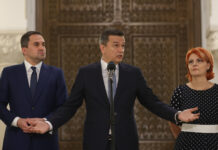




Romania’s centrist governing coalition scored a decisive victory in local and European Parliament elections on Sunday, while a hard-right challenger was the big loser in the poll.
Romania’s governing coalition of the center-left Social Democrats and the center-right National Liberal Party won 54% of the vote according to the Avangarde exit poll.
As expected, the hard-right AUR party came second, but drummed up just 14% of the vote, much lower than expected. The party won a surprising 20% in 2020 parliamentary elections, the year the group was created.
The vote bucked the trend in the rest of Europe where early projections for European Parliament gave far-right parties a strong showing. If confirmed, the predictions would reflect voter dissatisfaction and a rejection of the political mainstream.
Prime Minister Marcel Ciolacu, the big winner of the evening, said: “Democracy triumphed. Thank you Romanians for turning out in a heatwave and giving legitimacy to candidates. (The result) shows we governed well in a complicated period.”
The Social Democrat leader said the vote meant “more money for farmers and a bigger voice for Romania in the European Parliament.”
Rares Bogdan, a leading European Parliament lawmaker, called it a ‘great political victory for the Liberals which scored 28%. It’s a huge vote which shows Romanians’ appetite for democracy and ‘no’ to extremism unlike other countries. It’s important for me to praise Romania in Brussels about the fact that Romanians gave a lesson about rejecting extremism. Romania said no to extremism and no to the East.”
A center-right grouping which included the progressive center-right Save Romania Union known as the USR came third with 11% according to the opinion poll.
Incumbent Bucharest mayor, Nicusor Dan, an independent who’s nominally supported by the governing coalition, was easily re-elected with about 45% of the vote. He trounced two other candidates who were supported by the Social Democrats and Liberals.
Parties are basing their calculations and strategy for the presidential and parliamentary elections on the results of the June 9 vote. Presidential elections will be held in September and parliamentary elections are expected in December. President Klaus Iohannis steps down in September after a maximum two terms in office.
Turnout was just under 52% when polls closed at 10 p:m, higher than in 2020 when less than half of the electorate voted.
As well as Romania, elections are being held across the European Union for the European parliamentary elections to choose their representatives for the next five-year term.
Polls opened in 20 EU member states, including Romania, early Sunday for the June 6-9 elections for a new European Parliament, the legislative arm of the 27-member bloc.
AUR and other nationalistic parties which became more popular during the Covid pandemic were looking for gains amid a rise in living costs and the war in Ukraine.
Romanians focused on the economy, public health and the future of the bloc. Many saw the vote as a dress rehearsal for presidential elections in September when President Klaus Iohannis will step down after serving a maximum two terms, and parliamentary elections expected for December.
The full exit poll will be released at 11 p:m with final results expected Monday.
