














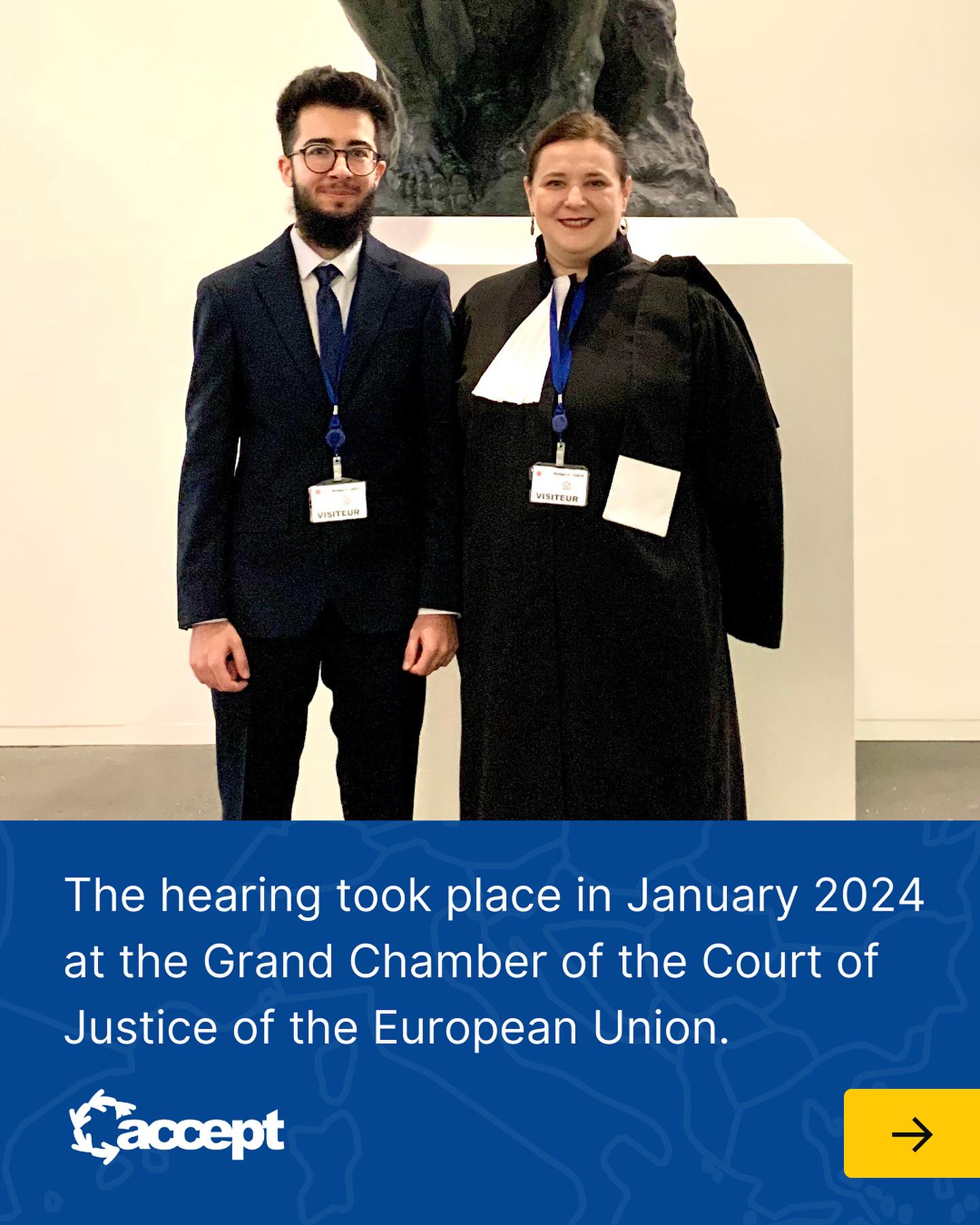
Romania’s refusal to recognize a change of gender legally undertaken in another member state violates the rights of EU citizens, the Luxembourg-based European Court of Justice ruled on Friday.
The ruling was welcomed by rights group ACCEPT in Bucharest who called it ‘a historic ruling’ and a step forward for the LGBT community which is still struggling to have basic rights respected.
The European Court of Justice’s ruling was based on a request by a British-Romanian citizen who changed his first name and title from female to male in 2017 and obtained legal recognition of his male gender identity in 2020 in the United Kingdom, where he had been living since 2008.
“I am emotional. I cried. It’s the best decision I could have; it’s a victory,” said Arian Mirzarafie-Ahi via video link from the UK.
The court said that refusing to recognize Mirzarafie-Ahi’s change of first name and gender legally acquired in another member state violated EU law and constituted an obstacle to the exercise of the right of free movement and residence.
In 2018, Mirzarafie-Ahi traveled to Romania to visit his family and was stopped at the border as police questioned his identity, comparing Romanian and UK documents, asking personally invasive questions. “They made me feel unsure of myself; I was vulnerable.” He hasn’t visited Romania since, due to the trauma.
On the basis of his UK documents, Mirzarafie-Ahi asked the local authorities in Romania to register the change on his birth certificate and requested new documents reflecting his change of first name, gender and personal identification number.
The Romanian authorities refused and asked him to open separate proceedings in Romania before the national courts to confirm the change of gender.
A Bucharest court however referred the issue to the EU’s top court, asking whether Romania’s refusal to recognize the UK decision was within EU law and whether Brexit had any impact on the dispute.
The EU’s top court, based in Luxembourg, ruled that Romania’s refusal to recognize the documents and its decision to force the citizen to start a new procedure to change the gender identity already acquired in the UK were unjustified.
“The ruling is applicable from this moment,” ACCEPT executive director Teodora Ion-Rotaru said. “If Romanian authorities don’t respect this ruling they are in breach of European law.”
Romania decriminalized homosexuality in 2001, decades later than other parts of the EU. It still bars marriage and civil partnerships for same-sex couples. Attitudes toward same-sex couples have relaxed in recent years in the socially conservative country but intolerance is still widespread.
In its ruling the court said that initiating new proceedings in Romania would also expose him to the risk that those proceedings would lead ‘to an outcome different from that obtained before the authorities of the member state which lawfully granted that change of first name and gender identity’.
The fact that the request was made in Romania after the UK exited the bloc was immaterial, the court said.
“This judgement will have an immensely positive impact, increasing legal protection for all trans people in the EU, all the more as certain EU countries like Romania still do not provide a legal framework for legal gender recognition conforming with European Court of Human Rights’ standards,” ILGA-Europe’s Senior Strategic Litigation Officer Marie-Hélène Ludwig said in a statement.
Rights group protests after Romanian city ‘bans all LGBT public gatherings’
