







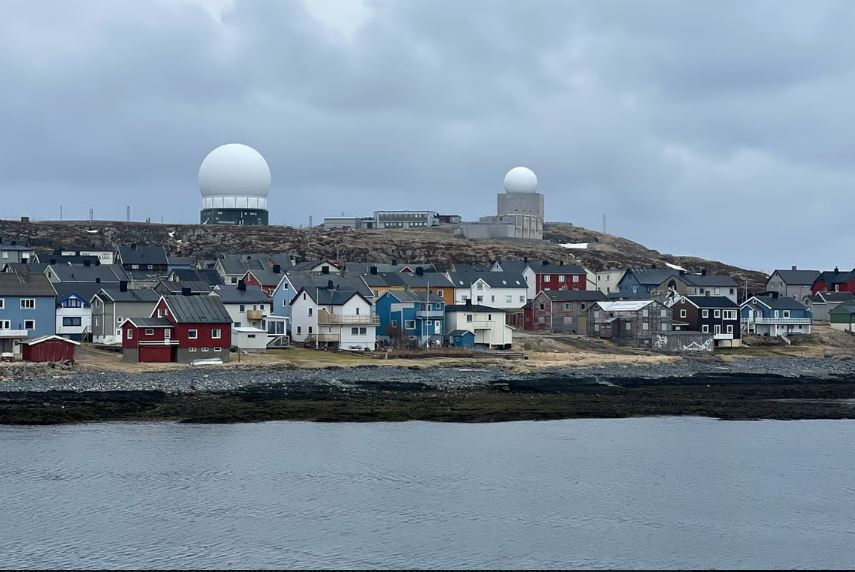
Vardø is an island in northern Norway, bathed by the Barents Sea. On it there is a picturesque fishing town, where about two thousand people live (among them, about 40 Russians).
The first thing you see when you approach the island are some huge white spheres. These are NATO radars. They sit on a hill, like giant mushrooms. Norwegian intelligence services use them to monitor outer space and to monitor the airspace of the Russian Arctic.
Russia is Vardø’s closest neighbor. On a clear day, if you go out on the shore, you can see the Kola Peninsula, separated from Norway by the Varanger Fjord. 150 kilometers east of Vardø is Gadjievo, where the Russian fleet of nuclear submarines is based.
• This is the translation of a report by Novaya Gazeta Europa
These two neighboring countries, Russia and Norway, have a rich common history. It retains the memory of the times when, in the eighteenth century, Russian peasants sailed by ship to Vardø to barter flour and birch tar for fish and salt, of how the two countries fought in World War II, then went through the Cold War and, subsequently, tried to rebuild their relations. Certain episodes in this story — often distorted — are now actively used by the Kremlin to gain the trust and support of the inhabitants of northern Norway.
As Novaya Gazeta Europa discovered in 2011, under the harmless pretext of organizing “historical memory trips” in the wake of World War II, Russian agents regularly penetrated Norway, promoting foreign policy narratives which were convenient to Russia there.
Moreover, by manipulating genuine dissatisfaction of Norwegians in the north with Oslo’s policy, they cultivated the idea that Russia is the one taking care of them, who understands them, and defends their interests better than their own government does, suggesting that Russia is for the Norwegian Nordics a much closer ally than the center of their country.
Chapter I
• The one in which “God himself” commands a Russian bishop to build an Orthodox chapel — right under NATO’s radars, in a neighboring country
Starting in 2017, during the time of the former mayor of Vardø, Robert Jensen, the parish priest of St. Onega Cathedral, Archpriest Alexander Koptev, and the bishop of Plesetsk and Kargopol, Alexander Zaitsev, began negotiations on the construction of an Orthodox chapel on the Norwegian island — as part of the “strengthening of ties with Vardø”, which they carried out by visiting the place regularly.
Archpriest Koptev is a former soldier. The diocese’s website mentions that in the early 1980s he performed two years of compulsory military service, after which he served another six years in the Russian armed forces, in the town of Katunino in the Arkhangelsk region, where an airfield of the Northern Fleet was then located. Among other things, several types of military aircraft used for maritime reconnaissance and radio-electronic warfare were stationed at Katunino. In 1997, Koptev was ordained a priest.
Bishop of Kargopol and Plesetsk, Alexander Zaitsev. Photo: Plesetsk Diocese / VK
The bishop of Kargopol and Plesetsk, Alexander Zaitsev, supported the Russian invasion of Ukraine: in the winter of 2023 he visited the wounded in a hospital, and in the summer he attended a charity concert “in support of the combatants of the special military operation” (which took place in Plesetsk). For “propaganda of the aggressive war against Ukraine and interference in the internal affairs of the Church in Ukraine”, Zaitsev was even included in the list of the Ukrainian project “War and Sanctions”. This project operates with the support of the Ministry of Foreign Affairs of Ukraine and the National Agency for the Prevention of Corruption. Anyone can send data on Russian personalities who supported the war in Ukraine there and ask for their inclusion on sanctions lists.
At home, in the satellite city of Plesetsk — Mirny — the bishop has his own cathedral. You can enter Mirnii only with a permit — it is a closed city, under the jurisdiction of the Ministry of Defense.
Before the war in Ukraine began, Koptev and Zaitsev regularly went to Vardø for the inauguration of monuments dedicated to Norwegian partisans and for the consecration of Orthodox memorial crosses, installed there at the initiative of Russian officials and security forces.
The initiative to build an Orthodox chapel in Vardø was initially supported by both the authorities and the city’s residents.
“Patriarch Kirill blessed the idea of construction, and Bishop Zaitsev even showed us the exact place where it needed to be erected — in the immediate vicinity of the radar station. To the Norwegian officials participating in these negotiations, the Russian cleric explained that the choice of the place was supposedly dictated by God himself,” says the current mayor of Vardø, Tor Erik Labahå. He took office in 2023.
The pandemic slowed down the realization of the project, but it did not affect the plans themselves. The Russian Orthodox Church continued to develop the project on paper.
At first, Mayor Labaho recalls, the project had been advertised only as a small chapel — “something very modest, which could be useful to Orthodox sailors visiting Vardø and reminded of the cultural ties between Russia and Norway.” But in the final phase of planning it became clear that Russian priests had changed their intentions.
When they presented the final drawing to the Norwegian officials, discussions began in the municipality of Vardø. After consultations, the Norwegians refused to build the chapel.
“First of all, because the Russian pressure [on the officials in Vardø] continues to increase. Their plans evolved towards the construction of a 17-meter-high church. What had initially seemed like a small cultural initiative quickly turned into a much more ambitious project. In addition, Russia did not properly consult with the Norwegian side,” says Tor Erik Labaho. “After Russia’s invasion of Ukraine, all these actions of the Russian clergy in Vardø no longer seem to be an innocent or sincere gesture,” the mayor continues.
Now it is clear: the Russian representatives, of course, did not choose by chance to erect the chapel exactly in Vardø. Thus, they wanted to establish a symbolic presence of Russia right next to NATO’s radars. And, of course, to create a flow of Russian clergy and delegates to the sensitive area, ensuring their influence and presence there, and probably, — obtaining espionage information.
Chapter Two
• The one in which the king apologizes “too late”
Professor and head of the department for the Barents region at the Arctic University of Norway, Kari Aga Myklebost has been studying relations between Russia and Norway’s northern territories for many years. In the early 1990s, Myklebost studied at the Faculty of History of St. Petersburg State University, then in Moscow and Vladivostok.
“In the 2000s, when I was already working at the University of Tromsø, I frequently collaborated with Russian historians. Since 2014, the perspective of the Kremlin and Russian colleagues on the Great War for the Defense of the Fatherland has become increasingly politicized. They were increasingly using that war to legitimize Russia’s invasion of Ukraine, claiming that Russia is fighting neo-Nazism there and that this is a heroic continuation of the deeds of the Soviet Red Army,” she says.
In addition, Myklebost noted that after the annexation of Crimea, the Kremlin began to actively intervene in the minds of Norwegians (especially those of the inhabitants of the northern parts of the country) with propaganda and “distorted historical narratives”.
To carry out this activity, Russian security forces exploited the “vulnerable moment” in Norway’s post-war history.
In 1940, during the German occupation, 45 residents of Vardø and neighboring towns in northern Norway fled across the Soviet border to the Kola Peninsula. They enlisted in the Red Army, trained as intelligence agents near Murmansk, and then returned to German-occupied northern Norway to spy on the enemy.
Later, during the Cold War, when hostility to the Soviet Union increased in Norway, the history of Norwegian hero-partisans began to be officially hidden “because of their sympathy for the communists”. They were considered Soviet spies, they were under surveillance, and society looked at them with suspicion. Norwegian authorities assumed that the partisans were in contact with their former Soviet supervisors.
History teacher Kari Aga Myklebost. Photo: Arctic University of Norway
“Marginalization and suspicion of partisans remain a painful memory in some municipalities in northern Norway to this day,” says Professor Myklebost. “Some even consider that justice has not been fully done to the Norwegian partisans, their heroism not being properly appreciated.”
The head of the department at the Vardø History Museum, Inger Lene Nyttingnes, admits:
“The work of the Russian security forces to restore historical memory has provoked a strong reaction in the local community. And although no one in Norway now doubts that our supporters should be respected and honored, the reality remains: the Norwegian authorities gave them recognition too late,” says Nyttingnes. “King Harald V of Norway expressed his support and apologized to the partisans and their families only in 1992, for the contempt shown by the state and society, which they had to endure after the end of World War II. It is precisely this vulnerable moment in the relationship between the inhabitants of Norway’s northern cities and the government that has been exploited by Russia.”
Obelisk in memory of the heroism of Norwegian and Soviet partisans, installed by Russian veterans of the FSB near Vardø in 2011. Photo: Kari Aga Myklebost
Chapter Three
• The one in which Russian FSB veterans restore “historical justice” in Norway
Since 2011, FSB veterans and Russian officials have organized “memory tours” twice a year, by bus from Russia to Norway: in May, on the occasion of Victory Day, and in October, to mark the liberation of the eastern part of Finnmark (a region in the far north of Norway, on the border with Russia and Finland) by the Red Army, in the autumn of 1944.
By regularly visiting Finnmark, officers and politicians in Murmansk promoted among locals the idea that the authorities in Oslo were hiding the history of Norwegian partisans and did not understand the harsh realities that existed in northern Norway during World War II. All this, while the Russian side, on the contrary, recognizes and honors their memory.
“After the annexation of Crimea, during the memory tours, Russian officials also criticized Oslo’s sanctions policy towards Russia, as well as Norway’s support for Ukraine,” Myklebost says. “They have fueled the discontent of northern residents with Oslo’s decisions, claiming that the sanctions do not correspond to the interests of the population of northern Norway, who allegedly have special friendly relations with Russia.”
After the start of the invasion of Ukraine, the professor studied the documents related to these trips by Russian officials to Finnmark, as well as how information about these “memory tours” was presented in Russian state media.
In addition to the chairman of the Murmansk FSB Veterans’ Association, Gennady Gurylev, these “memory tours” were also attended by the deputy speaker of the Murmansk Regional Duma, Igor Chernyshenko (since 2013 a member of the Federation Council of the Federal Assembly of Russia), priests of the Russian Orthodox Church, representatives of the Pechengsky municipal district (Murmansk region) and journalists from the Russian TV channel TV21.
FSB veteran Gennady Gurylev in the city of Zapoliarny in the Murmansk region, in October 2017, at the presentation of his book “What the Fjords Are Silent About”. Photo: Rune Rautio
According to the official version, this tour was organized to honor the memory of Soviet soldiers and Norwegian partisans who fought against Nazi Germany. After the wreath-laying ceremony, speeches and prayers, the tour of memory continued in Kirkenes, Norway. There, the group was greeted by the Consul General of Russia and Russians living in Eastern Finland. Subsequently, the tour continued to the municipalities of Vardø and Kiberg, where the group was greeted by Russians, as well as invited Norwegian historians and cultural figures, who deal with partisan history and historical ties between Norway and Russia.
During subsequent visits to northern Norway, Russian officials installed monuments dedicated to Soviet and Norwegian partisans there.
“The Shield organization later reported on its website that elderly residents of Norway attended the inauguration ceremony and expressed deep gratitude to Russia for the liberation of 1944,” Myklebost explains.
In 2013, the Norwegian Consul General in Murmansk received a letter from the leader of the Shield, Gennady Gurilyev, and Senator Igor Chernyshenko, from which he learned that they had ordered and planned to install no less than 90 obelisks in northern Norway in memory of the partisans of World War II. From the letter he also learned of their intention to organize regular “memory trips” to museums in Vardø and search patrols in Finnmark, to map the coordinates of the graves of Soviet soldiers. This letter, as Professor Myklebost discovered, was sent by the consul to museums and municipalities in Eastern Finnmark.
In the autumn of 2014, Russian and Norwegian politicians met to discuss Norwegian-Russian cooperation in northern Norway. Their surprise was great when, at the press conference at the end of the negotiations, Russian Foreign Minister Sergei Lavrov said that the joint military and historical events in northern Norway mean Norway’s support for Russia’s position on Ukraine.
“We could not ignore the problem of neo-Nazi tendencies in Europe and Ukraine. Our Norwegian friends are dedicated to preventing radical tendencies, including neo-Nazis, in Europe. Russia is convinced of the need to stop the emergence of new Banderites, Shusheviks and Quislings,” Lavrov said.
According to Myklebost, this case was not unique: Russia repeatedly used Norway’s willingness to participate in events dedicated to the memory of World War II for propaganda purposes.
“The cooperation that Russia managed to achieve in northern Norway was presented on Russian television as if Norway were supporting the Kremlin in the fight against alleged Nazism in Ukraine,” says the professor.
However, the activity of Russian security forces in northern Norway can be considered a success. Thus, in 2015, the Prime Minister of Norway, like many other European leaders, rejected the Kremlin’s invitation to participate in the celebration of Victory Day on Red Square in Moscow. This, while, in the north, the joint events of Norway and Russia continued
“Patriotic Tours of Remembrance”, organized by Russia, became popular in Vardø. The number of monuments installed by Russians in Norway has steadily increased. According to Myklebost, the Russians even managed to attract Norwegian funding for these activities, “although the dominant views and symbols related to military history in tours remained Russian.” In the spring of 2015, the Shield organization organized a banquet and reception, at which Mayor Vardø was present as the guest of honor. A report by Murmansk Vestnik noted that politicians in northern Norway do not share Oslo’s position towards Russia after the annexation of Crimea and that it would be good for the Norwegian government to adopt the spirit of cooperation that prevails in the north.
Since 2015, more and more Norwegians have participated in tours, and in 2016 the “Russian-Norwegian Group of Experts” for the history of the partisan movement was created. This group did not include historians, but FSB veterans such as Gennady Gurychev and Sergei Gonzachev, along with Russian officials from Murmansk; Senator Chernyshenko became the chairman of the group. In this Russian-Norwegian team there was only one Norwegian — the lawyer and politician from Vardø, Remi Strand.
Chapter Four
• The one in which the mysterious Marquis Karabas appears
Remi Strand is one of the most intriguing figures in this story: from 2011 until today he collaborates with the Russian security forces. When Russian priests decided to build a chapel next to NATO radars, it was Strand who kept in touch with them and conveyed their wishes to Norwegian officials. He also participated in the historical tours of memory organized by the Russian security forces. On the days of the celebration of the 75th anniversary of the liberation of Eastern Finland by the Red Army, Remi Strand organized a “Memory Tour” in Norway for the children of the Russian military-patriotic youth movement “Iunarmia” (teenagers who came in military uniform).
The young people from “Iunarmia” visited Norway in October 2019 at the invitation of Remi Strand. Photo credit: Atle Stolesen / Barents Observer
Some of my interlocutors believe that Remi is a naïve person, sincerely passionate about the history of Northern Russia, the trees and the Norwegian partisans, and that the Russian security forces are using him. Others believe that Remi is helping Russian officials aware of the real goals they are pursuing.
In Vardø, Remi Strand is, in a way, a kind of Marquis Karabas. Wherever you go on the island and look at a building, you’re immediately told that there Remi is either working, or managing something, or running something — in any case, it’s directly related to what’s going on there.
He presents himself as a jurist. In addition to his legal practice, he is part of the leadership of the Finnmark Labour Party and holds various positions in numerous associations and companies, both commercial and non-profit.
In addition, Remi Strand is a central figure in the Vardøhus Museum Association, which deals with the study of pomor heritage. He presents himself as a promoter of the history of the trees and, in this capacity, actively participates in the projects organized by the Russians.
We meet Remi Strand at the Pomora History Museum in Vardø. In fact, I had planned to ask him out on a date a few days later. But when I arrived at the museum, the employee who sold me the ticket handed me a notebook with Strand’s mobile phone number and told me that if I wanted a tour of the museum, I could call him directly and he would come right away to drive it.
Remi Strand. Photo: Irina Kravtsova
That’s how it happened. Remi came after 15 minutes: “I always come when I am called to talk about Russian-Norwegian relations. I like this story.”
I introduced myself as a journalist, and Strand began to tell me passionately (there were no more visitors in the museum) about the history of the “Russian and Norwegian trees”. Unlike many Norwegian historians who argue that it is not correct to call Norwegians “pomori”, Remi believes that it is very correct. He also considers himself a pomor. And in general, he believes that “anyone who lives in Vardø is a pomor” because he lives by the sea.
Strand says that the Russian peasants of the eighteenth century even created their own language: a mixture of Russian and Norwegian. Imitating for me a Norwegian tree negotiating with a Russian, he pronounces in Russian with a Norwegian accent: “Hello, old friend. No, it’s expensive, it needs to be cheaper.”
After the tour, Remi proposes to go to the Orthodox cross that the Russians installed in Vardø in 2011 “in memory of the Russians (probably trees or seasonal workers) who died on this land between 1700 and 1920”. “Because of their Orthodox faith, they found their final resting place here, not in a cemetery, because they could not be buried in the Lutheran holy ground,” reads the inscription of the memorial next to the cross.
As soon as I finish reading, Remi Strand hands me a medal prepared by the FSB veterans’ organization, Shield, and puts it around my neck. On the medal is represented a cross, and on the margin are the inscriptions: “Pilgrimage of the Trees”, “Arhangelsk, Vardø”.
Remi, taking a tour of the Pomor Museum. Photo: Irina Kravtsova
At the beginning of 2017, the Shield organized a three-week patriotic film festival in Vardø and the neighboring town of Kiberg. The audience was presented with two Russian-produced films (prepared on the basis of the materials of the “Shield” foundation by the company “North-West Broadcasting”) about the “joint struggle of Soviet and Norwegian patriots” against the German Nazis. As a result of this event, a report was broadcast on TV21 in which it was stated that, during the festival, the spectators discussed the “shame” related to the fact that the partisans “who helped the Red Army defeat the Nazis in Finnmark” were not rewarded by the Norwegian authorities with medals for their military deeds, but were declared spies.
Shortly after this, under the coordination of Gennady Gurilev, an 840-page book entitled “What the Fjords Are Silent About” was published. It reads as follows: “Forty-five years of silence regarding the defeat of German troops by the Red Army in Finnmark and the liberation of the northern regions [of Norway] had their effect: the population of central and southern Norway [during the Cold War] knew absolutely nothing about these important events. Therefore, the restoration of justice and historical truth is an extremely important part of the development of relations between Norway and Russia.”
In 2020, Remi Strand held negotiations with the Finnmark police to bring a 25-ton T-34 tank from Russia for the partisan history museum in the neighboring town of Vardø, Kiberg — in memory of the liberation of East Finnmark in 1944. Experts from the Norwegian Arctic University in Tromsø claimed that “the T-34 has nothing to do with the operations of the partisans in Finnmark”, but for Russia “the exhibition of the T-34 in the Norwegian museum would be a colossal propaganda victory”. Strand’s project was not carried out: the Finnmark police said that the initiative would violate the Norwegian law on the import of firearms.
I ask Remi Strand if his trust in Russian collaborators has diminished after Russia’s invasion of Ukraine in 2022. “In Vardø there is currently a serious debate on this. Our mayor believes that Russian monuments legitimize Russia’s aggression in Ukraine. But I believe that our task is to continue to preserve history and memory, and politics must remain separate. In discussions with Russian colleagues, I avoid the subject of the war in Ukraine. We don’t talk about politics, we talk about history,” Strand replies.
The Orthodox cross, installed by Russian FSB veterans. Photo: Irina Kravtsova
Despite the tense relations between the countries, Strand continues to travel to Russia. In Murmansk, this year he celebrated Victory Day — May 9, “because in Russia this holiday is celebrated more widely than in Norway.” In Norway, liberation from five-year Nazi occupation is celebrated on May 8. Strand was also invited “to an informal meeting with friends” in the city’s art library, under the cameras of reporters from the TV show “Vesti”. There, during the discussion about the “exceptional importance of preserving historical memory on both sides of the border”, Remi Strand shared his joy with his Russian collaborators: “If we talk about our city of Vardø, the authorities wanted to demolish the monument to the partisans. But we, the inhabitants of Vardø, defended this monument. He is still in the same place, in Kiberg — a small village not far from Vardø. Basically, in every family there was someone who fought against the fascists, someone who died. Unfortunately, the families do not know where the graves of their relatives are. That is why this memorial is the only place where these families can come and worship.”
“In Norway there are no legal restrictions that prevent the communication or even cooperation of private individuals with Russia. However, Remi is an elected representative of the municipality of Vardø and, from an ethical point of view, I believe that he should not maintain such links. This can be used by the Russian authorities for propaganda purposes, as his travels to Russia as an elected official can be presented as a form of legitimacy or political support,” says Mayor Labaho.
Chapter Five
• The one in which you have to fight for freedom
“Russia is trying to intensify the feeling of distancing and mistrust between Oslo and northern Norway. It does this by pointing out that the north is neglected, that Oslo does not take care of the local population, and that Russia is the natural partner for the region. Their propaganda is dangerous because it exploits the real discontent in the north, but distorts it in favor of Moscow’s political interests. In fact, Norway’s government and parliament have their own strategy for the far north, aimed at supporting the growth and development of communities in northern Norway,” says Mayor Labaho.
Of course, there can be discussions about priorities, but the idea of a deep divorce between North and South is false — it is something that Russia is trying to impose for its own purposes.
According to Labaho, although after Russia’s full-scale invasion of Ukraine in February 2022, cross-border “memory tours” are no longer officially organized, in reality Russian representatives have not stopped making propaganda in Norway — they have just changed shape.
“The Russian consulate in Kirkenes continues to create division in our community, using ceremonies at the monuments of Soviet soldiers and various meetings with residents, aimed at influencing their opinions,” says the mayor.
The head of the Finnmark police, Ellen Katrine Hetta, confirms that after the start of the full-scale war “the delegations coming with flowers to Norway, to the Russian military monuments, have become even more numerous than before”. However, Hetta does not know exactly who is part of these delegations: “They arrive legally in Norway, so it is not easy for us to ask for information about them. The Finnmark police are not trying to stop the Russians. This is how democracy works,” explains Hetta.
I witnessed this principle myself, at the celebration of Victory Day, on May 9, in Kirkenes, this year. At the Soviet soldiers’ monument that morning, the first to come was a slightly dizzy man named Sergei Korataev. He first unfurled his Russian flag, covered with signatures of Russian servicemen now fighting in Ukraine. Then he handed me his cell phone and asked me to record a video for him.
In front of the camera, he congratulated the Russian military on Victory Day and thanked them “for everything they do”. He then took out another flag — with the symbols of the mercenary company “Wagner” — and asked me to record his greeting and return wishes as soon as possible for them as well.
All this attracted absolutely no attention from the locals, and the police were not present at all at the event. Employees of the Russian Consulate General were arranging flowers and wreaths at the monument. Soon even the Russian consul general in Kirkenes, Nikolai Konygin, arrived, who gave a speech about the decisive role of Soviet soldiers in the liberation of East Finnmark, after which everyone listened to Soviet songs dedicated to Victory Day and then dispersed.
In a 2017 article in the FSB magazine “Pros and cons”, it is stated that Norway is “almost the only one” among the NATO countries bordering Russia “where, together with the Russian Federation, the memory of the Great War for the Defense of the Fatherland and of those who defeated fascism is truly respected”. “There is no shortage of examples: numerous monuments in Norway, museums and permanent bilateral meetings of various delegations, organized on the occasion of commemorative dates of the war, usually in May and October,” wrote the author of the article.
By 2024, Norway ranks first among all UN countries by the democracy index, while Russia occupies the last positions in this ranking.
“For Norwegians, who enjoy such a high degree of freedom, it can be difficult to understand that the Kremlin subordinates to its own goals everything that happens in the country, and especially the work of the Russian Orthodox Church as an instrument of the government,” says Inger Lene. According to her, “that is why the ideas of building an Orthodox chapel and organizing historical memory tours initially aroused confidence and support in the local community — we were not ready to understand that such actions can also be used to make propaganda. But Russian officials know how to do that. For Norway, the danger lies in the following: when small local communities are given disinformation, it can influence political attitudes there. This, in turn, can directly affect the decisions made in the local council. When facts are mixed with interpretation, and conclusions are drawn based on feelings, our local community can become vulnerable. It is important that decisions are made on the basis of critical thinking about historical truths.”
In 2023, the Vardø city council canceled the twinning agreement with Arkhangelsk due to the “continuous aggressive war and violations of international law, committed by Russia in Ukraine”. In August 2024, Labaho said he supported the demolition of Norwegian partisan monuments installed by Russia because, looking back, he noticed the lack of sincerity in its actions. The spokeswoman of the Russian Foreign Ministry, Maria Zakharova, then accused the Norwegian mayor of adherence to the Nazi ideology. However, Labaho’s desire to remove the two Russian monuments dedicated to partisans was not realized. In Norway, the mayor cannot decide alone, and his intention did not gather the necessary support in Finnmark.
Despite concerns about the infiltration of Russian propaganda into the field of history, museum employees cannot prohibit Russians from spreading it. But they are doing everything in their power to prevent them. And in Norway, museums themselves are not considered neutral institutions.
“Our task is to promote democratic values and a high level of reflection. We want to contribute to the fact that discussions and decisions in the local community are based on research-based knowledge and verified facts. Now we have knowledge that we didn’t have ten years ago. In particular, we can see that the motives of the Russian side were not at all as benevolent as we thought in 2011,” says Nyttingnes.
In January 2024, a discussion about the narratives “imposed on Norway by Russia” was broadcast at the Vardø History Museum, where Nyttingnes works. In September of the same year, the museum invited history professors Kari Aga Mjøkleboost and Stian Bouns to give presentations on their research on the subject. After the scientists’ interventions, a discussion took place at the museum. The broadcast was not watched by many people, but about 70 locals attended the event with the teachers.
“It was a good discussion between locals with different opinions, the mayor and researchers. Democracy is something that must be worked for, it does not come by itself. Freedom of speech and the press, the right to choose our leaders, civil rights, the right to love whomever you want, the right to education and to create one’s own identity — these are the things that someone fought for at some point,” Inger Lene continues.
Activist Remi Strand ignored both events.
