






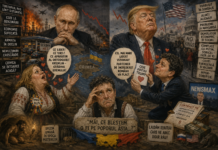


For Moscow, 2025 was the fourth year to end its failure, given that Russia remains mired on the front in Ukraine.
For the Russian army, the road to Kyiv remains, at the end of December, as long and arduous as it was at the start of the invasion, with somber difference that the number of dead repatriated by the Russians since 2022 has increased to leveld comparable to War II. 2025 was probably the bloodiest year.
For Russian diplomacy, however, the year end is somewhat more promising, because with Donald Trump back in the White House, the Kremlin gained a solid and unparalleled ally on Ukraine.
Even so, despite the Stakhanovite (Eds: a worker in the former Soviet Union who was exceptionally hard-working and productive) support offered to the Putin regime by the Trump administration, the progress made by Russian emissaries in the peace negotiations is similar to that made by Russian generals on the front: few in number, poor in quality, stuck somewhere, far from its goal.
This year it rained with peace formulas, especially starting in autumn, in terms of results, there was drought.
The reason for this deadlock is simple: all peace formulas were initiated exclusively by the Russian-American end and were designed exclusively from the perspective of the interests of the Putin-Trump pair, and all peace formulas were exclusively focused on forcing Ukraine’s surrender.
In essence, what the Americans and Russians called peace efforts in 2025 was actually just a collection of variants of a stinking diktat. The Russians imposed them, the Americans promoted them, the Ukrainians refused them, the Europeans helped the Ukrainians to stick to their refusal.
It was the diktat (Eds: harsh settlement imposed on a defeated party), not the negotiations, that was the underlying constant of the 2025 peace talks.
But there is something else as fa as Ukraine is concerned.
Those who have watched each episode of the so-called peace negotiations under the Trump-Putin aegis cannot overlook the different way each sides presents the course of things:
- Invariably, Trump and his people injected an optimistic note: Putin still wants peace, the talks were sometimes productive, sometimes constructive, we are making progress, the road is not easy, but we are getting closer to the goal of peace.
- Invariably, Putin and his people inject a dose of reserve or pessimism: President Trump is making efforts, we thank him and we recognize them; but the Ukrainians do not want peace, and the Europeans want war and to sabotage US efforts. Sometimes, as happened after the Russian-American talks in Miami before Christmas, Washington boasted of “progress”, while Moscow said there was no “progress”.
As for the constant in the background, there is a perfect alignment between Trump’s perspective and Putin’s perspective. They conceived it together, they tried to impose it together, they did not stress over divergences and differences of opinion.
Trump and Putin see the world through the prism of spheres of influence like in the Cold War; both see the EU as a declared enemy, one does not like NATO, the other is an enemy of NATO, both believe that smaller countries cannot pursue a great destiny, both want to do lucrative business together.
However, things are different in terms of form (what one side communicates rarely coincides with the other). And the question is simple: Why? Why do the Americans say that progress has been made, and the Russians don’t? Why do Americans say that Putin wants peace, but Putin says and proves that the war will continue?
The answer, on the other hand, is not entirely visible.
It is clear why, if we refer to Putin – his interest in Ukraine has been expressed openly and repeated obsessively, that his interest consists in the total domination of Ukraine.
Therefore, from Putin’s perspective, any discussion with the Americans, which does not foresee the capitulation of Ukraine, does not represent progress, does not offer even the slightest reasons for optimism and does not allow even an shaky ceasefire.
But it is no longer so clear why, if we refer to Trump.
In his public outings, the American president has always made it known that he wants Ukraine to make major concessions, because otherwise it is not possible. But Trump and his people (Vice President Vance, Emissary Witkoff) have also constantly tried to appear somewhat “washed out.”
And for this, publicly, they have carefully camouflaged what they really believe about Ukraine, as well as the desire that really consumes them about the future of the US relationship with Russia. They camouflaged these things in the cloak of their humanitarian concern for Ukrainian civilians and servicemen – impoverished, wounded, killed in this war. Behind the scenes of the talks with the Russians, Trump and his people stand non-stop with their foot on the accelerator, but in their public speeches they tap the brakes.
If, on the other hand, you take into account the various press revelations and written books, starting with the very first mugs say something completely different.
Because people who have worked with Trump or who have known Trump for decades have revealed, both in the press and in books, that the American president has a horror of acknowledging his failure and has even made a philosophy of life out of presenting anything and presenting himself as something successful.
As such, the only plausible explanation would be that the Trump administration reflexively presents all talks with the Russians on peace in Ukraine as something constructive, productive, as progress.
Trump does it out of habit, his representatives do as it’s an order.
It doesn’t matter what you did and what was achieved, it only matters what you say. In this chapter, of how the peace talks went in 2025, the irony of fate is that the Kremlin seems to have been infinitely more sincere than the White House. Including on the latest episode of Russian-American negotiations, the one in Miami.
