







Trump’s reckless trade war is based on a total misunderstanding of economics. Is he aware of it? Is he lying, or actually stupid? No one seems to know.
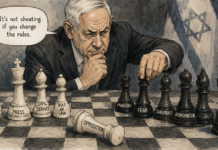
A day before the expiry of the self-imposed July 9 US deadline for concluding global tariff deals, came a delicious scene of bootlickery: Benjamin Netanyahu in the Blue Room presenting Donald Trump with a recommendation letter for the Nobel Peace Prize. Netanyahu is wanted at the Hague for alleged war crimes, so the recommendation probably won’t help much, but Trump loves bent-knee fawning — so in heightened spirits he began to boast about his tariffs.
“We’ve taken in hundreds of billions of dollars because of the tariffs,” Trump said (at 21:30 of the side-splitting video). “We’re the hottest country in the world right now.” Although delivered with the confidence of a very stable genius, the figures provided and the idea at the core of this are both complete and total bullshit.
Tariffs are not tribute by foreign countries but taxes that are paid by Americans. They are a tax hike whose only justification can be the protection of certain domestic industries. Trump’s “revenue” is your higher grocery bill, your pricier car, your more expensive clothing and electronics. As should be obvious, tariffs are levied at the border on importers (mostly US companies) who then pass those costs on to consumers. The $92 billion collected by US Customs in 2023 didn’t come out of Beijing’s bank account but from American families and businesses, quietly siphoned from household budgets into the federal treasury.
Trump wants to jack that figure way up and assumes you are an idiot (or is one himself). He has made this fiction so central to his image as a master negotiator that millions are being manipulated into celebrating their own exploitation. So the administration wheels out poor Press Secretary Karoline Leavitt to actually make the preposterous claim that tariffs are “a tax cut for the American people.” This should be the first search result for “insult to our intelligence.”
In the days since the silly Blue Room meeting, Trump extended the deadline to Aug. 1, and over the weekend he ramped up his threats, jolting America’s economic relationships with two of its closest partners in his desperation to pressure them into something that looks like concessions. He announced a sweeping 30 percent tariff on all imports from Mexico and the European Union (whose combined population of almost 600 million is close to double the US), effective next month. The move, unveiled on social media, signals a dramatic escalation in Trump’s effort to rewrite the rules of global trade. If it actually happens, expect another jolt to the stock market and your retirement funds — to complement the plummeting dollar which will make imports more expensive.

The blow to the European Union is especially sharp. Policymakers had gradually come to accept the possibility of a 10 percent tariff and were working to negotiate carve-outs for key sectors like automobiles, pharmaceuticals, and wine. But a flat-rate hike, and the threat to raise it higher if the bloc retaliates, torches that.
Mexico, too, was blindsided. President Claudia Sheinbaum had gone far to accommodate US demands. She deployed 10,000 troops to the border, cracked down on fentanyl smuggling, extradited cartel leaders, and imposed restrictions on Chinese goods. Just months ago, US officials praised the cooperation, and most Mexican exports had been spared. Now most of previously exempt goods could be hit, and Mexico is threatening countermeasures.
So, the threat of a full-blown trade war is now real and imminent. The European Union has a €21 billion retaliatory package on standby, set to be implemented as early as Tuesday unless Brussels calls it off. Mexico, which has never retaliated against the United States, is drawing up lists of US exports that could be hit in response. To be clear, that is money that will be paid by Europeans and Mexicans to their own governments — but this will make US exports uncompetitive.
Canada is also in the crosshairs, facing a 35 percent tariff. Brazil, Japan, and South Korea have been warned they may soon be hit with duties ranging from 20 to 50 percent. Bottom line: The United States is treating allies like enemies, and undermining the very rules-based system it spent decades constructing.
How did we get here? Let’s take a step back.
I don’t advocate free trade absolutism. There are legitimate reasons to reevaluate trade policy: To protect strategic industries, reshore essential manufacturing, or counteract unfair trade practices. Some industries —semiconductors, clean energy, vaccine production, rare earths —deserve smart, targeted protection. That requires strategy, coordination, and investment. Tariffs can be part of the toolkit — but they must be used with care and precision. Trump brings a sledgehammer.
During his first term, Trump imposed sweeping tariffs on steel, aluminum, washing machines, solar panels, and hundreds of billions in Chinese goods. China retaliated swiftly and sharply, hitting American soybeans, pork, and other agricultural exports. The result? A trade war that devastated farmers, disrupted industries, and necessitated multibillion-dollar bailouts that cost more than the tariffs brought in. And remember: Both costs are borne by Americans.
A 2019 study from economists at Columbia, Princeton, and the New York Fed found that the Trump tariffs cost US consumers and businesses $1.4 billion per month in new taxes, plus another $1.4 billion in efficiency losses — economic output flushed down the drain. Study after study confirms that Americans and not foreigners absorb the tariff burden.
John Maynard Keynes — the architect of modern social democracy and the most influential economist of the 20th century — was, at heart, an opponent of tariffs. Though he began his career as a staunch moral and economic advocate of free trade, the crises of the interwar period led him to reluctantly consider limited protectionism under exceptional circumstances.
Faced with mass unemployment, rigid wages, and political resistance to devaluation, Keynes argued that modest, temporary tariffs might offer short-term relief, as a pragmatic response when better tools were unavailable. Even then, he remained deeply wary. Tariffs, he warned, were dangerous and easily abused —inviting retaliation, distorting markets, and becoming politically entrenched.

Moreover, consider the history. In 1930, Congress passed the Smoot-Hawley Tariff Act, raising import duties to unprecedented levels. Over 1,000 economists — including Keynes — begged President Hoover to veto it. Hoover signed it anyway. Global trade collapsed. The Great Depression deepened. And the Republican Party was swept out of power for a generation. It took FDR’s Reciprocal Trade Agreements Act of 1934 to reverse course and usher in the postwar trading regime that would eventually evolve into the WTO — a rules-based system that preserved peace, fueled innovation, and expanded prosperity.
Trump, of course, doesn’t believe in structures and is drawn to spectacle. He seems to like that tariffs sound tough. As with so many things in the Trump era, this is basically a test of how collectively stupid we are. A high level, history will show, generally carries punishment.