













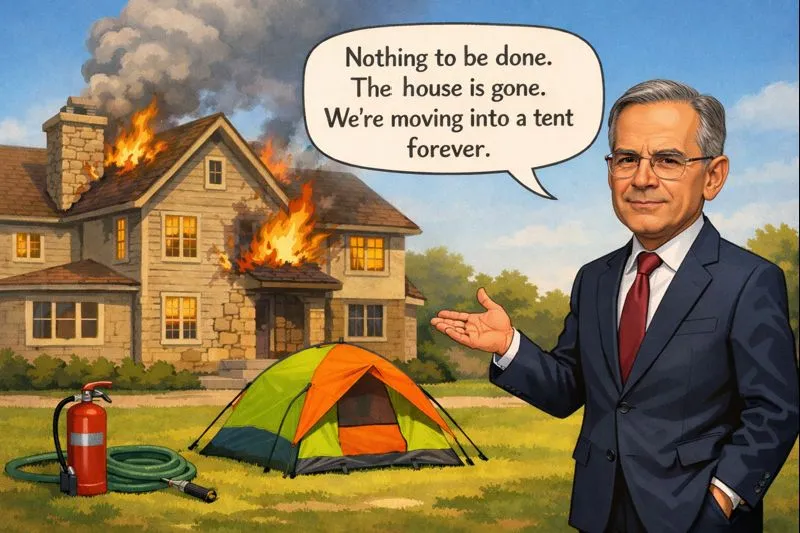
Not so fast, Carney: You’re declaring collapse where there is structural damage.
Imagine the following world. Donald Trump runs for president in 2024 not as a vessel for cultural grievance and unhinged ego, but on an explicit platform of demolition. He openly campaigns on dismantling the administrative state and independent institutions, treating alliances as liabilities, discarding NATO, abandoning Ukraine, aligning with autocrats, and burning down the global order the United States built and led for eight decades.
Also, he eagerly and openly embraces Project 2025, the shadowy plot developed by the Heritage Foundation in collaboration with a coalition of conservative and far-right organizations which outlines a sweeping plan to centralize executive power, dismantle large parts of the federal bureaucracy, and reshape American governance along hardline ideological lines. When asked about it, he makes it his own.
He is running against a strong Democratic opponent, one who dominates the primaries and enters the general election with a clear popular mandate. Yet he wins decisively — by ten points in the popular vote. And one action-packed year later, amid the smoldering ruins of the transatlantic alliance, polls show that 70 percent of Americans approve of his handiwork. The electorate has spoken, loudly and unmistakably.
In that world, when Canadian Prime Minister Mark Carney stands up at the World Economic Forum in Davos, Switzerland, and declares that we are not living through a transition but a “rupture” — that the American-led order is finished, that the “middle powers” must band together and build something entirely new with which to confront America and China. His diagnosis is grim, but coherent and incontrovertible. America, democratically, had clearly chosen to end the system it once upheld.
That is a grim scenario to be sure, but as you might be noticing, that is not the world we actually live in.
What actually happened is messier and murkier. Trump denied any knowledge of Project 2025, dismissing it as fake news.
He ran primarily on “wokeness,” grievance about his fantasy that the 2020 election was stolen from him, and retribution against his many enemies. He ran against a Democratic candidate who had not won a single primary in 2020 or 2024, who emerged through party paralysis rather than popular enthusiasm, who was burdened by the perception — fair or not — of having helped conceal Joe Biden’s incapacity, and who faced the enduring realities of sexism and racism in American politics. Trump won not by ten points, but by 1.5 percent, with under 50 percent of the vote. And a year into his presidency, he is less popular than any modern president at the same point in office.
This is not a some referendum in which Americans decided to trash the world order but a series of terrible accidents, mistakes, and misunderstandings.
And yet Carney got up at Davos, and acted as if we are living in the fantasy scenario described above.
He has received plaudits the world over, larger for seeming like an adult who can hold complex thoughts, articulate them reasonably, and not seem an egomaniac. But he is guilty of fundamental error.
Carney’s rhetoric of a “rupture” presupposes a legitimacy that does not exist. It inflates a narrow, accidental victory into a civilizational verdict. It treats temporary capture of the U.S. government by the likes of Stephen Miller and Steve Bannon as some permanent realignment. And in doing so, it risks talking the liberal order out of existence precisely when it is under strain but not defeated.
Carney’s position is also actively damaging, because it subtly weakens Europe at the moment Europe most needs to assert itself. By treating the world as a landscape of “middle powers,” he implicitly demotes Europe from a unified geopolitical actor into a loose collection of secondary states. That’s an assist to Trump and Vladimir Putin, for whom a fragmented Europe is easier to coerce and ignore. Europe’s power lies precisely in its unity: its market size, regulatory reach, institutional depth, and moral authority as the last major defender of classical liberalism. Weakening it is foolish if the goal is to combat Trumpism.
I am not arguing that the postwar order should be treated as sacred or frozen. The Security Council reflects the power map of 1945, not today. Burden-sharing in the Western alliance has been unequal for decades. Global institutions require more legitimacy, accountability, and representation. Trade rules must adapt to supply-chain vulnerability and strategic resilience. But updating a flawed system is the opposite of declaring it a “pleasant fiction” and abandoning it.
That said, Carney’s gambit raises an important question: even if Trump’s victory was narrow and his governance unpopular, can the damage he does be reversed?
There are two parts to that question, and they are often conflated.
The first concerns policy. Here, the alarmism is overstated. Almost everything Trump is doing — or can do—on trade, alliances, climate, multilateral institutions, and possibly even Ukraine is reversible. Sanctions can be reimposed. Treaties can be reentered. Funding can be restored. Commitments can be renewed. Institutions can be rebuilt. None of this is cost-free, and none of it is painless, but it is not irreversible. The United States has lurched before — Jim Crow, Vietnam, the Iraq War — and corrected course. Repair requires time, seriousness, and honesty. It requires a leadership willing to say plainly: we were wrong.
The deeper concern is credibility. What will America’s allies think once they have seen that the United States can elect a leader willing to torch the system — and that tens of millions of Americans were willing to hand him the match?
That damage is real. Trust, once broken, is not restored by a single election. Allies will hedge and doubt. They will ask whether the next American election could once again place the entire order at risk. In that sense, Trump has revealed a structural vulnerability that cannot be unseen. His recklessness, foolishness and venality have tainted his successors before anyone even knows who they will be.
But even here, the talk of irreversibility goes too far.
First, allies already hedge – they always have. Second, credibility is not binary; it is rebuilt over time through behavior, not rhetoric. And third — and this is where the Davos pessimism becomes self-indulgent—the shock to American reliability may force a long-overdue correction that ultimately strengthens the system.
Europe, in particular, has spent decades underinvesting in its own defense while proclaiming strategic autonomy. If Trump’s return finally compels Europeans to spend, coordinate, and take responsibility for their own security, which it basically has done, that is not the death of the liberal order but rather a maturation. An alliance in which Europe is less dependent on the United States is not a weaker alliance but a healthier one.
None of this absolves America. On the contrary. If Democrats return to power in 2028, the United States will have to do something it has historically struggled to do: apologize with any ifs, ands or buts. We refused to rule out force against our allies, treated them with contempt and indifference, and used tariffs in a way that was not only coercive but mendacious and domestically illegal. We allowed a minority coalition, through a fragile electoral outcome, to wreak outsized damage. And we are sorry.
Meanwhile, what is dangerous is the idea, now fashionable in elite circles, that the system is already over, that America’s stumble is its final fall, and that the only sophisticated response is to start over from scratch. History offers a warning.
Before World War I, the international order did not collapse because it was defeated but because its custodians lost faith in their own responsibility to preserve it. In the years before 1914, Britain still commanded the seas, but hesitated to use its power decisively in defense of the balance it had helped build. Germany read that hesitation as opportunity, France read it as uncertainty, and smaller states read it as permission to gamble.
Europe remained tightly interconnected by trade and culture, but elites began to speak as though war were inevitable and restraint naive, as though realism meant accepting destruction. Fatalism was elevated into sophistication. The system unraveled through miscalculation, not revolution.
The United States has lost not its power but its way, more or less by accident. The real danger today is not that the liberal order cannot survive America’s stumble, but that too many people, trying too hard to be realistic, are far too ready to surrender to Trump.
