














The World Health Organization (WHO) has declared that Europe’s unprecedented early-summer heatwave may have caused hundreds of excess deaths.
The extreme heat continued moving east across the continent on Sunday, with Germany, Poland and the Czech Republic all recording new national temperature records.
In a post on X, WHO Director-General Tedros Adhanom Ghebreyesus said more than 1,300 excess deaths linked to high temperatures had been recorded across Europe since 21 June.
“Heat stress is often called the ‘silent killer’,” he wrote, warning that homes, workplaces and schools across Europe are not equipped to cope with such extreme temperatures.
France has been particularly hard hit. On Sunday, the country’s health ministry said around 1,000 more people had died than expected since Wednesday. Most of those deaths were among people aged 65 and over, while deaths occurring at home rose by 40%.
Tedros warned that Europe is warming faster than any other continent, with temperatures rising at twice the global average.
Millions of people are enduring extreme heat, hundreds have died, schools have closed, and electricity grids are coming under increasing strain, he said.
Germany recorded its hottest day on record for the third day in a row on Sunday, with temperatures reaching 41.7C in the eastern town of Coschen, near the Polish border.
The Czech Republic also set a new national temperature record for the second consecutive day, with 41.1C recorded in Doksany, north of Prague. Meteorologists said the heat was expected to peak on Sunday before thunderstorms arrived in western parts of the country.
Poland likewise broke its all-time temperature record, reaching 40.5C in the western town of Słubice.
Tedros said climate change was driving the unprecedented conditions, warning that heatwaves once considered “once-in-a-generation” events are now occurring almost every year.
He urged European governments to strengthen heat-health action plans to better protect people from the growing risks posed by extreme temperatures.
The heatwave has prompted authorities across Europe to introduce emergency measures. For instance, in the Netherlands, the Defqon.1 music festival was cancelled after an unprecedented red warning for extreme heat was issued.
In Paris, officials banned the consumption of takeaway alcohol in public and cancelled the city’s Pride march to ease pressure on emergency services. The restrictions were in place from Friday afternoon until Sunday morning.
France has also seen a sharp rise in drowning deaths during the heatwave. Interior Minister Laurent Nuñez said at least 74 people had drowned since the hot weather began, most of them in unsupervised rivers, lakes and ponds.
Meteorologists say the exceptional temperatures have been fuelled by a “heat dome” – a weather pattern in which sinking air is compressed and warms as it descends. The descending air also becomes drier, preventing cloud formation and allowing intense sunshine to heat the ground even further.
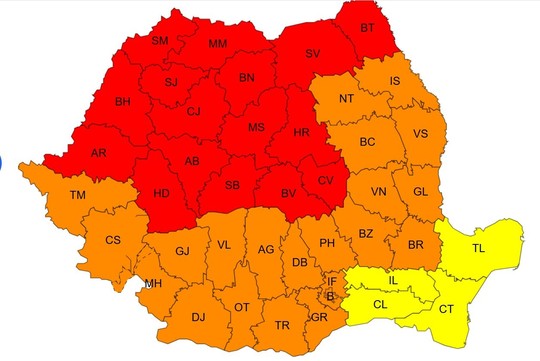
Romania is now in the path of the same record-breaking heatwave that has swept across Western and Central Europe. As the extreme temperatures shift eastward, the country has come under increasingly severe weather warnings, with authorities placing Bucharest and large parts of southern Romania under the highest-level Red Code alert.
According to Romania’s National Meteorological Administration (ANM), Bucharest is expected to see daytime temperatures climb to around 39C between Monday and Wednesday. Nights will offer little relief, with temperatures remaining between 18C and 23C, creating so-called “tropical nights” that prevent buildings and the human body from cooling down properly. Meteorologists have also warned of severe thermal discomfort, with the temperature-humidity index expected to exceed critical levels.
The capital entered the heatwave under successive Yellow and Orange Code warnings before escalating to a Red Code alert as conditions intensified. Similar warnings have been issued across numerous counties, particularly in southern Romania, where the most dangerous temperatures are forecast.
While countries such as France have begun reporting excess mortality figures, Romania has not yet released comparable data, and there are currently no official estimates of heat-related deaths. Such figures are typically calculated weeks later by comparing the total number of deaths with what would normally be expected during the same period.
Scientists say the unprecedented heat is being driven by climate change and amplified by a persistent atmospheric pattern that has trapped hot air over Europe before gradually shifting east toward the Balkans. With Romania now under the core of the heatwave, authorities are urging people to avoid outdoor activity during the hottest hours, stay hydrated and check on elderly or vulnerable relatives, who remain at the greatest risk of heat-related illness.
