














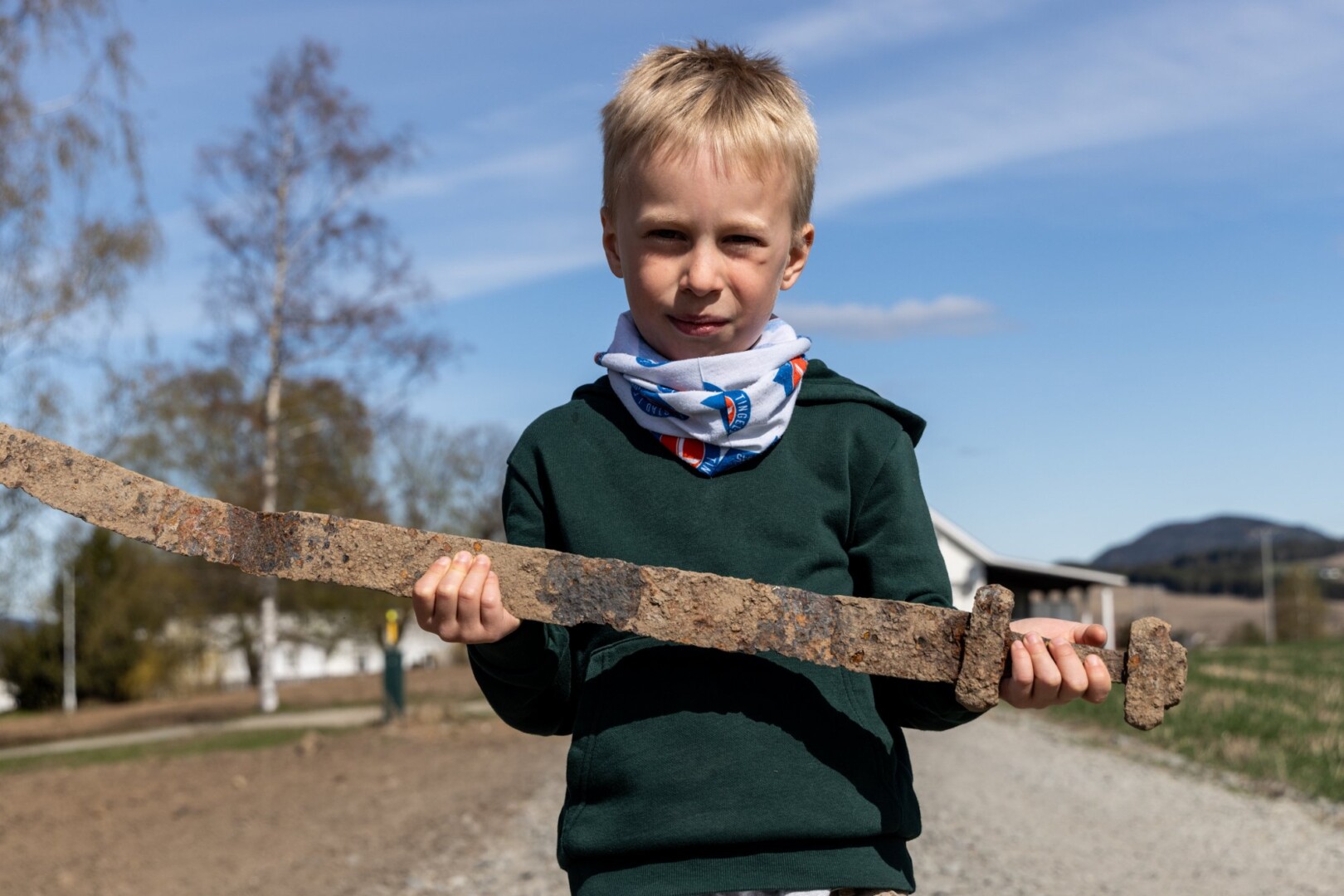
A seemingly average school trip in rural Norway gave way to an extraordinary archaeological discovery after a six-year-old boy stumbled upon a remarkably well-preserved sword believed to date back around 1,300 years.
The discovery was made by Henrik Refsnes Mørtvedt, a first-grade student at Fredheim School, during a class trip to Brandbu in the municipality of Gran, located in Norway’s historically rich Hadeland district.
While walking across a plowed field with his classmates, Henrik noticed what appeared to be a rusty piece of metal protruding from the earth, and picked it up and brought it to his teachers.
Both astounded and increasingly aware of the fact that the object could indeed be historically significant, Henrik’s teachers contacted local archaeologists, who later confirmed that the find was anything but ordinary: an ancient iron sword likely dating from between AD 550 and 800, offering historians a glimpse into the turbulent transition between the late Merovingian and early Viking Age.
The object is rare: unlike later Viking swords, which were typically sharpened on both sides, this type of blade was designed with only one sharpened edge. Such weapons were commonly known as scramasaxes or saxes and were widely used across Northern Europe during the early medieval period.
The sword’s age places it at a fascinating historical crossroads in Scandinavian history: a time marked by major cultural and military developments that would eventually culminate in the Viking expansion across Europe.
The location of the discovery adds another layer of significance, for Gran lies within Hadeland, a region whose name translates roughly as “Land of the Warrior.” This area has long been known for its dense concentration of archaeological finds connected to the Iron Age and Viking era, including burial mounds, settlements, and ceremonial objects.
Over the years, Hadeland has yielded numerous important discoveries, from Bronze Age graves to intricately crafted Viking swords. However, archaeologists say Henrik’s discovery contributes further evidence of the region’s longstanding warrior culture and may help researchers better understand the development of weapon-making traditions in pre-Viking Scandinavia. Archaeologists hope that further analysis may reveal more about the people who once carried such weapons and the society that produced them.
Although the blade spent centuries buried underground, it appears to have survived in unusually good condition, making it especially valuable for historians.
Sadly for him, Henrik was not able to keep the sword: the artifact has now been transferred to the Museum of Cultural History in Oslo, where specialists will examine it in greater detail.
