







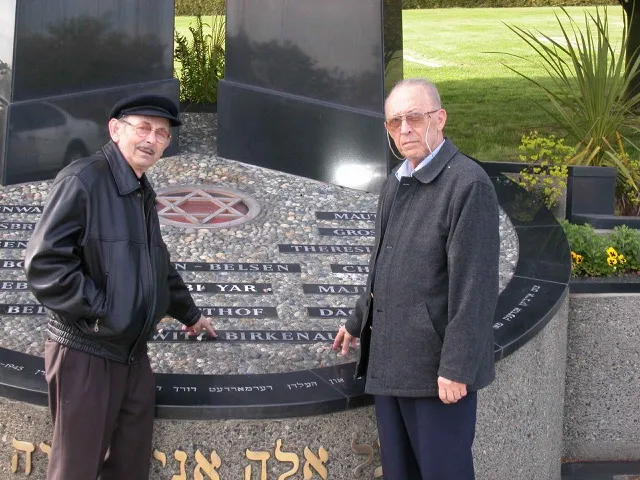
The astounding story of Kalman and Leopold was released ahead of the Jan. 27 commemoration of the 80th anniversary of the liberation of Auschwitz
Richard K. Lowy’s Kalman & Leopold: Surviving Mengele’s Auschwitz is a harrowing and meticulously detailed account of two Holocaust survivors whose paths crossed in Auschwitz II-Birkenau under the shadow of Dr. Josef Mengele’s notorious experiments. This work is more than a historical record; it’s a testament to resilience, friendship, and the imperative of preserving Holocaust memories as the generation of survivors dwindles.
The book (available on Amazon here) was just released amid preparations for the January 27 commemoration in Poland of the 80th anniversary of the liberation of Auschwitz. The event is in the news over Poland’s controversial decision to grant immunity to Prime Minister Benjamin Netanyahu despite arrest warrants issued by the International Criminal Court. A must-read for anyone who cares about Holocaust remembrance, this is a reminder that Auschwitz resonates far beyond the vulgarity of the quotidian. Politics dominate the news cycle, but Lowy’s work calls for a deeper engagement with the memory of genuinely unimaginable horror.
Author Richard K. Lowy, a Jewish Canadian, is the son of Holocaust survivor Leopold Lowy, one of some 3,000 twins subjected to genetic experiments by the notorious SS doctor Josef Mengele at Birkenau’s medical barracks during the Holocaust.
In 2002, his efforts to record his father’s experiences yielded an unforeseen link to Kalman Bar On, another Mengele twin, who was in Israel (the story was first presented by Lowy that year, at the Enav Cultural Center in Tel Aviv).
Lowy pieced together the fragments of his father’s life through personal interviews, archival footage, and firsthand accounts – resulting in a document that serves as a voice for both Leopold and Kalman, two men who survived the unimaginable and maintained their humanity in the face of the relentless inhumanity that beset them.
The structure of Kalman & Leopold alternates between the lives of its titular characters, tracing their early years, their time in Auschwitz, and their eventual reunion decades later. This dual perspective allows the reader to see the Holocaust not as a monolithic event but as a tapestry of individual stories, each marked by unique experiences of suffering and resilience.
The book approaches Mengele’s gruesome experiments with unflinching honesty. The barbaric fascination with twins and his inhumane “research” are described in detail, not for shock value, but to underscore the extent of Nazi cruelty (and perhaps the potential of human cruelty in general). Amid this horror, the bond between Kalman and Leopold offers a glimmer of hope. Their friendship becomes a testament to the human capacity for connection even in the darkest of times.

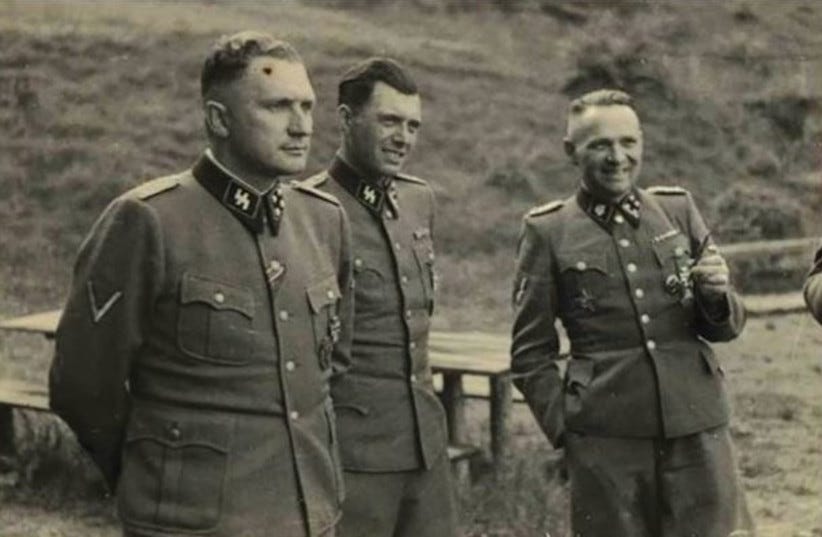
The deeply personal narrative is framed within the larger machinery of the Holocaust, reminding readers that the atrocities were not just statistics but a collection of deeply personal tragedies and triumphs. By focusing on these two men, Lowy humanizes a history that often feels too large to grasp.
As the generation of Holocaust survivors dwindles, the importance of reading and engaging with Holocaust literature becomes increasingly urgent. Books like Kalman & Leopold serve not only as historical records but also as tools to deepen understanding, foster empathy, and combat the rising tides of Holocaust denial and historical revisionism.
Holocaust denial has grown alarmingly in recent years, amplified by social media and political movements that seek to distort history for ideological gain. The looming absence of living witnesses to refute these lies makes literature an essential bulwark against forgetting. Kalman & Leopold is part of this vital canon, offering meticulously documented accounts that leave no room for doubt about the atrocities that occurred.
Moreover, Holocaust literature fosters empathy and reflection, helping readers connect emotionally to the victims and survivors. Through such stories, readers confront the devastating consequences of hatred, indifference, and complicity. While the Holocaust was a singular event, these are lessons that apply today as well.
In this sense, Kalman & Leopold is not just a memoir but a guide for how to engage with history meaningfully. The book shows how the next generation can honor their predecessors by ensuring their stories remain vivid and impactful.
As Elie Wiesel famously said, “When you listen to a witness, you become a witness.”
Indeed, the book is dedicated “to the many who were unable to tell their stories and to the few who were.”
Beyond the compelling story of the two, the narrative provides detailed descriptions of the camp’s layout, the daily routines of its prisoners, and the machinery of extermination that defined it. The inclusion of maps, diagrams, and historical data enriches the reader’s comprehension and grounds the narrative in historical fact.
Lowy’s interviews with his father began shortly after the 1999 death of his twin sister Miriam. “Dad’s past was so haunting that even talking about it in an interview brought on weeks of terrifying nightmares,” he reports.
The result was a 2001 documentary on the National Geographic History Channel. Soon after, the Lowy family received a call from Kalman, in Israel, then an email that said simply, of Leo: “He is my hero. I’ve been looking for Leo all my life.” Lowy traveled to Israel for a week of interviews with Kalman, detailing the man’s common experiences with his father. Incredibly, the material sat waiting for 18 years, until the COVID-19 pandemic somehow focused Lowy’s mind.
The narrative describes what Lowy calls “chance encounters, hidden reservoirs of resilience, and the bonds that held them together in the face of unimaginable horror.” He quotes Kalman as asking the unanswerable: “When you are certain of death, when hope is an illusion, how do you will yourself to survive?”
The narrative weaves together the separate testimonies of Leo, born in 1928 in Czechoslovakia, and Kalman, born in 1930 in Yugoslavia, and for good measure offers a brief biography of Mengele, born in Bavaria in 1911 and harboring early desires to be a dentist. The parallel events in the lives of each are skillfully woven together, detailing the anti-Jewish edicts in the 1930s, for example, until the arc of history lands them all together in Auschwitz.
At that point, Mengele believed that some people were “unfit to reproduce.” Assigned to Auschwitz in 1943, he “relished his role of deciding who would die and whom he would use for experiments, which involved numerous injections, painful life-threatening procedures, and unnecessary surgeries without anesthetic. His main interest: twins and dwarfs.”
“I’m shaking,” Leo remembers, of his first meeting with “The Angel of Death.” “His boots are like mirrors… He looks like he couldn’t hurt a fly. He tries to calm us down. He examines me. Very routine: Raise you arm, check this, check that. He does the same with Miriam, then looks at the notes from the other doctors. … Now I know that with a flick of his wrist he got rid of my parents and thousands more. … As long as this Mengele still needs us, we have a chance to live.”
I will give no more of the narrative away – it simply must be read to be believed. I mean that literally: If books like this aren’t read, one day the norm will be that it won’t be believed.
While many works focus on the Holocaust as a singular historical event, Lowy expands the scope to examine its long-term impact on survivors and their families. His exploration of post-liberation struggles, such as displacement and psychological trauma, offers a nuanced understanding of what it meant to survive.
The danger of forgetting looms large in Kalman & Leopold. Lowy’s meticulous documentation, supported by archival evidence and survivor interviews, is basically a call to action – a reminder that the responsibility to remember now falls on those who did not experience the Holocaust firsthand.
My own parents were Holocaust survivors from Romania. My father survived a labor camp run by Nazis and their local fascist goons (by becoming, improbably enough, a ping pong mascot who took his tormentors down to the wire and always let them win). My mother survived a major pogrom in her native Iasi, through subterfuge too horrible to mention on these pages. This book is a compelling read about others – but as I read it, I felt I was honoring my parents too.
Many readers, I am sure, will experience a similar sensation.

