





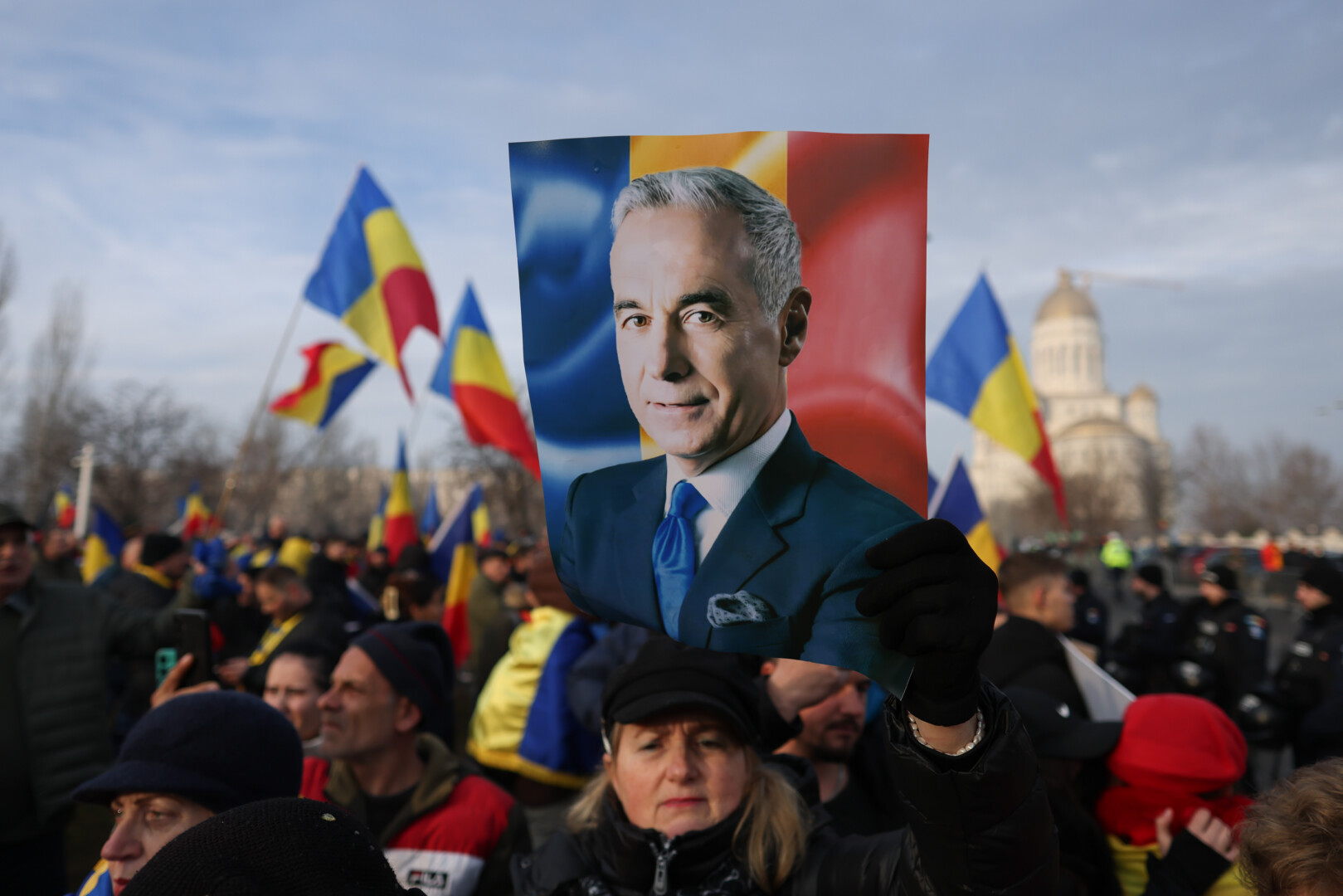
A leader of Romania’s ruling coalition claims Calin Georgescu whose surprise win of the first round of presidential elections shocked supporters and critics alike owes his career to a network that was linked to a Romanian communist-era agent who spied for the KGB.
Kelemen Hunor, the chairman of the UDMR party that represents Romania’s ethnic Hungarian community said in a recent interview with Maszol that the radical independent Georgescu who styles himself as an anti-system politician, was in fact linked to Romania’s deep communist past, via his mentor who in turn is connected to double agent Mihai Caraman, who died last summer.
Georgescu, 62, says was mentored by Malița, an elite diplomat like Caraman of the Ceausescu regime, Mr. Hunor claimed. Caraman, who died last summer aged 95, headed Romania’s foreign intelligence agency, the SIE when communism ended. Before that, he rose through the ranks of Romanian espionage at the foreign agency (DIE) that penetrated NATO and provided information to the KGB.
“Behind Georgescu there is a network of (Eds communist-era) reservists from all areas who were looking for a candidate, and they mobilized. Here is a man (Eds: Calin Georgescu) who presented himself as anti-system, although he is part of the old system.He is not anti-system,” the Hungarian leader said.
After the interview was translated into Romanian, Georgescu hit back, saying Hunor’s party was not a real political party and would be investigated ‘very soon.’ He did not elaborate.
In 1986,Mr. Georgescu studied in New York and London, a privilege granted only to a few people in the Ceausescu regime, Hunor said.
Mihai Caraman, a contemporary of Malita, worked for Ceausescu’s foreign intelligence and penetrated NATO in the 60s delivering classified information to the KGB. He sparked an international scandal when he managed to recruit several NATO employees, with the help of whom he obtained intelligence.
The information he obtained for Romania was then also passed on to the Russian secret service, the dreaded KGB, according to the website of the Institute for the Investigation of Communist Crimes,”Hunor said.
After the NATO security breach was discovered, Caraman was expelled from France and continued his career in domestic intelligence.
He returned to the forefront of Romanian espionage immediately after the anti-communist revolution, and was appointed deputy defense minister, a department head of the Romanian Foreign Intelligence Service (January 20 – August 20, 1990), then director of the Romanian Foreign Intelligence Service (August 20, 1990 – April 9, 1992); adviser to the director of the Romanian Foreign Intelligence Service (Apr. – Sept. 1992).
He was removed from the position following pressure from then NATO Secretary General Manfred Worner as Romania began its pro-Western trajectory.
Călin Georgescu was part of the Romanian branch of the Club of Rome, created by Mircea Malița (Romanian Association for the Club of Rome). Mr Malița served as deputy foreign minister and education minister during communism, and ambassador to the United States between between 1982 and 1985, during the darkest years of communist rule.
Calin Georgescu credits Malița as his mentor. In a podcast, he said: “I always recognize Mircea Malița. He was, you see how life was, he was Sadoveanu’s secretary (Eds: former writer and regime sympathizer Mihail Sadoveanu), when Sadoveanu was at our UN secretariat in New York. I became Mircea Malița’s secretary when he was held the same position.”
Malița became a member of the preparatory councils of the UN World Conferences on Population, Science and Technology, for Development in 1974.
Kelemen Hunor said Romania was now at a turning point in its history, not dissimilar to 1989.
“What almost happened in last year’s elections (Eds: the elections were canceled) was (the efforts ) of what was left of the old pre-89 system. The secret services reservists almost defeated the new system.”
Kelemen Hunor criticized a lack of communication from Romania’s leaders on the current political situation, taking an aim at outgoing President Klaus Iohannis.
“There is another question, the fact that they didn’t find who was responsible, not only did they not explain, but they did not find those responsible, which is again a very, very big problem, which undermines trust in public institutions.”
“The president of the state should … explain to society what happened, in a way that respects certain rules… But he did not do so. I consider this a big mistake, because it increases distrust, makes people think a kind of trickery has taken place. There have been all kinds of theories, conspiracies fabricated and spread by people in recent weeks.”
Asked about Calin Georgescu, Kelemen Hunor said that “the fact that they (Eds: a foreign state actor) bought thousands of fake profiles on Tik-tok earlier, and used them, only shows that they have mastered this field from a technical point of view.”
He said that Calin Georgescu was helped by commentators who promoted him on Tiktok and other social media, which turned out to be bots, robots, comments, and actions “that were from outside Romania, but … the first problem was in Romania”.
He accused Georgescu of spreading ideas of the Iron Guard, legionnaires and the extreme right for years despite it being illegal.
“He uses simple sentences that please..,..whether it is about the family, about God, about the homeland. His campaign measured (his message) very precisely…they told everyone, through simple and short sentences, what they wanted to hear. From this point of view, Georgescu had a company of well-trained people behind him,” he said.
