



(And how you can help us amplify them)
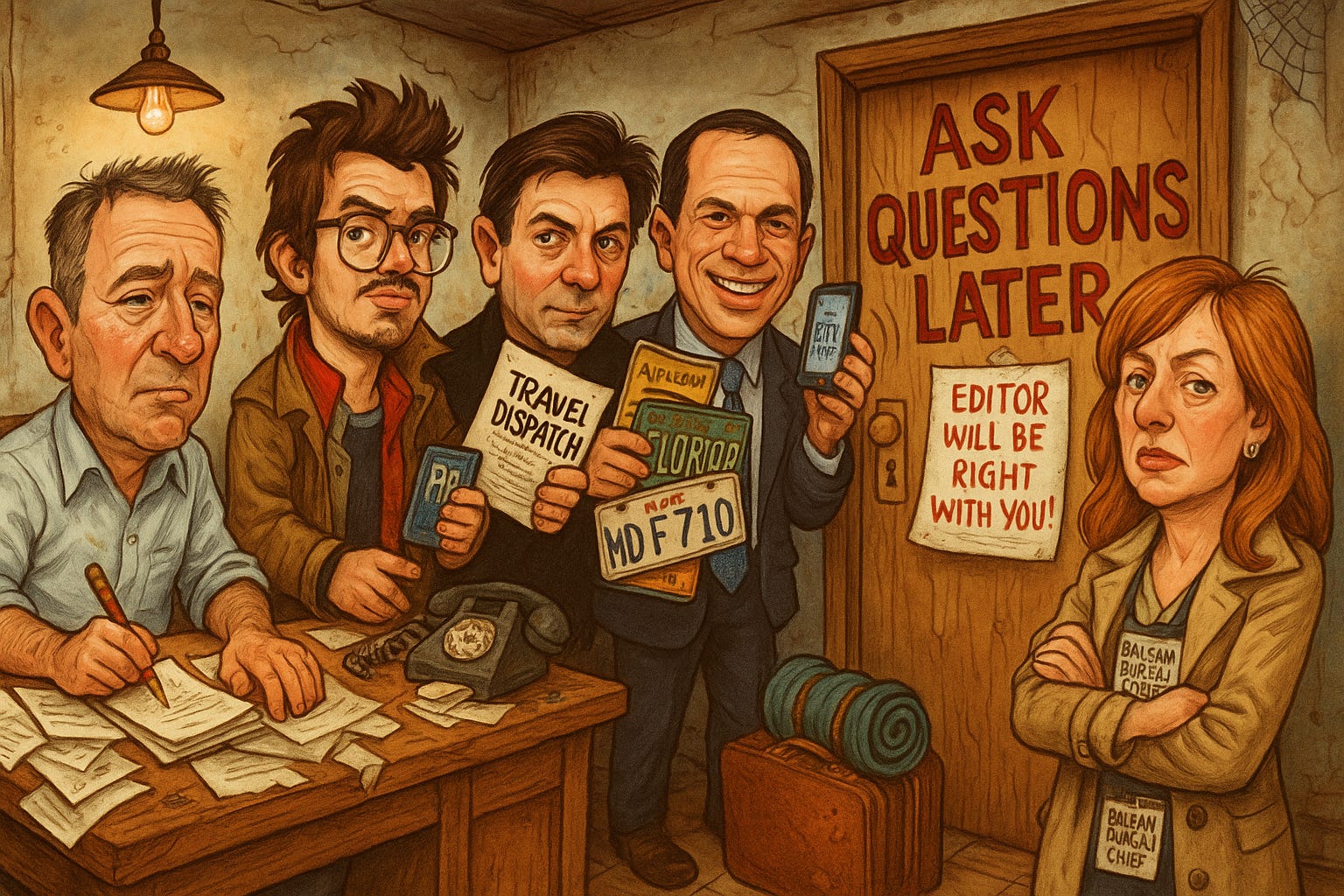
Over the past few months, Ask Questions Later has hosted an eclectic assemblage of guest writers — talented, fearless and quirky voices from around the world — to make the platform richer, more diverse, and more alive. We want to be a home for great journalism, fresh thinking, and the kind of storytelling that both matters and entertains (else, alas, it usually will not sell). As we wind down April, this post is aimed at celebrating all of that.
You’ll find a short feature about each of them below — a veteran foreign correspondent, a grizzled war reporter turned international law guru, a veteran of Puerto Rico journalism and rare disease expert, a celebrated British author and columnist, a Gen Z phenom multimedia in-the-making. We hope you’ll explore their work — and if you believe in this project, consider upgrading to a paid subscription. Some contributors hope to be paid for their work in the future. With your support, we can make that happen.
And we promise: when the day comes that we’re as big as The Economist, or maybe half or a quarter as big, all our early backers will receive lifetime free subscriptions — as a real and lasting thank you (use this copy as your coupon!). Here’s to building something fun and important — together.
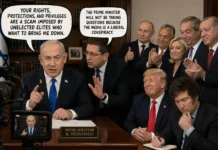
Chris Stephen is an acclaimed war correspondent — from the Balkans to Libya and beyond — and an author who has spent decades covering war, diplomacy, and justice. He has written two books, and an AQL series on the ICC and the vagaries of international justice.
In his riveting report, Chris brings readers inside the legal and political earthquake triggered by the International Criminal Court’s indictment of Israeli Prime Minister Benjamin Netanyahu. With signature clarity and depth, he shows how the case isn’t just a legal proceeding — it’s a global political collision involving Trump, the ICC, Israel, and the future of international law itself. Chris’s background reporting on the trial of Serbia’s Slobodan Milosevic gives him rare insight into the complexities of international justice, and it shows. He outlines not just the facts but the immense consequences: from Netanyahu’s restricted travel to the potential U.S. sanctions against the court. Chris’s work reminds us that in moments of history like this, nuance matters, and real journalism is more essential than ever. We’re honored to feature his work — which has included great stories on the extradition of the Philippines’ Duterte, about a Libyan warlord nabbed in Italy, and more — at a time when the world has gone so far off the rails that the stakes could hardly be higher.
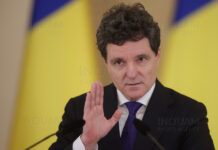
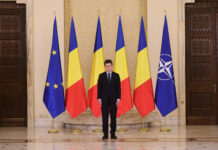
ALISON MUTLER: Dispatch from Romania: “Eyebrow” the Envoy and a Nation on the Brink

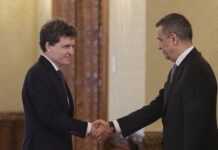
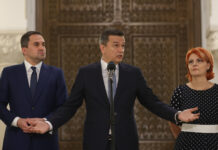
Alison Mutler is a longtime foreign correspondent based in Bucharest, who is director of the Universul news website and the doyenne of the country’s English-language journalism.
In her vivid dispatch, Alison introduces readers to Dragoș Sprînceană, Romania’s improbable new envoy to the Trump world — a flashy, improbable figure at the heart of Romania’s struggle to stay tethered to Europe. Through Sprînceană’s story, Alison paints a broader, gripping portrait of Romania at a crossroads: battling Kremlin disinformation, nationalist surges, and internal political upheaval following the annulled 2024 elections. With sharp reporting and subtle wit, she captures the surrealism of a world where bartenders become envoys, TikTok reshapes geopolitics, and the future of a NATO ally hangs precariously in the balance. Few can navigate Eastern Europe’s strange realities as Alison can — and in this story, she offers readers an indispensable (and hilarious) view of a place where democracy is fiercely tested.
GLEN OHARA: The Great University Unravelling

Glen O’Hara is Professor of Modern and Contemporary History at Oxford Brookes University and a leading British political commentator.
In his deeply researched and provocative piece, Glen tackles a crisis that has gone strangely underreported: the collapse of the Anglosphere university model. From the US to Australia to Britain, universities are facing funding cuts, cultural backlash, political hostility, and an identity crisis about what they even exist to do. Glen expertly ties this turmoil to the broader political discontent shaking the West — and asks whether these institutions, once engines of progress, are now at risk of fading into irrelevance. With historical perspective and sharp-eyed analysis, he makes the case that universities must rediscover a true sense of mission if they want to survive globalization, populism, and public mistrust. It’s a vital, urgent reflection on a problem whose consequences we are only beginning to understand. Read also his story Is Britain Falling Apart — a question he answers, perhaps surprisingly, in the negative. And check out his upcoming book on the Blair years!
LARRY LUXNER: License Plates Trace History of World in Chaos

Larry Luxner is a veteran American journalist whose career spans Puerto Rico, the Balkans, Israel, and the South Caucasus.
In his uniquely charming and sharp piece, Larry tells the unlikely story of a monument made of old Azerbaijani license plates — and how even something as mundane as vehicle tags can become symbols of history, conflict, and memory. With wit and a collector’s eye for detail, Larry uses the destruction of this “shrine” in Nagorno-Karabakh as a jumping-off point to explore how objects, bureaucracy, and identity get tangled up in places marked by war. His passion for license plates (and their hidden stories) turns what could have been a dry topic into something poignant, funny, and deeply human. Larry’s writing is a reminder that history isn’t always in grand monuments; sometimes it hides in the smallest artifacts — and in the people who remember to look. And if you want more, read his story on the bizarre cult around the number 420.
LUCA WOLFE MURRAY: The Magician’s Secret I Learned at Sixteen
Luca Wolfe Murray is a 22-year-old UK-based traveler, digital storyteller, and aspiring entrepreneur.
Luca’s writing — like his travel videos — brims with immediacy, empathy, and wide-eyed curiosity. At 16, he performed magic on the streets of Bath, England, raising money for charity. The key lesson he learned, he writes here, was that distraction often beats deception — as long as the audience is looking the wrong way, the trick works. Now in his early 20s, he sees Donald Trump using the same magician’s logic. While the public fixates on headlines and spectacle, Trump quietly revoked 77 Biden-era executive orders that supported climate action, drug price reform, labor protections, and transparency. The real damage, he argues, is unfolding quietly — in plain sight. We have no doubt Luca will soon emerge as a powerful voice of his generation. Why not start reading today?
Never mind my accent. Romania risks losing big time in Ukraine with a George Simion presidency
