



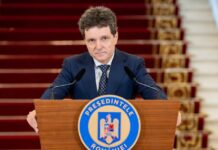



I was delighted to open this year the Economic Trends conference which the National Bank of Romania was pleased to host. We highlighted the fact that the war in the Middle East is generating severe economic volatility, as the oil market reacts quickly and sharply, with global implications. Energy shocks are transmitted, with varying degrees of intensity, and cause inflationary pressures on the global economy.
We included several key messages in our opening remarks, such as:
Romania’s energy dependence is significantly lower compared to most European states. Romania’s energy needs were covered by imports in a proportion of only 30%, a level comparable to Sweden, compared to 39% in the Czech Republic, 46% in Poland and 49% in Hungary, while the average energy dependence at the level of the European Union states amounts to 57%.
The beginning of 2026 appears to be burdened by some negative developments: industry – down 3.9% in January, but also retail turnover – down 9.1%.
The developments in 2025, however, also show good signs: the economy is gradually changing its sources of growth. The contribution of investments to economic growth of 0.7% was 1 percentage point, much higher than consumption, whose contribution was 0.4 percentage points.
We expect the annual headline inflation rate to return to a clearer downward trajectory only in the second half of the year. However, returning to target still requires time and caution in calibrating economic policies.
Monetary policy faces the essential challenge of avoiding adding “salt to the wound” by raising the benchmark interest rate, despite inflationary spikes, but also of avoiding adding “gas to the fire” in a financial context dominated by multiple risks.
It is imperative to continue fiscal consolidation, an objective that requires political stability and consistency of decision-making. Unfortunately, these requirements also seem subject to volatility, if we refer to the tense atmosphere that accompanied the approval of the budget in Parliament.
In complicated times, amid the war in the Middle East, such tensions and anxieties translate directly into financial costs, through the increase in the interest rates at which we borrow, but also through increased pressures on the exchange rate.
The budget deficit assumed by 6.2% of GDP does not include, attention!, the rising risks of the current global tensions.
The budget for 2026 provides for investment allocations of 8% of GDP, the highest level in the last 10 years. However, the full realization of the assumed investments cannot be done without increasing the administrative capacity for implementation.
Next, the full message conveyed at the opening of the Economic Trends 2026 conference, an event organized by the European Business Women’s Employers (PEFA):
“I am glad to open this year the Economic Trends conference, which we are hosting with pleasure and interest at the National Bank of Romania. I congratulate the organizers for the consistent way in which they bring together the business environment and public authorities to topical debates. I appreciate the involvement of the European Business Women’s Employers in supporting Romanian entrepreneurship, including the publication of the Entrepreneurship and Female Leadership Index, an additional argument to develop projects based on the strength of women in the economy.
Currently, the global economy is going through a period of deep adjustments, amid the crises of recent years – pandemic, war, energy crisis, geopolitical tensions. And the war in the Middle East is now generating severe rounds of economic volatility as the oil market reacts quickly and sharply, with global implications.
Research shows us that energy shocks are transmitted in the economy through multiple channels. At first, for a few weeks, shocks affect transport costs. Subsequently, within a few months, production costs and inflationary expectations are affected. But these mechanisms do not operate simultaneously or uniformly.
In the case of Romania, however, there are some elements of resilience. The latest data show that Romania’s energy dependence is significantly lower compared to countries in the region, in fact, compared to most European states. Thus, Romania’s energy needs have been covered, in recent years, by imports in a proportion of only 30%, a level comparable to Sweden, compared to 39% in the Czech Republic, 46% in Poland and 49% in Hungary, while the average energy dependence at the level of the European Union states amounts to 57%.
Another equally important indicator is energy intensity, namely the amount of energy, oil equivalent, in relation to a thousand euros of Gross Domestic Product. Romania is positioned, also from this perspective, better than the states in the region and than the Union average, also as a result of structural transformations in the Romanian economy.
We are no longer just talking about goals, but about potential and realities. Our country can be a pillar of stability in the regional energy architecture, thanks to domestic resources, including from the Black Sea area, but also through the resilience of benchmark companies in the energy field.
The conference agenda includes panels dedicated to energy and the business environment. Companies feel the volatility in the energy markets most acutely, and the business prospects show us how these developments are transmitted in the economy.
Romania continued to record economic growth in 2025, albeit at a somewhat slower pace than in previous years, but despite the severe but necessary fiscal adjustment.
The beginning of 2026 appears to be burdened by some negative developments, and I mention here the industry, down by 3.9% in January, but also the turnover in retail trade, down by 9.1%.
Certain signals about restructuring and layoffs at the level of some players in the industry, benchmark companies such as Dacia, Azomures, with outstanding performances especially in exports, recorded even in difficult and not so distant times, are really worrying.
The developments in 2025, however, also show good signs: the economy is gradually changing its sources of growth. The contribution of investments to economic growth of 0.7% was 1 percentage point, much higher than consumption, whose contribution was 0.4 points. It is important to strengthen this path, in order to accelerate the productive potential of the economy.
Rest of the speech here
