











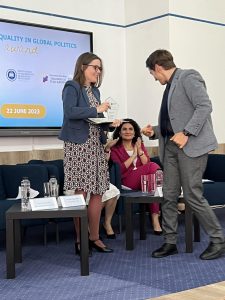
Icelandic Prime Minister Katrin Jakobsdottir on Thursday was hailed as a ‘champion of democracy’ as she received the Gender Equality Award from the prestigious Babes-Bolyai University in the Transylvanian city of Cluj.
Ms. Jakobsdottir has been an elected member of Parliament—or Althingi (the world’s oldest Parliament)—since 2007 and has chaired the Women World Leaders since 2020. She is one of eight women who head their governments in Europe.
Impressive political leader
The impressive political leader from a small island nation whose population is not substantially bigger than that of Cluj is a world leader in gender equality. Her longevity at the helm of Icelandic politics has given her punching power on the global arena which is short on long-lasting, authoritative female leaders.
“I’m not an exceptional woman; I’m just a normal woman who benefited from women who fought for rights who came before,” she says modestly in flawless English.
“It’s been inspiring to see the city and the university,” she told Universul.net at the end of her first day over dinner at the Casa Ratiu in Turda. “You see the whole spectrum… it’s multi-cultural. Being here is like being in a movie. It’s been a diverse spectrum seeing the small villages,” as well.
Her relaxed and friendly air belies a fierce intelligence and sharp political focus. Popular at home, she is known globally for her commitment to democracy, the rule of law, the climate crisis as well as gender equality.
She flew into Romania late Wednesday from Reykjavik for a two-day visit, which kicked off at the Babes-Bolyai University one of the jewels of Romanian higher education.
She was given the newly established Gender Equality Award by UBB rector, Prof. Dr. Daniel David.
Fishing industry
Iceland, which has a population of 388,000, is a member of NATO but not of the European Union which it hasn’t joined to protect its substantial fishing industry. While not a member of the 27-member bloc, it is part of the EEA and Schengen, and closely associated with the EU with access to the internal market, but not part of the agricultural and fisheries policies.
The 47-year-old describes herself a member of the “Angry Icelandic Women,” club which started when the island, a neighbor of Greenland and Norway, was first settled in the 9th century.
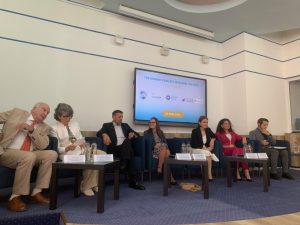
“Gender equality is about all women having the same opportunities as men,” she told hundreds of students who had turned out for the event.
Gender equality, however, doesn’t happen automatically. It needs systematic structure—laws and rules that guarantee women the same salary as men in the same job, equal rights in the workplace and representation at the highest levels of business and government, she said.
Gender equality
Iceland is achieving that, though there is still work to do. The United Nations has estimated it will “take 300 years to achieve full gender equality” in the world, she said.
Nevertheless, in Iceland, half of the seats in the 63-seat Parliament are filled by women and her Cabinet includes six men and six women ministers. Iceland has been using gender budgeting since 2015. “The key to this is policy decision.”
A progressive parental leave law gives both men and women six months parental leave, with only six weeks to share. The legislation supports women employees who potentially face discrimination in the hiring process.
“Culture followed the politics,” she said. “As a woman, I didn’t get asked ‘Are you planning to have children?” as men have the same parental leave rights. In the event, she had three sons and managed to combine her political career with raising a family.
Gender pay gap
Areas that need working on in Iceland are gender-based violence (50% of crimes in Iceland are domestic violence), the gender pay gap— and attitudes.
“We need to value jobs differently,” she said, adding that there was a silver lining in the pandemic.
“It showed us the importance of jobs done by women,” in the healthcare and teaching sectors.
But progress meets obstruction when the old ways are threatened.
“There has been a pushback. We need to push back against the pushback. Gender inequality is one of the most persistent evils of our time. Gender inequality means challenges to democracy.”
Long-term policies
Relaxed, experienced, and still young, Ms. Jakobsdottir is grateful for having a second term as prime minister.
“It takes time to turn a ship that is the state,” she says eloquently, using a fitting marine metaphor. “I was privileged to be re-elected. What the world needs is long-term policies.”
Romania and Iceland work together within the Council of Europe and NATO. Iceland was one of the founder members of the military alliance in 1949 and unusually does not have troops apart from a small coast guard.
At the forefront of gender equality, some 77.5% of women are employed, and 50% of women educated to degree level, while women occupy 35% of company board seats.
Female foreign minister
Romanian Foreign Minister Luminita Odobescu who took office a week ago is the first woman to hold the post in democratic times, and Romania’s second female foreign minister in 75 years. Soviet-backed Ana Pauker was Romanian foreign minister in 1947.
“You serve an example for all of us,” she told Ms Jakobsdottir. “Romania is committed to protecting human rights at home, in the region and worldwide.”
“Gender disparity in the political sphere will be overcome by promoting education. Gender equality is a strategic objective,” she said in English.
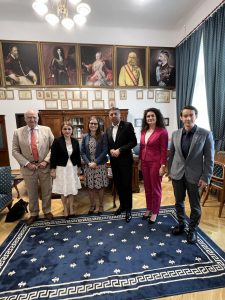
She noted that women filled 47% of managerial posts in the Romanian foreign ministry and accounted for 35% of heads of mission abroad. “Gender equality is achievable. I challenge you to dream big and to make it happen,” she told the audience.
Role model
Adviser to President Klaus Iohannis, Sandra Pralong, praised the UBB university for “finding such a role model for this award from the country who gave us the first democratically elected woman president.”
Vigdis Finnbogadottir, now 93, was president of Iceland from 1980 to 1996. Ms Jakobsdottir said “I grew up thinking it was impossible for a man to be president. “
Iceland had the first gender autonomy act and has a feminist foreign policy pushing women’s rights, representation and resources making sure women’s issues are adequately funded, Ms. Pralong said.
“Gender is about having an equal voice,” she added.
Democratic credentials
Philanthropist Nicolae Ratiu, the younger son of Ion Ratiu, who promoted Romanian democracy while living as an exile in London during the dark years of communism and went on to be a presidential candidate in 1990, praised Iceland’s democratic credentials.
“For 14 years Iceland has been top of Transparency International’s index for gender equality. That’s all of the prime minister’s mandate and many more,” he added.
He noted his own family’s contribution to the cause. Emilia Ratiu was a champion of women’s rights in Transylvania at the end of the 19th century, and his mother, Elizabeth Ratiu” achieved more concrete differences that he (Ion Ratiu) did in the 1990s” with her Leukemia Aid which brought medicine and equipment to Romania.
Impressed by her leadership and policies, the Ratiu Forum invited Ms Jakobsdottir to visit Romania last year and hosted her during her visit.
Societies still associate characteristics typically attributed to men—competition, zero sum gain, and ambition—with people in leadership roles.
Smiling
“I’ve been criticized for being too soft, too nice and smiling too much,“ the prime minister said.
“But what can be harder than fighting for gender rights and the healthcare of mankind?”
EXCLUSIVE | China’s ‘bromance’ with Russia will be hard to give up-LSE professor Christopher Coker
