










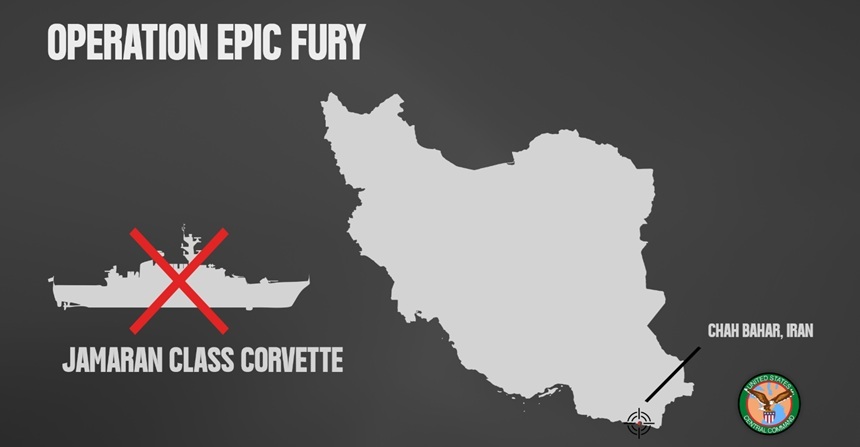
The military, intelligence and technological power of the US shone again, with a new war against Iran: the bombings were overwhelming, the intelligence was high-class, and the decapitation of the tyrannical regime in Tehran was spectacular in terms of precision, speed and scale.
Likewise, the ability of security analysts in the US to assess the degree of risk of the strikes was also at the high levels: in just 24 hours after Donald Trump had warned his fellow citizens about the possibility of the loss of life of IS military, the Pentagon confirmed the first deaths and the wounded in its own ranks.
The operation ordered by Trump on February 28 is one of enormous complexity, given the fact that the enemy, Iran is a country of great size, with a harsh terrain, highly populated and extremely militarized.
And from the perspective of American planners, the degree of complexity of the operation increased as the strikes were delivered exclusively by air as the Trump administration was not prepared to assume the extreme political costs of an extended adventure on the ground (easy to understand, in the light of US precedents in other theaters, in the last quarter of a century).
As in any war, however, the problem with the transition from planning to execution lies in the management of the variables that can arise during the operation. Excellent planning can reduce their number and importance, but it cannot reduce them to zero.
Such problems tend to increase when operations take longer.
At this point, it is not clear how willing the Trump administration is to continue the fight or how much the regime in Tehran can continue it. The regime is obviously weakened both in terms of the decision-making chain, as well as its military infrastructure after the first two days of strikes.
At the same time, it is hard to predict the number of potential victims in the ranks of the American military, as calculated by the American generals, and what number the US president is willing to bear, from a political perspective.
Of course, these are blind spots that significantly undermine the quality of outside analysis. But at the same time, there are elements that help in formulating a conclusion: although the US strike force has secured a generous level of control over the terrain, from a military and intelligence point of view, it does not offer the president the same comfort in terms of his control on the political terrain.
Donald Trump has been frank by informing the American public that there will probably be loss of life among the American military, but that doesn’t mean that the American public has, from the president’s perspective, a high level of tolerance for this type of loss.
Polls that have so far measured the mood of the US population about this are not encouraging. As for Trump, natural concerns should also arise because of the profoundly peaceful and deeply critical platform of his predecessors, from which he ran in the race for the White House.
As far as the American public is concerned, the level of tolerance it has towards the loss of life on the battlefield depends on numerous factors: from ideology, to the vision of America’s role in the world, through its fanaticism in relation to Donald Trump, and how it views the ongoing military operation.
The last element – the perception of the president’s objective – is probably the easiest to analyze, while the other components require new measurements and in-depth sociological analysis.
Theoretically, the president’s objective itself should be easy to decipher because it is supposed to be clearly defined by the commander-in-chief.
But in the case of Trump and the case of Iran, there isn’t clarity.
For its objective seems to be variable:
- When Iran’s nuclear program is destroyed (although last June, Trump had announced that he had destroyed it).
- When the imminent threat of Iran’s missiles and nuclear program is removed (although after the June 12 strikes, at least the imminence had been removed).
- When there is regime change (but without ground troops, no one has managed to do that).
- When creating conditions for the Iranians to change the regime (but if so, why didn’t Trump do this in January, when the population was on the streets, and Trump himself had told them “help is on the way”?)
- When there are new negotiations and a new agreement (But how? Trump ordered the bombings during the negotiations. In addition, he also spoke of regime change, so with whom could he reach an agreement? Then, if the Iranian regime is willing to conclude a total de-nuclearization agreement, what would that mean? That Trump will leave the regime alone, as per the agreement as well as leaving the population the regime oppresses in the hands of the regime?).
In the context of this complex military operation, Donald Trump’s vulnerability is obvious looking at a few simple questions: What did you watch? Why did you choose this path?
The existence of any doubts or suspicions about the objective and how to achieve it carries a high risk of negatively influencing the public’s willingness to accept the loss of life in their own camp.
The fact that three US servicemen were declared dead in the first 24 hours of the war, and others were confirmed as wounded, will weigh heavily on Donald Trump’s ability to emerge politically intact from this whole adventure that has ignited not only Iran, but the entire Middle East (already a historic powder keg).
As the U.S.-Israeli operation progresses, even if the Iranian regime suffers heavier losses, the alarm will sound increasingly disturbing in Washington as well.
There are already solid premises in this regard, and new ones can be added every day.
It can’t be excluded that Trump will panic prematurely due to US casualties.
It may not be by chance that on Sunday, when the first deaths and injured were confirmed that the president announced that the regime in Tehran had announced that it wanted to negotiate.
- PS: From the perspective of the regime change that Donald Trump envisages in Iran, the afflicted population must know they are dealing with a charlatan. There are at least four reasons: 1. He deceived their expectations once, in January – some Iranians paid with their lives, because they took him at his word that he would help them immediately and exposed themselves to the repression of the criminal regime. 2.Trump has consistently said he is ready for an agreement with the regime, without clarifying whether this means abandoning the population’s aspirations for the collapse of the regime. 3. Venezuelans, no less thirsty for freedom, are witnessing today sordid relationship between the Trump administration and the Maduro regime, with only Nicolas out of the picture. 4. Trump has been pressuring Ukrainians to surrender to Russia and end up in the hands of the Russian tyrant. And Russia – what irony! – is an essential ally of the tyrannical regime that is making Iranians miserable.
