







Universul.net is publishing a personal account written by former Romanian President Emil Constantinescu on his meetings with former U.S. President Jimmy Carter whose funeral was held in Washington on Thursday.
Mr. Constantinescu who was president from 1996 to 2000 broke his silence to speak about the 39th president of the United States died on Sunday aged 100. His death spurred an outpouring of tributes from state leaders.
In a 3,000-word essay he said he had decided to speak out about Mr. Carter as a role model because “we live in a time when the authoritarian model of the president prevails over the democratic one., not only dictatorial regimes or showcase democracies, but even in consolidated democracies such as the United States (so) I decided to abandon non-involvement in domestic politics, a position I have held over two decades.”
“After the 1992 presidential election, when I made it to the second round and was designated the sole candidate of the Democratic opposition for the next election, I was often asked abroad what my model as a Democratic president was. I answered without hesitation: Jimmy Carter, thanks to his moral status before his presidency, during his term of office and, especially, after it ended.
In Romania, no one asked me this question, and the elections before and after those of 1996 showed quite clearly that, in fact, the majority often voted for people who were presented to them precisely because they could be blackmailed and then elected them knowingly. There are also enough presidents who do not need a benchmark, considering themselves as a model for others.
Since we live in a time when the authoritarian model of the president prevails over the democratic one, not only in dictatorial regimes or showcase democracies, but even in consolidated democracies such as the United States, I decided to abandon non-involvement in domestic politics, a position I have held for over two decades, and to use the brief emotional impact generated by President Carter’s funeral to evoke why? And since when? He became for me the model of a democratic president, guided all his life by moral principles or the national interest, and not by personal political or financial goals.
The first impulse came in 1991, when I was a visiting professor of mineralogy at Duke University. I was, like any intellectual in Eastern Europe, a fan of the Republican Party and David Funderburk, a Republican eagle, and former American ambassador to Ceausescu’s Romania, had just visited me when I received an invitation from Zbigniew Brzeziński, professor at the School of Advanced International Studies at Johns Hopkins University in Washington, to the anniversary of the former Institute of Soviet Studies, newly established as the Center for Strategic and International Studies.
He had been President Carter’s National Security Adviser, a position often considered more important than President Carter’s vice president or secretary of state in making international policy decisions, from 1977 to 1981. Along with Henry Kissinger, whom I met at Harvard, Richard Nixon’s secretary of state, he is considered the main strategist of American politics. In 1989 he had predicted in his book, “The Great Failure”, the birth and death of communism in the twentieth century, the dissolution of the USSR and the repercussions worldwide. Now, when former communist propagandists flooded the internet with Carter’s laudatory speech at Ceausescu’s 1975 visit to the White House, I remember how he explained to me the political context of the Cold War and the considerations that underpinned the use of the President of Romania in the interest of American global politics and his subsequent rejection when he became the last Stalinist-type communist dictator during the Gorbachev era.
As a Pole born in Warsaw, Zbigniew Brzeziński was interested in what direction Romania would take. I kept in touch over the years and he gave me a lot of good advice. First of all, regarding Romania’s relationship with Poland, to constitute a dam for a future expansion of Russia to the West. Then the suggestion of a trilateral Poland – Romania – Ukraine, for which he congratulated me, when I launched it in Bucharest together with Presidents Kwaśniewski and Kucima. In 1998, he offered me his book published that year The Grand Chessboard: American Primacy and its Geostrategic Imperatives, with a beautiful dedication of success on Romania’s way to the European Union and NATO.
In 1997, in the first year of my mandate, I had followed his advice to keep the relationship with China following Carter’s model and to initiate relations with Turkey with the newly independent countries of Central Asia, to which he had dedicated two chapters of his book “The Eurasia Chessboard” and “The Eurasian Balkans”.
After I launched, together with Shevardnadze, Demirel and Aliyev the project “Revival of the Silk Road”, he invited me to present it at Georgetown University in Washington in the presence of the former national security advisers of the last presidents, after I had committed myself to ensuring the presence of the presidents of Central Asia. I received congratulations from Carter for the event.
A man of religious beliefs, leader of a superpower
In 1997, five months into my term, I received in Cotroceni, at his request, Peter Bourne, President Carter’s special adviser to the White House, anthropologist and physician, professor of psychiatry. He had come to give me his book Jimmy Carter: A Comprehensive Biography from Plains to Post-Presidency, accompanied by a warm dedication: “To President Emil Constantinescu. I hope this story of president Carter will help to inspire you as you work to create democracy. With best wishes.” I read and reread it very carefully and it inspired me in the decisions I made in the last three decades. We have recently digitized it, in order to be available to those interested.
After my mandate ended, when I had the opportunity of forming a close personal relationship, I knew almost everything about him and I think that in the current conjuncture it would be useful for many Romanians to know the route of his life for a century. The rapprochement occurred in the last 17 years, within the “Habitat for Humanity” project, sponsored by Jimmy Carter, which attracted me not only by its noble purpose, building houses for the needy or victims of natural disasters, but, above all, by its philosophy. Only those who have a job and pay a minor, symbolic contribution over the years, but also work alongside volunteers in the construction of houses sponsored by the Foundation and furnished with everything necessary for a new start in life, qualify for this aid.
As an elected member of the steering committee, I attended construction sites in countries on all continents, including Romania and the U.S., and the annual meetings in Atlanta and Americus, which usually coincided with President Carter’s birthday. One of the most significant was his participation in the “Jimmy & Rosalynn Carter Work Project 2008”, held in Pascagoula, Biloxi and Gulf Port, to help families affected by Hurricane Katrina. 108 homes affected by the hurricane were erected and rehabilitated by volunteers in just five days. At one of the houses built for a black widow, I worked for five days with Jimmy Carter and his wife, Rosalynn, and at the President’s dinner at the end, I had the honor of giving the keynote address.
Romania was the only country in the world, outside the USA, that participated with volunteers and money offered by OMV Bucharest. It was a dignified response to the actions financed by the American Foundation, with the participation of American volunteers, in Romania, in Rădăuți, Băltești, Băiceș, Oarja.
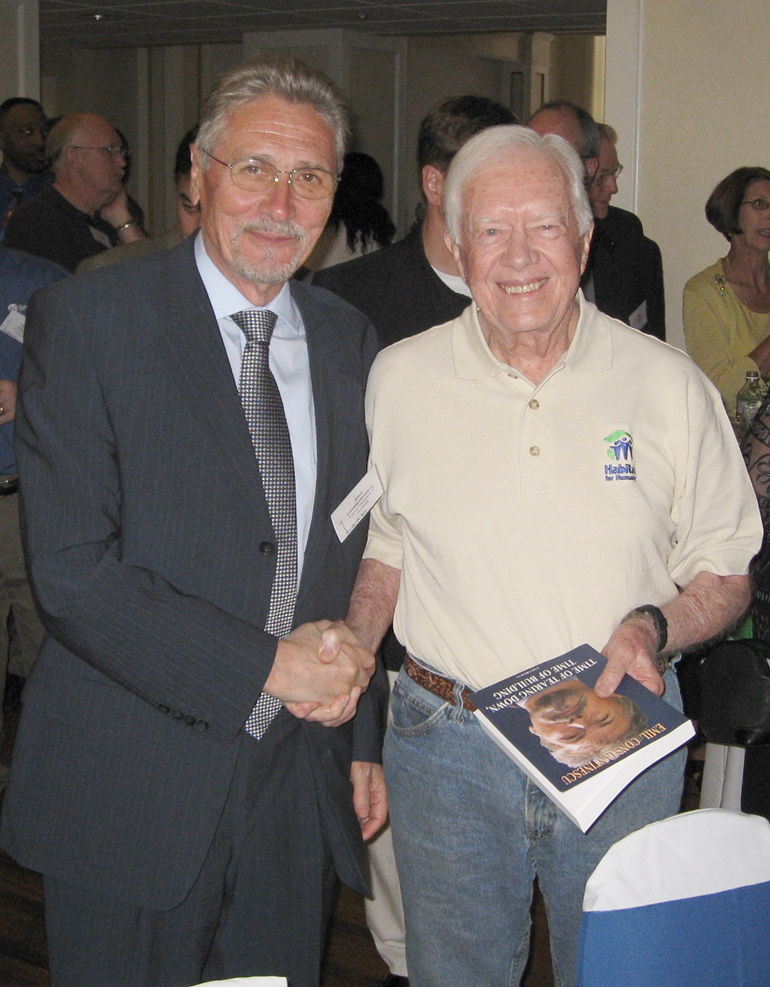
In 2009, President Carter gave me his 20th book, Our Endangered Values, a meditation on a rare situation in which a man of religious beliefs became a holder of a world superpower. A year later, I had the opportunity to offer him on his birthday, celebrated in the Dominican Republic, the English version of my memoir, “The Time of Demolition, the Time of Building”, in which he found shared personal convictions.
In December 2013, we met again in Johannesburg at the funeral of South African President Nelson Mandela, a man who, after a long period of life in prison, was a president of interracial reconciliation. In July 2017, at the fifth World Justice Forum, where I was a founder and board member, I received, along with Jimmy Carter and former President of Ireland, Mary Robinson, the titles of Honorary Chairs of the World Justice Project Foundation. I cannot conclude this review of a long cooperation without mentioning the pivotal role that his wife Rosalynn, with whom he shared a marriage of 77 years, played in President Carter’s life.
Jimmy Carter, surprisingly well informed about developments in Romania
I found that both Jimmy Carter and his wife were surprisingly well informed about developments in Romania, and a recurring question was: how could we build a democratic society, moving towards Euro-Atlantic integration as the 3rd president (American terminology), after the former had been sentenced to death and executed for the murder of participants in a peaceful anti-communist uprising and the latter was being investigated for crimes against humanity? They were somewhat obsessed with the relationship with the Ceausescu family.
In October 2011, I had the opportunity to talk, for several days, at length, in Tunis, with Rosalynn Carter, included in a delegation of the National Democratic Institute for the Supervision of the First Free Elections in Tunisia, which marked the beginning of the Arab Spring after the revolt against the dictator Bourguiba. The delegation, led by a US governor, was initially rejected by the interim prime minister on the grounds that, after they had been a French colony, they would not be interpreted as wanting to become an American colony. When I was asked to become co-president, the delegation was accepted and received by the Prime Minister, precisely because of the close relationship between Bourguiba and Ceaușescu, and the good reputation of the Romanian specialists who had worked in Tunisia following the agreement signed by them, and of many former Tunisian students trained in Romanian universities, some of whom even had diplomas signed by me. as rector.
The first question Rosalynn asked me was: how is my wife? In 1997, my wife, who had continued her legal career at the Ministry of Justice and the European Commission for Human Rights since 1991, had received a personal invitation to a conference organized by Rosalynn Carter. We decided, together, not to participate, precisely because it was too early for the position of First Lady after Elena Ceausescu’s visit to Washington during the Carter administration, and we understand, now, that she would have liked to make a comparison.
At the end of this confession, what are the lessons we can learn from President Carter’s long life experience? I want to add, first of all, that I was not the only one who chose him as a model of moral president. As one of the few survivors of the first democratic presidents of the former communist dictatorships of Central and Eastern Europe, who formed a real family in the last decade of the twentieth century, I recall that we often evoked the figure of President Carter in our private meetings, first of all, because he was somewhat similar to us. He was the author of dozens of books, memoirs, novels, poems, political and economic studies, but also travel books, being also passionate about painting. He was a full professor at Emory University in Atlanta, with a teaching career that began with Sunday school classes at the Baptist Church and continued for 37 years, until 2019.
For those who have forgotten or do not know, I remind you that the first democratic presidents of the former communist countries of Central and Eastern Europe came from the academic elite: the President of the Czech Republic, Vacłav Havel – writer; the President of Hungary, Arpad Göntz – President of the Writers’ Union; President of Bulgaria, Jelio Jelev – professor of philosophy at Sofia University; President of Lithuania, Vytautas Landsbergis – rector of the Vilnius University of Music; the President of Estonia, Lennart Meri – playwright, director and rector; President of Belarus Stanislav Shushkevich – scientist in nuclear physics; President of Armenia Levon Ter-Petrosian – writer; President of Slovakia, Ivan Gašparovič – jurist and co-author of the Slovak Constitution; the President of Croatia, Stjepan Mesić – jurist; President of Albania, Sali Berisha – cardiologist; President of Latvia, Vaira Vīķe-Freiberga – psychologist, professor at the University of Montreal. I would also like to mention the group of distinguished intellectuals around Polish President Lech Wałęsa.
We shared common beliefs and values. We were not interested in perpetuating the presidential office. Most of us served a single term, paid the price for painful political, social, and economic reforms, and faced difficult events during our terms, like President Carter. Another similarity between us is the fact that none of us were interested in material benefits. We left behind libraries and non-profit foundations, modeled after the Carter Center.
Authoritarian and populist and often corrupt leaders vs. honest leaders dedicated to the public good
Beyond these personal affinities, which made us appreciate him, perhaps, more than his fellow citizens, what could they learn from the legacy left by Jimmy Carter to posterity and what it must be known and analyzed, in this period of crisis of democracy worldwide, marked by the rift created between Western civilization and the European culture that was its basis and by the replacement of a society based on humanist ideals with a society based on interests And profit, the first question we need to answer is why do people currently prefer authoritarian and populist and often corrupt leaders to honest leaders dedicated to the public good?
The first answer is offered by the life of Jimmy Carter himself, spanning 100 years, of which only four were president, with the conclusion that it is no misfortune to be “former president”; It is serious to be a “former citizen”, with the consequence that the problem of today’s democracies is not only the poor quality of the leaders, but the poor quality of a majority of citizens who elect them in their image and likeness, and not for their intellectual and moral superiority. It becomes obvious that it is also a result of the welfare status, and that difficult times create strong people, and easy times, weak people.
History lived personally can give an image of the history of peoples. Jimmy Carter’s life spanned the great global economic crisis of the 1930s, the tragedy of World War II, racial segregation in the United States, but also his first failures as an entrepreneurial farmer. His destiny was shaped by the choice of difficult paths, undergraduate courses in engineering at an institute of technology.
In 1943, in the midst of World War, Carter enrolled in the Naval Academy to prepare for a military career. After graduation, he remained an officer on a ship tasked with a war patrol on the west coast of the Pacific. Later, it entered the American nuclear submarine program.
In 1952 when an accident caused the basement of the nuclear reactor building to flood millions of liters of radioactive water, Carter led a crew tasked with shutting down the reactor. He descended individually with protective equipment exposing himself to radioactivity to disassemble the paralyzed reactor. As I said before at today’s meetings with young people, courage can only be talked about in the past tense and only about the risks you have personally faced. Empathy is limited to what you’ve experienced, not what you imagine. I know this because, although I am 15 years younger than Carter, I experienced first-hand, as a child, the war with the dead and wounded, the refuge in Bessarabia from the Soviet army, my grandparents’ house in Ploiesti destroyed by the bombings of the American air force, the occupation of the Red Army, the drought and famine after the war, the polio pandemic, the terror of the communist dictatorship in the ’50s with the arrest of family members, the suspicions and betrayals, the cold and shortages of the last period of the dictatorship, the death, wounding and torture of people close to them during the days of the popular uprising in December 1989, but also the aggression of the mineriads in 1990. All this prepared those of my generation, as well as those of Jimmy Carter’s generation, to face the vicissitudes that followed.
Jimmy Carter’s life marks the evolution from an individual, to a personality endowed with beliefs and beliefs, capable of transmitting them to those around them, to a historical figure who can make decisions that influence the life of his nation and the world as a whole.
His self-confidence and tenacity gradually led him to build a political career as a senator and then governor of the state of Georgia until he was a candidate and then president of the United States. Carter’s term was marked by a bad economic situation, inflation, severe recession, an energy crisis with oil shortages, and job losses. Despite this, Carter initiated and led health care reform in the U.S., but also created the State Department of Education. Internationally, he responded to the Soviet army’s invasion of Afghanistan, mediated the Camp David accords between Israel and Palestine, and promoted closer relations with the People’s Republic of China by establishing diplomatic relations with it in 1979, which produced an explosion of trade between the United States and a China that was implementing economic reforms under the leadership of Deng Xiaoping.
Jimmy Carter will also go down in history by signing the SALT 2 treaty with the Soviet Union, during the Cold War, to limit nuclear weapons. Due to his diplomatic, humanitarian and cultural achievements, crowned in 2002 with the Nobel Peace Prize, he was appreciated more for his post-presidential work.
I think that, with the passage of time, his presidential mandate will be reevaluated more positively. I was impressed by two attitudes of the former American president: the refusal to develop the neutron bomb for reasons of religious conscience, and his determination not to hide from the American people the failure of the operation to rescue American hostages in Iran, from which eight soldiers died by the collision of two American planes, with a major effect in collapsing his chances of being re-elected for a new term.
When I was born, Hitler and Stalin, two great criminals of modern history, were still in power, adulated by their peoples. Since then, dozens of dictators have ended up being assassinated, their statues demolished, and their graves desecrated. Why, perhaps, do other leaders who follow this path always find supporters? As far as understanding the character of dictators is concerned, I remembered a meeting I had with Eduard Shevardnadze, the architect of the end of the Cold War, who told me that he had met Ceausescu many times and that he always avoided his gaze in face-to-face conversations. Like other dictators, he did not tremble in the face of death. I understood that the only thing they are afraid to look in the face is the Truth; the truth about them, about the world around them, and about the ruthless future of the grandiose posterity they worked so hard to build during their lifetime, for eternity.
From Jimmy Carter I remembered the warm look and the bright smile of a man at peace with himself. This, in these troubled times, is also the message he left to those who will come: the respect we owe to those who dedicated their lives to the service of truth, justice and good understanding among people.”
