













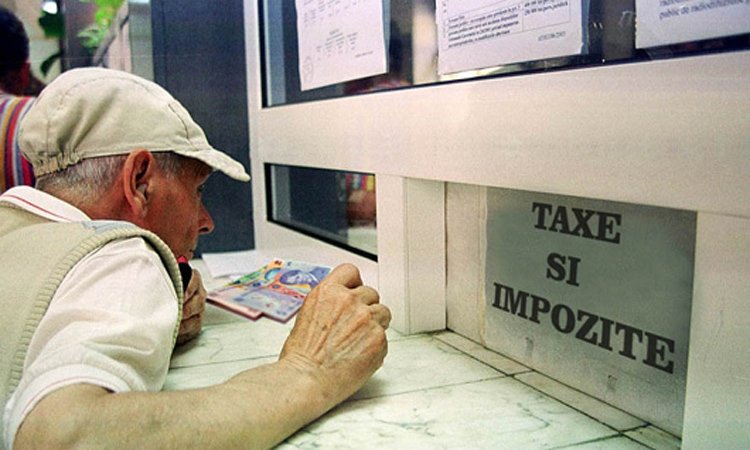
From January 1, 2026, taxes in Romania increase for both individuals and companies, as a result of recent austerity measures.
Most saliently, Romanians will pay property taxes up to three times higher on homes and land.
Car taxes also rise and apply even to fully electric vehicles, which have so far been exempt.
Below are the precise details.
Property taxes for individuals will be raised under the Local Tax Law. Even for apartments in buildings older than 30 or 50 years, the tax may triple. Currently, older homes benefit from lower taxation.
The taxable value will continue to be calculated by local authorities, but based on a benchmark indexed to inflation.
The tax rate is selected by local administrations within a range provided by the Fiscal Code.
Under the new regulations, city halls are no longer allowed to adopt a lower tax rate than the one applied in the previous year.
“In 2016, the base value was 1,000 lei per square meter. Starting in 2026, it will be 2,677 lei per square meter. Local authorities choose a tax rate within the range of 0.08% to 0.2%. However, the new legislation no longer allows the adoption of lower rates than those used the previous year. As a result, the increase in the taxable base will automatically lead to higher taxes,” explained Adrian Vascu, founder of Veridio.
The taxable base will increase for both new homes and apartments in buildings older than 30 or 50 years, which previously benefited from reduced taxable values. This applies in particular to apartments in buildings with more than three floors and more than eight units, where taxes were lower.
“Under the previous version of the Fiscal Code, reductions applied to the taxable value of buildings older than 30 or 50 years. By eliminating these reductions, the taxable value of an apartment becomes the same regardless of its age. For non-residential buildings owned by individuals, the system of determining taxable values through valuation reports remains in place,” Vascu explained.
How much will owners of an apartment less than 30 years old, in a building with fewer than three floors and fewer than eight apartments, pay starting January 1, 2026? For this category, tax will increase by about 1.8 times. In practice, the owner multiplies the tax paid this year—say, 170 lei—by 1.8, resulting in a new tax of 306 lei.
For the same apartment in a building over 30 years old, with more than three floors and more than eight apartments, the tax will increase by approximately 2.3 times, reaching 391 lei.
For apartments older than 50 years, the tax may triple. In this case, the owner will have to pay a tax of 510 lei in 2026.
Also starting January 1, 2026, the taxation of income from accommodation services and short-term rentals of personal homes via Airbnb and Booking changes.
For income obtained from short-term rental of 1–7 rooms, net income is calculated by deducting a flat-rate expense of 30% from gross income, with a 10% tax applied to the resulting net income.
Income from short-term rental of 1–7 rooms must be declared through the Single Tax Statement, and the annual tax is determined by the taxpayer based on actual income received. If the number of rooms rented exceeds seven, the income is no longer classified as “short-term rental” but as income from independent activities, subject to real accounting (simplified bookkeeping).
Thus, net income is determined by deducting a flat-rate expense (30% for short-term rental of 1–7 rooms) from gross income. It is important to note that gross income does not include the platform’s commission, but only the amount actually received from the platform. For example, if you received 100,000 lei from Booking in one year, you deduct 30,000 lei as flat-rate expenses, and the 10% income tax applies to the remaining 70,000 lei, resulting in a tax of 7,000 lei.
Flat-rate expenses represent costs incurred by the owner for property maintenance, such as cleaning after guests or various repairs. These expenses do not need to be validated by the tax authority (ANAF).
In most cases, car taxes will rise by several dozen lei. Fully electric vehicles, previously exempt, will now also be taxed. Taxes on hybrid vehicles will increase significantly, exceeding 1,000 lei for many models, informs HotNews.ro.
For the most popular car models, where annual tax was around 40–70 lei, it will increase to approximately 80–150 lei. For cars with larger engine capacities, taxes will rise from 170–180 lei to over 250 lei.
For a car with an engine between 1.6 and 2.0 liters and an emissions standard between Non-Euro and Euro 3, the tax will range from 237 to 297 lei. For the same engine with a Euro 4 emissions standard, the tax will range from 228 to 285 lei.
Previously, car taxes were based solely on engine displacement. Starting in 2026, emissions standards will also be taken into account, under the “polluter pays” principle. The year of manufacture does not bear any weight.
Six engine capacity brackets are defined, and the tax is calculated by multiplying a fixed amount for each bracket by a standard unit of 200 cc. This fixed amount varies depending on the emissions standard.
Local councils may set levels different from the national base, so tax values may vary by county.
Unfortunately, electric vehicles will no longer be exempt from taxation; a fixed tax of 40 lei per year will apply.
Starting in 2026, taxes on hybrid vehicles will increase substantially. Shortly before Christmas, the government amended part of the tax calculation table to clarify the amounts owed by hybrid vehicle owners.
For a Euro 6 hybrid with a 2.5-liter engine, the tax will be 972 lei; for the same engine with a Euro 4 standard, the tax will be 1,107 lei. For Euro 6 hybrids with a 1.5-liter engine, the tax will be 130 lei, while for a much larger 3.0-liter engine it will exceed 2,200 lei.
City halls will be able to grant a maximum reduction of 30% for hybrid vehicles, compared with up to 95% previously.
For gasoline cars with Euro 6 standards, taxes will increase by several dozen lei. For example, for a 1.0-liter engine, the tax will rise from 50 to 80 lei; for a 1.5-liter engine, from 80 to 132 lei. For 2.0-liter engines, the tax will be 251 lei (Euro 6).
Starting January 1, 2026, income from capital gains on financial instruments (shares, bonds) will be taxed at 3%, up from 1%, if held for more than 365 days, or at 7%, up from 3%, if held for less than 365 days. This taxation applies only to financial instruments traded through authorized intermediaries—stock exchanges and investment firms.
The withholding-at-source rule remains in place, with authorized intermediaries responsible for calculating, withholding, and paying the tax to the state.
If you trade through non-resident brokers (foreign platforms), you must declare gains (and losses) in the Single Tax Statement and pay the tax in Romania.
Also starting January 1, 2026, the tax on gains from cryptocurrency transactions will increase from 10% to 16%, applied to the difference between the sale price and purchase price.
Gains under 200 lei are not taxable, provided the total annual amount does not exceed 600 lei.
From 2026, crypto platforms will also be required to report user data to ANAF to facilitate tax enforcement.
Moreover, special tax on high-value buildings and cars will triple. This applies to residential buildings with a taxable value exceeding 2.5 million lei owned by individuals, and to cars with a purchase value over 375,000 lei owned by individuals or legal entities.
The “luxury tax” will be paid as follows:
- By individuals owning residential buildings with a taxable value exceeding 2,500,000 lei; the tax base is the amount exceeding this threshold.
- By individuals or companies owning cars with a purchase cost exceeding 375,000 lei; the tax base is the amount exceeding this threshold.
In other news, parcels valued under €150 arriving from outside the EU (from China or Turkey—from retailers like Temu, Shein, or Trendyol) will be subject to a fixed tax of 25 lei.
The flat 25 lei tax on all non-EU parcels under €150 is part of the government’s second package of measures, approved by Parliament in November.
So, is this outrageous?
Well, it’s certainly jarring for the common citizen. Households are hit at once with a severe cascade of measures, at a time when cost of living is very high in Romania. The simultaneous nature of these measures feels like a punishment.
Meanwhile, the government sees it as aligning taxable values with inflation and market reality.
Who is hit the hardest? Not high earners: pensioners or middle-class family, who live in the old blocks. Very many families in Romania live in apartments in communist blocks, which require costly maintenance. Unfortunately, this large group of the demographic cannot easily relocate, and the tax increase is not related to actual income. High income individuals are actually least affected, because tax increases are a smaller share of income, and they also happen to be owners of newer real estate.
As for electric of hybrid owners, the policy is just no longer credible.
