







As with most “revolutions,” change won’t come from the streets alone but when parts of the military break with the Islamic Republic
The central fact about regime change is simpler than often thought: in most “revolutions,” it is the military that decides the outcome. Crowds matter – they provide energy, legitimacy, theater, and courage. But regimes fall, more often than not, when the security establishment concludes that the leadership or the structure at the top has become a danger to the state and to them personally.
We persist in the uplifting mythology of the people rising and tyrants falling because it feels morally right and historically tidy — and many people around the world hope that this will soon happen in Iran. Nationwide protests there are now in their tenth day, with demonstrations spreading from Tehran’s Grand Bazaar to dozens of cities across most provinces. They began in late December 2025 over a collapsing economy, soaring inflation, and the plunging value of the rial, and have since widened into broader anger at the political system. Human rights groups report that at least 35 to 36 people have been killed by security forces and more than a thousand have been arrested, as authorities deploy live ammunition, tear gas, and mass detentions in an effort to contain the unrest.
And this violence is basically the key. The reality is that, especially in societies structured not on legitimacy but power, the people with guns decide. And the main decision is whether to continue firing on crowds.
Once that lens is in place, events that are typically thought of as popular uprisings acquire a dramatically different hue. Let’s take a deep dive into two historic convulsions, each very different from each other and from Iran, that are nonetheless similar in a fundamental, crucial way.
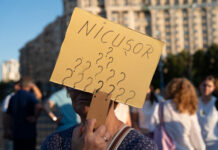
Consider Romania in 1989, long held up as a quintessential revolution from below. The images remain indelible: Nicolae Ceausescu addressing a crowd that suddenly breaks from choreographed applause into dissent; the dictator whisked away by helicopter; the execution with his wife on Christmas Day; the crowds surging across Bucharest as symbols of communism were pulled down.
Yet what actually ended the regime was the army’s decision not to keep shooting. Senior commanders recognized that the Soviet Union was no longer prepared to bail out hardline rulers, that the protests had crossed a threshold beyond repression without catastrophic consequences, and that their personal survival lay in joining rather than crushing the revolt. Once the military stopped obeying Ceausescu, the rest followed. The “revolution” preserved much of the underlying state and many of its elites; what it definitively removed was the man at the top – as well as the stale “communist” branding and bric-a-brac around him. The story was of popular liberation. The instrument was, in essence, a military coup unfolding under revolutionary banners.
Egypt in 2011 followed the same essence, even if the scenery was different. Tahrir Square became a global symbol of youthful hope; the chants still echo in memory. But the pivotal moment did not occur there. It happened inside the Supreme Council of the Armed Forces, where generals confronted a simple institutional question: Was Hosni Mubarak now more dangerous to the continuity of the state — and to their vast political and economic interests — than removing him would be? They decided he was.
Mubarak’s departure was framed as the consummation of a popular uprising, and in an important sense it was, but only because the military permitted it and then choreographed what followed. The army did not dissolve itself or surrender its central role. It managed the transition in its own image (and, of course, two years later just seized power altogether). Again, the plot was revolution; the engine was elite decision-making within the coercive organs of the state.
If one carries that understanding forward, Iran’s situation comes into sharper focus. We are often invited to think about change in Iran in maximalist terms: either a sweeping popular revolution somehow replicates 1979 in reverse, or the regime grinds along indefinitely, increasingly repressive, increasingly brittle, yet indefinitely durable. But the Romanian-Egyptian pattern suggests something else: a moment in which stress accumulates, legitimacy frays, the costs of maintaining the status quo rise, and elements within the state decide that the survival of Iran requires altering the character of the Islamic Republic itself.
In this unusually volatile context, even Trump’s otherwise reckless-sounding claim that the United States is “locked and loaded” to protect the Iranian people takes on a sharper strategic meaning — as does Washington’s brazen, legally dubious weekend move against Nicolás Maduro in Venezuela.
Both gestures belong to a long and deeply compromised tradition of American regime-change signaling. But here, their immediate function is narrower and more surgical: they are not aimed at Tehran’s streets so much as at Tehran’s barracks. In different ways, both are designed to move the Iranian military’s internal risk equation — to make continued loyalty to the Islamic Republic feel more dangerous than breaking ranks from it. And indeed, they may be very useful in influencing risk calculations within Iran’s military.
And there, one finds a complex and confounding structure. Iran is not held together by one coercive institution but by two, and that duality is the system’s most important vulnerability. On one side stands the Islamic Revolutionary Guard Corps, the ideological core of the regime, deeply intertwined with the economy and charged with defending the revolution as a project. On the other side stands the Artesh, the national army, older than the Islamic Republic and rooted less in clerical ideology than in a traditional ethos of state defense. For decades the arrangement has been that the Artesh stays politically quiescent, and the IRGC handles internal repression. So long as that bargain holds, protest movements crash into a wall.
If elements of the Artesh stop honoring that bargain, everything could change quickly. Up to now, the security forces have faced unarmed civilians. Were parts of the national army to signal unwillingness to suppress dissent — let alone side with it — the regime would confront a rival armed institution rather than merely crowds. For the IRGC that would be an existential dilemma. Its legal protections, economic empire, patronage network and ideological claim all depend on the current order. In a rupture Iran would enter a dangerous period of rival commands, defections, split loyalties in provincial units, and grave uncertainty.
From such a moment, several paths are conceivable. One is a harsher IRGC-dominated junta that wins the internal showdown and rules more nakedly than before. Another is a negotiated transition enforced in part by the Artesh — untidy, fragile, but opening space for political change. A third is a multi-sided conflict that risks drawing in regional actors – perhaps also from the West – fragmenting the state. If the regular army leans toward the street early enough, before militias splinter and foreign intervention accelerates, it could tilt events toward negotiation rather than prolonged chaos.
Past protests in Iran did not topple the regime, but they punctured its ability to spread fear. Repeated demonstrations and strikes have etched dissent into daily life.
Officers in the Artesh command conscripts drawn from the same families enduring the economic collapse. The ideological fervor of the early revolutionary period no longer binds a younger generation that has known mostly global economic sanctions, isolation and thwarted ambition. Reports abound of quiet dissent — officers complaining of unpaid wages, families of security personnel joining breadlines — even as the regime insists on unity. Whether these rumblings cohere into a break is unknowable, but that they exist is telling.
There is also a deeper, more personal institutional memory at work. In April 1979, months after the Shah fled and Ayatollah Ruhollah Khomeini returned from exile, a referendum — hastily organized and crudely manipulated — announced that 99 percent of Iranians had chosen clerical rule. It was the armed forces that possessed the means to slow that process, to demand a genuine constitutional transition, or even simply to insist that choices about Iran’s future not be reduced to a single theocratic option under revolutionary pressure. Instead, exhausted and fearful of civil war, the generals stood aside in the name of stability.
They assumed Khomeini would serve as a temporary moral figurehead rather than the architect of a durable theocracy. It was a catastrophic miscalculation that has cost countless lives around the region.
The new regime purged senior officers, constructed parallel ideological forces, and permanently subordinated the traditional military to clerical power. In doing so, it locked Iran into a political structure that has since impoverished the country and isolated it internationally. The Islamic Republic has not only oppressed the Iranian public but attempted to spread jihadism around the region by funding, training and arming militias that have brought chaos to Iran, Yemen, Syria and Lebanon – and unspeakable tragedy to the Israeli-Palestinian arena.
It has also provoked the West by pursuing nuclear weapons while misleading UN inspectors and machinating endless negotiations. This culminated in a 12-day Israeli assault last June in which Iran’s air defenses were rendered impotent and its nuclear and ballistic missile program dramatically set back. Iranians watched as the regime’s unwise investments in tools of aggression went up in smoke. That regime now visibly frays under the weight of such failures. And the acquiescence of 1979 casts a long shadow inside the institution that then rolled over.
If Iran’s military eventually moves to undo that mistake, no one should romanticize what might follow. A change initiated from within the security establishment would not immediately produce liberal democracy. It would almost certainly be framed as a “correction,” a rescue, perhaps even the fulfillment of the revolution’s “true” ideals. Militaries that try to unseat criminal rulers often have trouble letting go of power. In Iran’s case, it could also lead to a messy civil war with the Revolutionary Guard.
But such a shock would also break the aura of permanence on which the Islamic Republic depends. It is probably the best hope for Iranians, a great and proud civilization, to end a nightmare that has lasted almost a half-century.
