











Reflections on AP’s struggles to respect the impartiality imperative
Words shape narratives, influence perceptions, and, in the context of international reporting, can either bridge cultural divides or deepen existing chasms. I can state from long experience that The Associated Press agonizes as few news organizations would about selecting terminology that conveys facts without succumbing to bias or reflecting a political leaning.
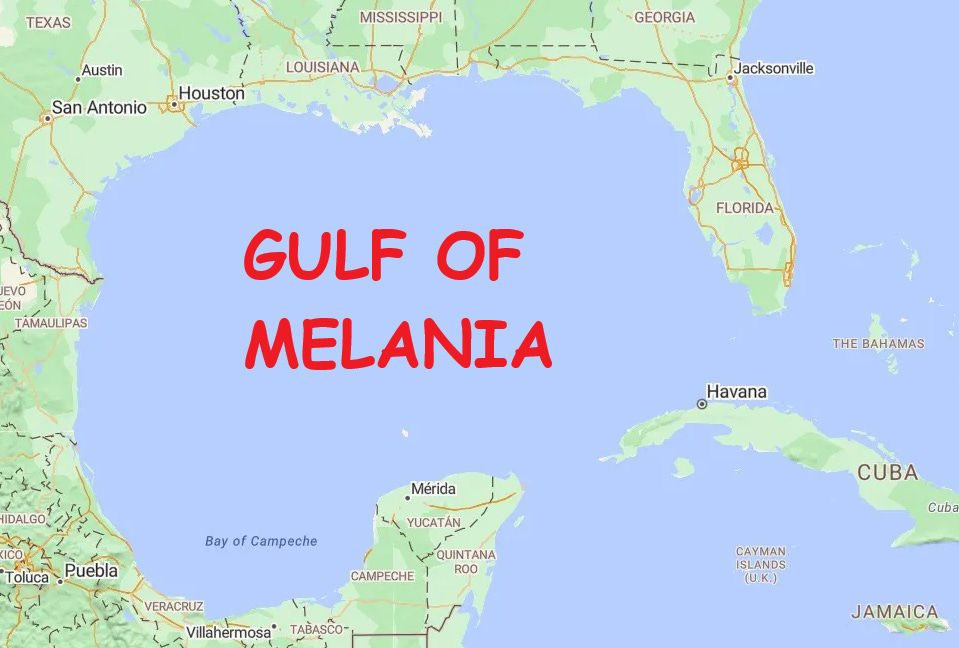
But sometimes politics are inescapable, and that’s the situation with the controversy over AP’s refusal to adopt Donald Trump’s decree changing the Gulf of Mexico to the “Gulf of America” (one wonders how his followers would react to “Gulf of Melania,” but we digress).
AP’s argument was straightforward: Trump cannot actually rename a thing that is not in the United States – only determine how it is referred to by the government and its dependent entities. Since AP’s readership is global, convention and widespread use must rule the day – and Gulf of Mexico it shall remain. AP reporters were then blocked from attending White House events – and voila: a controversy about freedom of the press, and a chance for Trump to signal that he’s not done sticking it to the “fake news media.”
AP has taken this to court and argues that since so many Americans rely on its Washington coverage, through many hundreds of member and client platforms, the ban is an assault on transparency and a violation of the First Amendment. I assume such arguments will only delight the president.
Putting aside the merits of the case, this grim business landed me in a nostalgic frame of mind, for I spent countless hours myself agonizing and sometimes arguing over charged vocabulary in my years at AP, where was was variously the chief editor for Europe and Africa (Should Serbian and Croatian be treated as different languages?) and as bureau chief in Israel and most recently the Cairo-based Middle East Editor.
The impartiality imperative is enshrined in AP’s so-called News Values and Principles – guidelines underscoring the organization’s mission to deliver accurate, balanced, and unbiased reporting. Central to this is the meticulous selection of language, especially when reporting on contentious issues. The AP Stylebook serves as a compass, directing journalists toward terminology that upholds clarity and neutrality – and it is widely used outside of AP also.
So, for example, The AP will not refer to Russia’s war against Ukraine as a “special military operation” – the euphemism preferred by the Kremlin, meant to whitewash the fact that it was a colossal unprovoked military invasion. So far, so good.
But what to do when covering a story of a century-old conflict in which two sides have hardened into parallel narratives that perceive utterly different realities while observing the same thing? And when both have legions of otherwise reasonable partisans, passionately sharing the blinders?
If you suspect I am referring to the Israeli-Palestinian conflict, that’s because I am. There are few more perfect examples of a linguistic minefield.
Terminology such as “settlements,” “occupation,” “terrorists” and “refugees” carry profound political and emotional weight. Efforts by AP and others to be impartial drives some readers nuts, and I sympathize to a degree.
For instance, the AP has been known to avoid labeling groups like Hamas as “terrorists,” opting instead for terms like “militants” and focusing on event descriptions (while slipping in the word when it can be attributed to someone else). This stirred much agitation. The term is of course subjective – one person’s terrorist is another’s freedom fighter, goes the cliché (though with a different original pronoun). And Israel had greatly cheapened with overuse, going all the way back in the 1982 Lebanon invasion, when any enemy combatant was referred to as a terrorist. It just meant they’re very bad.
What if you personally agree that a someone’s very bad? That doesn’t really matter at AP. What if the “militants” carried out what is undoubtedly a terrorist attack – say, against a kindergarten? That’s different, yes, but the instinct was still to just call it a bombing, or whatever it was. The official story is that this is the most accurate way; unofficially, there’s always relief when you can avoid the problematic term and get on with your day. So in the second intifada, we would use “suicide bomber,” “assailant,” anything but “terrorist” – and I was OK with that. Many on the Palestinian side accused Israel of “state terror” and we certainly avoided that too – there’s just no way to win.
Then came 9/11. Suddenly the media was full of references to the “terrorists” who carried out the biggest ever “terrorist attack.” Why? Well, because anyone objecting is probably in a cave in Afghanistan. I saw some inconsistency, tried mildly to point it out, but largely let it go. Then along came ISIS, a terrorist group so widely seen as vile that it was OK to call them what they are, and this I assuredly made sure we did.
Next up, “refugees.” Supposedly there are 6-7 million Palestinian ones. But in the English language, the number is vastly smaller. They actually are “descendants of refugees” who fled or were coerced into leaving what become Israel in the 1948-9 war. The “refugee camps” are miserable to be sure, but they’re mostly shanty towns by now.
Hereditary refugee status is unique to the Palestinians (who were also given their own UN agency to make sure of it – UNRWA). If we applied that standard in south Asia we’d currently have tens of millions of Hindu and Muslim refugees, descended from the 15 million or so who moved around during the partition into India and Pakistan. We’d also have millions of Jewish “refugees” descended from the one million who fled (or were coerced to flee) Arab countries and mostly ended up in Israel. But news platforms don’t call them refugees.
Of course it’s more complicated. You could argue that many of the descendants are still technically refugees because the host country has refused to give them citizenship or basic rights, even though they culturally, religiously, linguistically and ethnically fit right in. Lebanon still does this to several hundred thousand, in order to perpetuate the grievance and prolong the conflict. I don’t mean to be heartless – I pushed for stories about their plight. But to me they may be “stateless,” yet still not “refugees.”
Basically, it’s political. Inflating the numbers of refugees and calling shanty towns “refugee camps” is a device for making Israel look evil. One may think Israel has it coming – but that is not an argument for inaccuracy.
Another debate centered on the description of Jewish neighborhoods in Jerusalem. We have all settled on the term “settlements” to refer to Jewish communities on West Bank land that Israel seized in 1967 but has not yet annexed. Indeed, it is hard to think of precedents where an occupying power build communities for its own side’s people on land it doesn’t officially claim ownership of. That is bizarre and distinctive enough that a separate term did seem warranted – both for the “settlements” and for the now half-million “settlers.” But do you call them “illegal settlements”? Some journalists want to.
I bristled at this, arguing that there is more than one law. Most are not illegal under Israeli law, and AP tends to go by local law in coverage (some “unauthorized” ones actually are). As for international law, it is fuzzy and has no true and agreed arbiter, with all due respect to the International Court of Justice. We generally settled on boilerplate about how much of the international community considers them “illegitimate” – which is how the United States government sometimes gets around the problem too.
But then came a truly sticky wicket: the Jewish neighborhoods in East Jerusalem. This area of the city, abutting the “West Bank,” was occupied in 1967 — and unlike the rest of the area it was annexed. Its Arab residents theoretically have the right to request Israeli citizenship (and some have successfully done this – though Israel certainly makes it hard with extreme security background checks).
I’m not so sure I can call it “occupied” – because under this paradigm all of Israel would have that status. I prefer “disputed” – which achieves the AP stated purpose of being most precise and, well, indisputable. But that word drives pro-Palestinians bananas by implying Israel’s claim might be legitimate.
When Israel started building Jewish neighborhoods in this part of the city, we had discussions about whether to accept the Palestinians’ term for them: “Jewish settlements in occupied East Jerusalem.” To me, settlements, at least in the West Bank context, are discrete entities and not contiguous neighborhoods in a large city. Many considered me a quibbler, but I did my best to minimize use of the term, without ever escalating the matter to an edict either way. Six years ago I left, and the term came roaring back.
You cannot use “terrorist” enough for the Israelis – and “settlements” and “occupied” and “refugees” enough for the Palestinians. And the reason is rather clear: all suggest that one side is somehow in the wrong.
They are dog-whistles, a little similar to the way Trump uses language. Trump’s dog whistle on “Gulf of America” is “America is great.” Fact-based arguments won’t matter much when the goal is to animate supporters or pick a fight with the media – the same way his purposefully wrong capitalizations of nouns (“end the War”) is meant to annoy opponents.
I actually wonder whether impartiality is always the way to go. Dignifying sham processes in places like Russia as “elections,” or calling dictators by the title “president,” can seem cowardly and craven. Running away from loaded terms at all times can feel like running away from reality. It’s not so simple.
The AP is a major engine of global news machinery, and it is a delicate and important undertaking. They’re right about the “Gulf of America” and walked right into controversy, which goes somewhat against the grain, and that makes me rather proud. Journalists tend to sidestep controversy, hoping to present fact-based realities in a way that most news consumers in the world can relate to and agree on. But ours, increasingly, is not that kind of world.
