











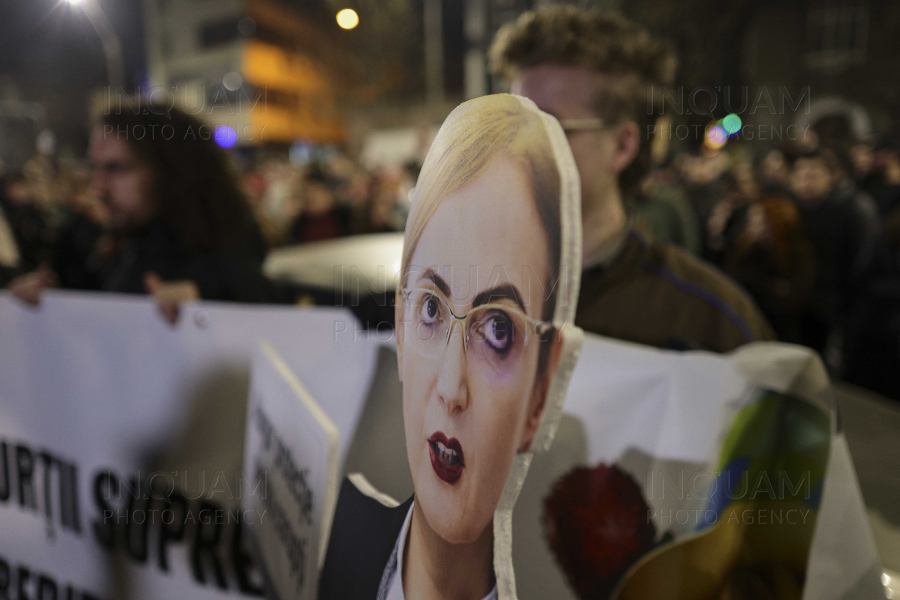
The Constitutional Court deeply disappointed (again) by postponing a decision to reform magistrates super inflated pensions for a fifth time. But even now, it was no surprise at all.
And even when it is scheduled to meet again to make a decision on February 18 there do not seem to be any real chances of delivering a decision, given the fact that in addition to a request by High Court Judge Lia Savonea to refer the matter to the EU Court of Justice, another request submitted by Gheorghe Stan, one of the Constitutional Court judges was addressed to the same forum.
From press reports, it is known that Stan also did another move on Wednesday by suddenly going on paternity leave. However, by also formulating his own request to refer the matter to the CJEU, he can be suspected of having kept the paternity leave trick up his sleeve probably for another time.
At this point, one can clearly observe a pattern of action that needs no introduction: the thugs at the top of the judiciary, who vigorously protect their clique’s indecent privileges have exhausted their conventional arsenal, and so have unleashed a guerrilla struggle with the government and society.
Procrastination, by any means and on any time frame has become the watchword.
In this phase, all they have to do is serially fabricate new and ingenious pretexts, no matter how absurd they are in reality to avoid making a decision. They are taking time hostage.
And nothing is simpler than that: historically, the art of sophistry has special works from which they can be inspired, and the potential that sophistry holds is truly unlimited. The fact that there are sufficient Romanian magistrates familiar with this reality has often been seen even in their scandalous aberrant motivations for outrageous sentences.
With paper you can work wonders when efforts are concerted, when the institutional framework is slightly adrift, when the language used is dense and totally indigestible for the general public.
In this phase, of fabricating pretexts meant to postpone the issue indefinitely, the only obstacle that can upset such calculations is the outbreak of a major crisis, a kind of black swan. It is probable that the clique at the top of justice system has considered the prospect of such a risk, and has taken precautionary measures, for example by forging pretexts with the most benign appearances.
Of course, when it comes to black swan crises, the size of the risk is amplified by the intrinsic inability to control and anticipate all the variables.
In this phase of warfare unleashed by the clique in the judiciary via the Constitutional Court there is a certainty: how long can this form of conflict be sustained and what could inhibit it?
Where certainty separates us – it, the clique, from us, taxpayers, the unknown perversely unites us – because both the clique and, us, society, are stressed about the unknown, of course from totally different perspectives.
Romania’s judges are costing the country hundreds of millions of euros
