




Trump picks fight with France over a political killing, Bibi coalition picks a fight with US Jews, China busts sanctions
In recent days, Trump has warned mafiotically that Ukraine must “come to the table fast,” and Marco Rubio, his glum secretary of state, skipped the key Ukraine meeting at the Munich Security Conference. It’s all part of the same reality in which the current bizarro variant of America would like the war to end on terms that allow Putin to claim a victory, whereupon Trump will try to get the sanctions lifted and Russia restored to world bodies. Most US direct aid to Ukraine has ceased, and recent rounds of talks, in their various formats, have gone nowhere, because Russia wants Ukraine to hand over the “fortress cities” it cannot capture.

European governments have responded to this with an effort to fill the widening gap. The European Union’s proposed €90 billion ($106 billion) loan package for Ukraine, designed to stabilize the country’s finances through 2027, representing one of the most ambitious collective funding initiatives since Russia’s full-scale invasion. A large share is directed toward defense-related expenditures.
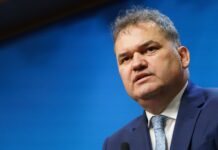
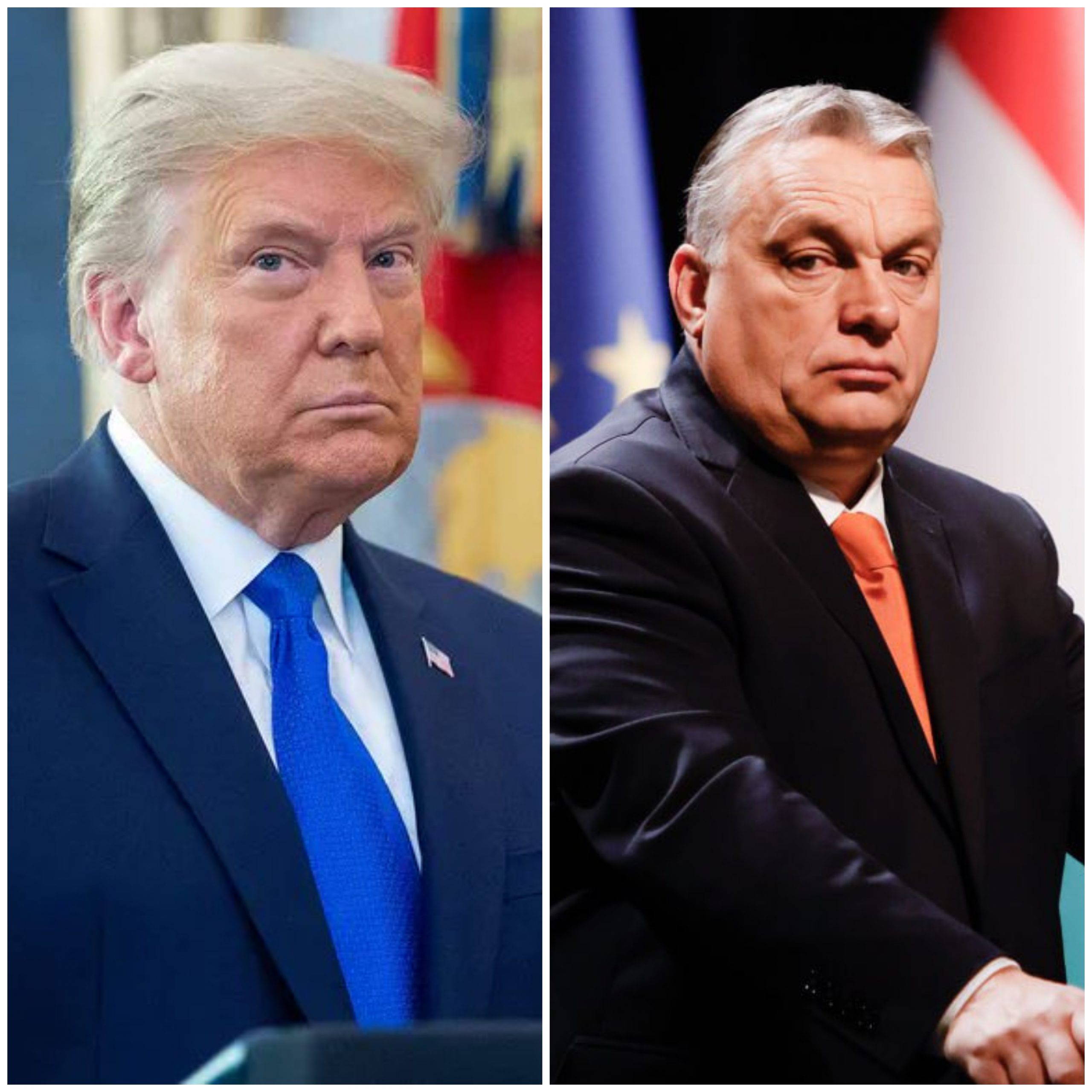
Europe’s effort to project unity has once again collided with a familiar and predictable obstacle: Hungary, whose elected autocrat Viktor Orban is the darling of the MAGA movement in America. Orban — the European Union’s most consistently Russia-friendly leader — has threatened to veto the Ukraine financing package unless Russian oil shipments to Hungary resume via a key Druzhba pipeline. “As long as Ukraine blocks the Druzhba pipeline, Hungary will block the €90 billion Ukrainian war loan,” Orban declared.
This is a problem for Ukraine, but also for the EU. If Orban stays in power much longer (which he might not, as we shall see), the EU really needs to figure out workarounds to the veto power accorded member nations (which may require a change to the treaties — which themselves might be vetoes). It is a little sad that there is no way to kick out a member, though Article 50 allows them to depart, and perhaps this can be compelled.
Here’s what’s going on, and how Hungary, Russia, Ukraine, MAGA (and even Israel!) are somehow all connected this weekend.
The rest of this briefing is for Paid Subscribers. Join the community!
Across NATO, governments have also accelerated defense spending and military production. From expanded artillery shell output to long-term weapons procurement programs, European states are attempting to build the industrial and financial capacity required for a protracted confrontation with Russia. Even if America can no longer be relied upon — incredibly — to help.
Although Europe can provide major funding and weapons, key elements of US support to Ukraine remain hard to replicate, particularly high-end intelligence, surveillance, and reconnaissance that enable real-time battlefield awareness and targeting. American assistance also includes critical enablers such as logistics networks, rapid replenishment capacity, maintenance pipelines, and long-range precision capabilities built on unmatched scale and integration. European industries are expanding but cannot quickly match these volumes or systems.
But the money, obviously, is key. Final approval of the loan by the Council of the European Union had been widely regarded as procedural. Orban’s veto threat has now forced a postponement, injecting uncertainty into Ukraine’s financial planning at a moment when battlefield pressures and infrastructure attacks are intensifying.
The Druzhba pipeline, one of the world’s largest oil transport networks, carries Russian crude across Ukrainian territory to Hungary and Slovakia.

Ukrainian authorities say flows have been disrupted since January, when Russian attacks damaged infrastructure connected to the route. Budapest and Bratislava reject that, accusing Kyiv of deliberately obstructing supplies. Slovak Prime Minister Robert Fico — a sort of Orban wannabe — declared a state of emergency tied to fuel concerns and warned of retaliation unless deliveries are restored.
The confrontation illustrates how energy dependence continues to fracture European policymaking nearly five years into the war. While the EU as a whole has dramatically reduced its reliance on Russian hydrocarbons, Hungary remains heavily dependent on Russian crude, with Moscow accounting for the overwhelming majority of its oil imports. Hungary had secured exemptions from earlier EU sanctions, preserving pipeline deliveries even as much of Europe diversified away from Russian supply. Hungary has excuses, but it also chooses this path (see this analysis) — and Europe could do better.

The domestic stakes for Orban are high, because for the first time in more than a decade, his hold on power faces a credible electoral challenge in an election to be held in April. Doubtless he will frame his moves as fighting for cheap energy, and we will see how gullible Hungarian voters — who have already given away many of the basics of a functioning democracy — might be.
If Druzhba oil flows fully resume, the direct economic benefit to Moscow would be measurable but limited in macroeconomic terms. The pipeline’s southern branch historically carried roughly 250,000–300,000 barrels per day — a modest share of Russia’s overall exports, which remain in the millions of barrels per day despite sanctions and rerouting toward Asian markets. Hungary alone is not capable of transforming Russia’s wartime revenue base.
Yet the significance of resumed flows lies less in volume than in structure and symbolism. Pipeline deliveries are financially attractive for Russia. They involve lower transport costs than seaborne shipments and generally avoid the steep discounts Moscow has been forced to offer buyers such as India and China. Even modest volumes therefore generate comparatively efficient hard-currency revenue, supporting a Russian federal budget still dependent on energy taxation.
More importantly, a visible restoration of flows tied to political bargaining would signal the fragility of Europe’s sanctions regime. Since the invasion, the Kremlin has sought to exploit precisely such fractures, arguing that Western restrictions are porous, reversible, and vulnerable to domestic political pressures.
Finally, continued Druzhba reliance preserves Russia’s residual energy foothold inside the EU. Russian hydrocarbons, though sharply reduced as a share of European imports, remain instruments of influence where dependency persists. Moscow’s long-standing strategy has been not merely to sell energy, but to convert energy relationships into political leverage. All European countries would be wise to avoid any trace of dependency.
That might help compel a change in Russia. Then again … China.

Meanwhile, the US is also picking a fight with France.
The killing of nationalist student Quentin Deranque in Lyon last week has shaken French politics, but the repercussions now extend well beyond France’s domestic arena. Deranque, 23, died of head injuries after being beaten during clashes on the margins of a small university protest. Mobile phone footage showing masked attackers repeatedly kicking and striking him has circulated widely, fueling outrage and a rapidly escalating political debate. Seven suspects have been charged, several reportedly linked to La Jeune Garde (The Young Guard), a far-left activist network whose past connections to figures near Jean-Luc Mélenchon’s La France Insoumise (LFI) have intensified scrutiny of the radical left.
In France, the case has people wondering whether the political stigma historically attached to the far right could migrate toward the far left, which had hitherto been more annoying than dangerous. LFI, treated as part of the acceptable “Republican arc” despite its combative posture, now faces fierce criticism. The National Rally (RN), by contrast, has kept its powder dry, benefiting from a controversy that shifts attention away.
Into this fray, bien sur, stomp the Trumpy Americans, with US officials warning that “violent radical leftism is on the rise” and describing Deranque’s death in terms more commonly associated with terrorism.
Paris has responded with irritation, rejecting what it sees as instrumentalization of a French criminal investigation and summoning the US Ambassador. Trump couldn’t be happier. Expect him to fuel the fire with charges that the youth is a French Charlie Kirk. I wouldn’t be shocked to hear Trumpy demands for a national day named after him,
Because beneath the bullshit lies a broader tension. The Deranque case is being elevated into a symbolic clash between Washington and Paris over competing visions of political legitimacy and extremism. American officials and commentators aligned with Trump have increasingly criticized European governments for constraining ultranationalist movements that challenge the EU’s institutional order. In this framing, European efforts to marginalize hard-right actors are cast not as democratic safeguards but as ideological suppression.
For observers of the geopolitical landscape, the episode carries an unmistakable strategic relevance: by aligning with European forces hostile to the EU’s cohesion, Trump’s posture once again converges with Putin’s — just as with Ukraine. Moscow has consistently sought to weaken European unity to avoid a strong monolith o its west; disputes that pit the US against core EU states over the treatment of nationalist movements delight Putin no less than Trump.
Meanwhile, one can envision a political impact in France, where the far left, the far right and Emmanuel Macron’s center are of similar size, meaning no one can govern. A diminished far left could be very helpful indeed.

Rounding out our survey, Israel’s Netanyahu coalition is picking a fight with the world’s Jews.
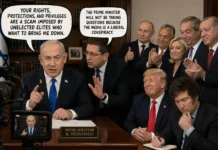
We started with Orban — let us conclude with his scowly immitator in the Middle Easy. Even as the drums of war with Iran are beating and Israelis deal with a state of heightened alert, the Netanyahu coalition’s efforts to erode the country’s liberal-democratic character continued. Netanyahu’s decision on Sunday to cancel a ministerial committee vote on legislation that would effectively criminalize egalitarian prayer at the Western Wall aimed to avoid friction with US Jews on the day of a virtual appearance at an AIPAC event, but they should not be fooled: his coalition is in conflict with most of them.
The legislation, backed by Justice Minister Yariv Levin and authored by far-right coalition member Avi Maoz, is expected to reach the Knesset floor this week even without formal government endorsement. Its substance is extraordinary. The proposal would grant the ultra-Orthodox-controlled Chief Rabbinate exclusive authority to define “desecration” at Jewish holy sites, including the Western Wall, with violations punishable by five to seven years in prison.
