













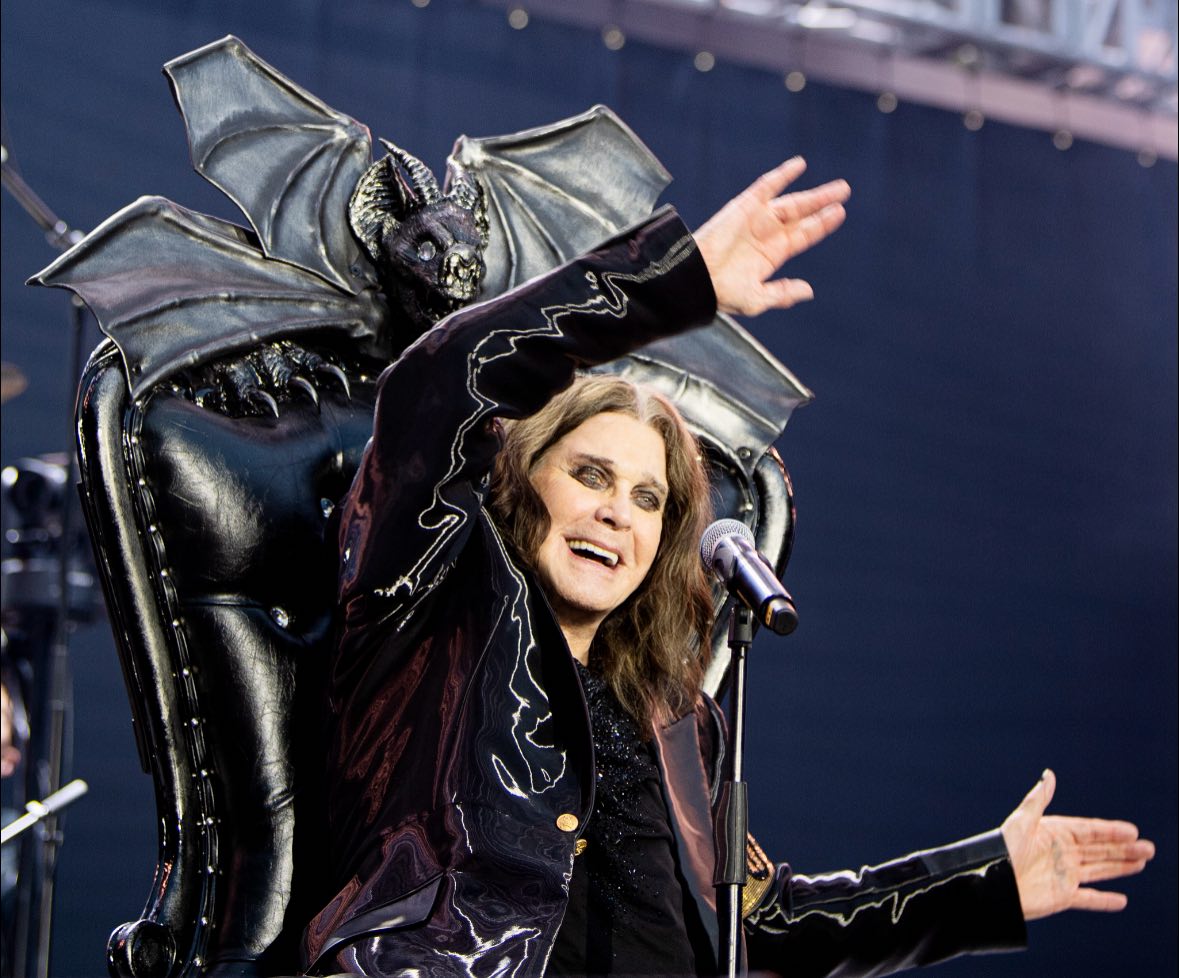
As the world mourns the passing of legendary Black Sabbath frontman, Ozzy Osbourne, the Prince of Darkness is remembered in Romania for offering a window to freedom under the repressive communist regime at a time when travel to the West was out of bounds for the average Romanian.
Western rock music was not banned by late dictator Nicolae Ceausescu, but listening to ‘decadent, Western rock’ was frowned upon by the authorities who encouraged the population to listen to traditional Romanian folk music and other homegrown artists who were not critical of the regime.
So as millions of music lovers mourn Osbourne’s death on Tuesday, older Romanians have a special reason to be nostalgic about his music and remember him as a symbol of freedom.
Romania’s most respected musical journalist, Andrei Partos, a diehard fan of Black Sabbath and its lead vocalist for the last 40 years, was one of five million people who listened to his farewell concert on July 5.
He sent this tribute to Universul.net.
“Anything I write about my relationship with rock, with Ozzy, is doubly, even triply subjective. I am the same age as Ozzy; he was born on December 3rd, the same day as my son.”
“I have the English and Romanian versions of his autobiography: “I am Ozzy”. In the 1980s, I played his album Paranoid with Black Sabbath on Radio Vacanța Costinești on August 23rd (Eds: Romania’s national day under communism).”
“Rock was for me and many colleagues of my generation was a way of escaping the monotony of life we lived under an oppressive communist regime.”
Romanian rock bands were permitted under the communist regime because the party bosses and the Securitate (Eds: Communist-era all-pervasive secret police) didn’t grasp its potential. They didn’t understand him. The rock concerts, and I can say that I presented a few hundred, thousands (of them), were huge releases of energy, of longing for freedom. We presented and organized the first rock concerts in February 1990, Mr. Partos said referring to the Rock for Romania.
“There is no field in which the rule of “suspension” has been applied more often, as in the musical world where artists have access to the microphone. For words (the communists were and still are afraid of words), for long hair, for broken windows, for everything that music means.”
Ozzy was and will remain a symbol with all his flaws, with his troubled life, with his complex personality. He didn’t have a great voice, but it was an unmistakable one. Rock allows this. To have an identity. Black Sabbath was not the only band we loved.”
“For me it was amazing that on July 5, 2025 there were more than 5 million people from all over the globe watching (for a fee) the farewell concert of Ozzy Osbourne and Black Sabbath in Birmingham, Ozzy’s hometown.
Maybe it’s important to know that the proceeds went to charity,” he said.
“Ozzy came to Romania in 2010 and the concert area wasn’t full, perhaps because now rock was allowed, but also because not everyone understood that Ozzy, a symbol of Rock is not something to miss. It hurt. I went to Budapest in 2016 to see him perform with Black Sabbath.”
Now it’s trendy to talk about Ozzy, but in the 70s, 80s, 90s there weren’t many doing it.”
“He was a rebel, a nonconformist, with a special sense of humor, the authentic rocker, “The Prince of Darkness” paradoxically generated, light!”
Another Romanian, Cristi Tabara, a 57-year-old television presenter who studied theology, credited Ozzy Osbourne with strengthening Romanians’ resolve in the communist era.
“Paradoxically, rock strengthened my path to God, when I had to clarify what is satanic and what is not in music. I learned that we do not decide in God’s place who He welcomes next to Him and who he doesn’t.”
“May God rest you at His right hand, Ozzy, in the hope that the two of you will clarify everything. Receive, Lord, this servant, if only because he kept alive the fighting spirit in us, those in the communist East.”
Luca Niculescu, a Romanian diplomat and coordinator for Romania joining the Organization for Economic Cooperation and Development, reminisced about listening to Black Sabbath and other rock bands with a group of enthusiastic friends in his small apartment in the Berceni district back in the 1980s. In a post on Facebook, he simply said:
UPDATE. Popular Romanian rock musician Adi Barar dies after catching Covid-19
