











ADAM REICHARDT REPORTS: Romania just rejected a populist strongman, barely. Now comes a similar test in Poland. Naturally, Trumpworld supports the anti-European candidate.
By Adam Reichardt
KRAKOW, Poland _ While much of the democratic world breathed a sigh of relief after Romania narrowly rejected the far-right nationalist George Simion in its presidential election two weeks ago, another showdown over liberal democracy has been quietly gathering in a country where the stakes are arguably even higher: Poland. Still recovering from their loss in the 2023 parliamentary election, populist illiberal forces are making a serious bid to stall the country’s democratic recovery, this time with backing from a powerful ally in Washington.
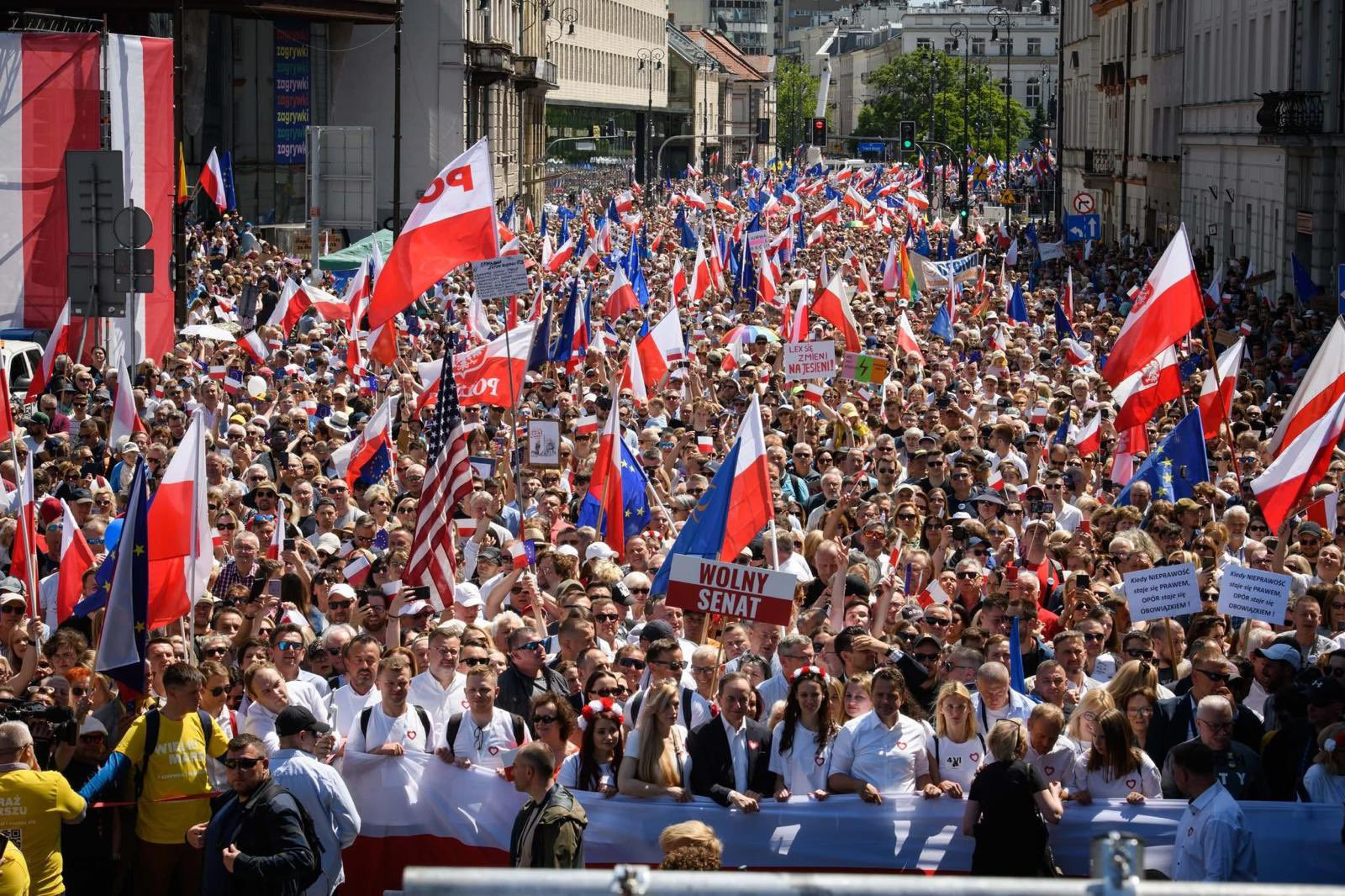
Poland’s June 1 presidential runoff pits the Warsaw liberal mayor, Rafał Trzaskowski, against Karol Nawrocki, a relatively unknown figure who has backing of the conservative PiS party. What happens Sunday will have profound consequences: The ruling party led by Prime Minister Donald Tusk is counting on a Trzaskowski victory to finally allow his government to push through key reforms that have been stalled by the outgoing president, Andrzej Duda, who repeatedly used eto power to block them. This includes key legislation to reverse major judicial reforms passed by the previous PiS government which led to the deterioration of the rule of law in the country.
Should Nowrocki win, it would create new barriers to the pro-democratic forces. No major governmental initiative would have a chance under his presidency and in the worst-case scenario the country could see snap elections and the collapse of the fragile democratic coalition, which hasn’t even been in power for a full two years.
The first round of the presidential election, held on May 18, revealed some stark surprises in Polish society. All expectations were for Trzaskowski to win the first round, but not with a majority. While Trzaskowski technically came out ahead in the first round, his narrow lead – 31.4% to Nawrocki’s 29.5% – left him politically diminished rather than strengthened. The more striking development, however, was the surge of support for the far right. Sławomir Mentzen, the libertarian, anti-system candidate from the far-right Konfederacja party, secured 14.81% of the vote, while the openly antisemitic and anti-European Grzegorz Braun followed with 6.34%. Taken together, the three leading right-wing candidates (covering a wide ideological spectrum) captured over 50% of the total vote. In contrast, the left performed poorly, with all three left-wing candidates combined receiving nearly 10%. Notably, the first round saw the highest voter turnout in a post-1989 Polish election, with 67% of eligible voters casting their ballots.
Following the first round, both remaining candidates – Trzaskowski and Nowrocki – vied for Mentzen’s support and endorsement, which even saw the liberal candidate and his ally, Foreign Minister Radosław Sikroski, have a beer with the far-right leader on social media. As a result, all polls indicate it will be a nail biter, with no candidate enjoying a statistically significant advantage.
One clear takeaway already is that Polish society remains deeply polarized. The country is still grappling with the legacy of eight years under PiS – a period marked by systemic democratic backsliding. Though the PiS strongman Jarosław Kaczyński rarely held formal office, his influence remains dominant, orchestrating power dynamics from behind the scenes.
Between 2015 and 2023, PiS undermined core democratic institutions: it politicized the judiciary, severely weakening the rule of law, attacked civil society and transformed the public media into a powerful propaganda tool. Much like Viktor Orbán in Hungary, Kaczyński recognized that to stay in power, illiberal forces need not abolish elections, but only render them hollow through polarization, disinformation and the manipulation of fear and grievance.
The first round of the presidential election, held on May 18, revealed some stark surprises in Polish society. All expectations were for Trzaskowski to win the first round, but not with a majority. While Trzaskowski technically came out ahead in the first round, his narrow lead – 31.4% to Nawrocki’s 29.5% – left him politically diminished rather than strengthened. The more striking development, however, was the surge of support for the far right. Sławomir Mentzen, the libertarian, anti-system candidate from the far-right Konfederacja party, secured 14.81% of the vote, while the openly antisemitic and anti-European Grzegorz Braun followed with 6.34%. Taken together, the three leading right-wing candidates (covering a wide ideological spectrum) captured over 50% of the total vote. In contrast, the left performed poorly, with all three left-wing candidates combined receiving nearly 10%. Notably, the first round saw the highest voter turnout in a post-1989 Polish election, with 67% of eligible voters casting their ballots.
Following the first round, both remaining candidates – Trzaskowski and Nowrocki – vied for Mentzen’s support and endorsement, which even saw the liberal candidate and his ally, Foreign Minister Radosław Sikroski, have a beer with the far-right leader on social media. As a result, all polls indicate it will be a nail biter, with no candidate enjoying a statistically significant advantage.
One clear takeaway already is that Polish society remains deeply polarized. The country is still grappling with the legacy of eight years under PiS – a period marked by systemic democratic backsliding. Though the PiS strongman Jarosław Kaczyński rarely held formal office, his influence remains dominant, orchestrating power dynamics from behind the scenes.
Between 2015 and 2023, PiS undermined core democratic institutions: it politicized the judiciary, severely weakening the rule of law, attacked civil society and transformed the public media into a powerful propaganda tool. Much like Viktor Orbán in Hungary, Kaczyński recognized that to stay in power, illiberal forces need not abolish elections, but only render them hollow through polarization, disinformation and the manipulation of fear and grievance.

Poland’s current Tusk government has only recently begun to repair the damage wrought by PiS. Since returning to power Tusk has reoriented Poland towards Brussels, thawed relations with Germany and reasserted support for Ukraine in its defense against Russian aggression. His pro-European credentials, bolstered by his tenure as president of the European Council, have reassured allies that Poland is no longer a Trojan horse for Euroscepticism inside the EU. Yet PiS’s influence still casts a long shadow and victory for PiS-backed Nawrocki would likely entrench this obstructionism and pave the way for a PiS resurgence in 2027 or sooner.
Poland is a post-communist success story, with a booming economy that should, in theory, insulate it from political upheaval. GDP per capita now stands at $22,000 nominally ($50,000 adjusted for purchasing power) — above Romania’s and among the highest in the region. Unemployment is below 3%, infrastructure rivals Western Europe’s, and decades of EU integration have delivered tangible gains. Yet despite this prosperity, Polish politics remain bitterly divided. The explanation lies not in economics, but in culture: national identity, the role of religion and the church, migration, the war in Ukraine, media control, and judicial independence have become the real battlegrounds. As in many democracies today, it is culture wars more than class wars driving the stakes.
The pro-Western camp, meanwhile, is far from ideologically cohesive. It includes progressives from the New Left, centrists from Poland 2050, and the conservative Polish People’s Party (PSL). Trzaskowski, while a popular and experienced figure, must navigate these competing agendas. On sensitive issues such as abortion rights, judicial reform, and refugee policy – particularly regarding Ukrainian refugees – divisions run deep. His attempts to find middle ground risk alienating both his base and potential crossover voters from the right.
In contrast, Nawrocki has embraced the illiberal, populist playbook. Virtually unknown in national politics before 2025, he presents himself as youthful, tough and media-savvy – a friendlier face than Kaczyński, yet firmly aligned with PiS’s ideological core. Despite being implicated in several scandals, including recent revelations that he allegedly facilitated prostitution while working security at a luxury hotel, his appeal among the PiS base remains strong. Supporters continue to attend his rallies with unbridled enthusiasm, drawn to his charisma and outsider persona.
His early May visit to Donald Trump in Washington, and the subsequent MAGA endorsement, including Kristi Noem’s speech at CPAC Poland this week, sends a clear message: Nawrocki wants to position himself as Trump’s ally in Warsaw, sidelining Tusk and amplifying institutional conflict between the government and the presidency.
This scenario is not without precedent. In Romania, the Trump administration lent tacit support to Romanian presidential candidate George Simion, the far-right figure who challenged Romania’s EU and NATO commitments. That a country like the United States, which once championed and led the liberal order, would now flirt with backing autocrats and ideologues is no longer shocking, though of course it should be. In a rational world, a country like Poland, which has embraced the EU, supported Ukraine, and modernized its economy to Western standards, would be a model partner. Instead, it finds itself caught between its own authoritarian past and a liberalism that often seems unsure of itself.
Part of the problem is that liberalism in Poland – as in many places, including Romania – has struggled to articulate a compelling vision. It is increasingly perceived not as a guarantor of opportunity and rights, but as elitist, condescending and out of touch. Many Poles feel culturally marginalized, politically patronized, and economically unheard. In such an environment, populist parties like PiS and Konfederacja don’t need to offer coherent policy alternatives, they just channel resentment.
Given Poland’s size, geopolitical significance, and proximity to flashpoints like Ukraine, Belarus, and Kaliningrad, the stakes are uniquely high. Poland hosts US troops, underpins regional logistics for the war effort, and is a vital recipient and transmitter of EU investments. It is also a symbolic battleground. If liberal democracy cannot survive in Poland, a country once considered a democratic success story, its failure will resonate far beyond Central Europe.

The outcome is not inevitable. Trzaskowski is a credible and compelling candidate with a clear commitment to democratic norms and European integration and his slight lead in the polls gives some room for optimism. Yet, no matter the outcome, this election demands a reckoning, a sober recognition by Polish voters of what is at stake.
The result will not only shape Poland’s democratic future, but the broader trajectory of Europe as a whole. Romania pulled back from the brink. Whether Poland can do the same may offer a glimpse into the fate of European democracy in the years ahead.
Krakow-based Adam Reichardt is the Editor-in-Chief of New Eastern Europe, a leading magazine on Central and Eastern European affairs, and co-host of its official podcast, Talk Eastern Europe. He has served as a Transatlantic Media Fellow with the Heinrich Böll Foundation.
