




On Monday, April 27, Romania descended into the ridiculous:
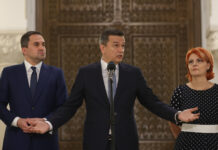
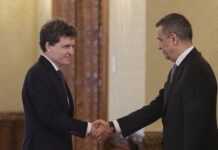
- Someone with a corruption conviction (Marian Neacșu – PSD) and a former adviser to ex-PM Adrian Năstase (Petrișor Peiu – AUR) announced in unison that they would submit a motion of censure to remove the Government led by Ilie Bolojan.
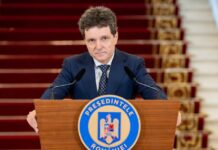
- The president, who arrived in Cotroceni as a great reformist even promising to be fighter, went quiet leaving us all speechless, telling Digi FM, it wasn’t constitutional to say whether he supports the besieged prime minister, who he himself had appointed. How did he get to this dubious diagnosis? How can it be unconstitutional as head of state to give your opinion about the prime minister, after as head of state, you appointed him prime minister? In other words, in the universe of Nicușor Dan’s logic, the action is constitutional, but speaking isn’t. . Mr President, it is not only alarmingly confusing, but it’s a serious matter!
I have written before about the origins of the current political crisis:
- The PSD’s dash to block reforms that hit the interests of a wide range of their “smart Alecks”.
- The PSD’s dash to monopolize decision-making in the governmental level, even if it’s in a coalition as it didn’t get enough votes to govern on its own.
- AUR’s dash to try and be in government.
- Finally, it is also worth noting the modest if any role played by the president who since he was elected in May 2025 seems rather to have de facto suspended himself, obsessively telling the public that he is nothing more than a humble observer/mediator and must remain neutral. Benefiting from his spectator position, PSD and AUR had a good five months to quietly prepare their ground. And today, the anti-reform camp’s plans are beginning to bear fruit.
The truth is that President Dan had few options from the get-go and none of them very good.
He faces a PSD that has decades of practice of blocking structural reforms and with an AUR doing well in the polls, Bolojan’s Government is in a dicey position.
With a PSD and an AUR like this, and a president who doesn’t have a party behind him, and aware that Bolojan would be a strong rival in future presidential elections, President Dan is not in an enviable position.
In this context, he had to chooseto either take a r a combative stance (like ex-President Traian Basescu) or have a good relationship to the PSD (as ex-President Klaus Iohannis did in his second term).
Nearly a year after he became president, there is nothing to suggest that Nicușor Dan wants to be combative and everything to suggest he wants a good relationship with the PSD.
In this unstable and hostile political environment, Nicușor Dan had one good option to delay or block the crisis started by the PSD and ensure a solid position for himself: cultivating public opinion and transforming public opinion into its informal party.
Because public opinion is the only authentic ally that Nicușor Dan could have made, and also the only ally that a president without a party could not do without if wanted to be a president to actually change something for the better, rather than just observe how the country is going downhill.
Ater almost one year in office, it’s hard to remember an occasion when he’s made a rousing speech or an incisive initiative, or even really inspired Romanians with a clear and uncompromising direction for the country.
However, if you review Nicușor Dan’s public positions, you quickly deduce that the position of president is almost devoid of real power; and the head of state is a prisoner in his palace and that between the politician with the greatest legitimacy and the common man there’s not much difference in terms of how he exercises political power.
Acting like this, Nicușor Dan risks sending a false message, something obvious in theory (see the Constitution and the legislation), as well as from practice (see Traian Basescu’s two terms, a president who survived two impeachments and who had to deal with a PSD infinitely more powerful than today’s shadow as well as the massive economic crisis of 2008-2010).
As I recently mentioned (see link at the end), the current political crisis is also a profoundly moral one and it is this moral dimension that would have provided Nicusor Dan with a wide and favorable terrain for intervening in the political crisis on different levels.
There are now political analysts and old supporters of Nicușor Dan who still hope that the president will change.
Because hope dies last, I belong to this camp, although I am skeptical. At the same time I note that Nicușor Dan has already wasted precious time, and an eventual change of his character won’t be easy given the irreversible time lost so far.
The political crisis is a reality, and pretending reality is otherwise is harmful. Therefore, in the national interest, the president should simply enter, something he has studiously avoided so far.
Failing to enter the fight, when the combined assault of the PSD and the extremists is a fait accompli, will certainly leave Nicușor Dan a president, but at best a cardboard figure.
- PS: Overnight, Romania’s clock was turned back a few decades. PSD-Grindeanu, through its relationship with AUR, has just legitimized extremism as only PSD-Iliescu did in the ’90s – an long-gone era, in which Romania scared the civilized world with its horrible miners rampages and a distasteful political-social combination of xenophobia and chauvinism.
