










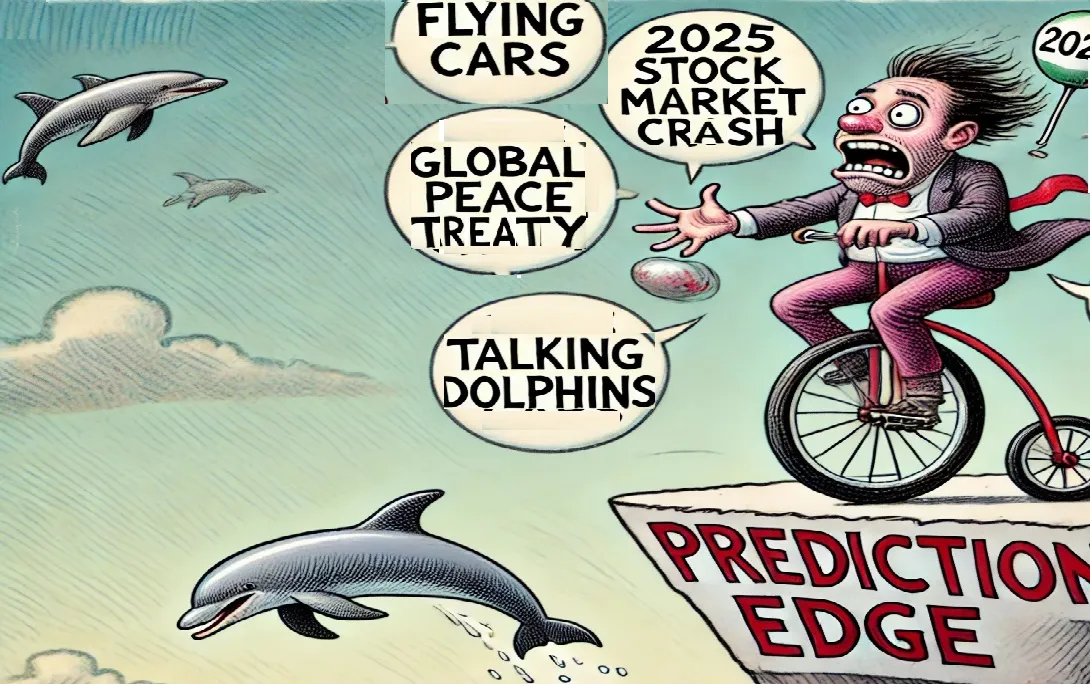
Will it be world peace – or an end that is well nigh? Perhaps flying AI dolphins?
“The future is open,” wrote the philosopher Karl Popper. “It is not predetermined and thus cannot be predicted.” He had a point: Our world is an unruly beast, seldom tamed by the sharpest minds or most careful calculations. It’s also true that people don’t change at my age – and so, appreciating the folly of my endeavor and in line with a lifetime of recklessness, here are my predictions for 2025.
Generative AI becomes truly ubiquitous
Let’s start with an easy one, since I did not promise that all of them would be reckless. The integration of generative AI into mainstream professional and personal workflows will reach a tipping point by the end of 2025. While Gen Z students have been using AI tools like ChatGPT for at least two years, and many industrious professionals in fields like marketing, coding, and design are early adopters, holdouts remain in some industries. But not using AI will soon be akin to avoiding search engines—untenable for anyone aiming to maintain productivity and competitiveness.
This shift will particularly challenge professions and individuals that rely on demonstrating originality and intellectual rigor, such as students. Educational institutions will likely move away from assigning routine tasks as homework—knowing AI can complete such assignments with ease—and instead prioritize in-class assessments, oral exams, and performance-based evaluations. The focus will shift from regurgitating information to demonstrating critical thinking, creativity, and adaptability in real-time. That’s not so bad – because in a professional world where AI is ubiquitous, those are precisely the skills they will need. But concerns will grow about mass worker displacement – and there will be pressure on companies to avoid it: the knew way to get sustainability points will be less DEI, more retraining for AI.
There is, however, a downside (if not a dark side). Meta seems ready to roll out fake users based on AI (they would call it by some less-dire euphemism) in a misbegotten attempt to appeal to younger users (or, at least, their worst impulses and instincts); this is clearly a corollary of CEO Mark Zuckerberg’s flailing obsession with the Metaverse (which Elon Musk, who like a broken clock is right twice a day, pleasingly mocks). And deepfakes will go through the roof; expect a flood of false videos depicting interesting-yet-plausible things, and criminals claiming evidence of their misdeeds was faked via AI (and in some cases it will be true). Election interference via AI (and its deployment via social media, as occurred in Romania in November) will skyrocket too. The mayhem will be great enough to give nostalgia a good name – but the improvements to quality of life will be spectacular, as well.
Middle East wars wind down in bizarre Trump Effect
The regional mayhem sparked by the Oct. 7, 2023 invasion of Israel by Hamas has set in motion tangled conflicts across the Middle East — from the disaster in Gaza to the insanity of the stone-age Houthis of Yemen firing at Israel from 1,000 miles away and attacking ships headed to the Suez Canal. The war between Israel and Hezbollah in Lebanon is in a cease-fire, and Israel has thrashed the Iran-backed militant group, but it could still reignite.
All this may finally wind down, largely due to the new-old US President Donald Trump. Trump’s determination to end the conflicts that erupted on Joe Biden’s watch – both in the Middle East and Ukraine – may actually bear fruit. That is largely because it is the Gaza war that keeps all the other fronts percolating, and Trump has enormous leverage on the one person who can end it, Israeli Prime Minister Benjamin Netanyahu.
Israel’s military says Hamas’ military wing has been eviscerated and is no longer a threat. But Netanyahu has blocked any effort to engineer a different government in Gaza, and he uses that fact – that Hamas is still the likely ruler in the strip – as his excuse for prolonging the war. An Israeli pullout in exchange for the hostages – a deal Hamas offers and which more than 70% of Israelis desire – is opposed by the far-right which threatens to bring down the government. This is why Netanyahu has swatted aside Biden’s proposals for a war-ending package to include normalization deal with Saudi Arabia. Expect Trump to adopt these proposals, claim credit for them, and rope in Netanyahu. The cynical Israeli leader will have a much tougher time ignoring Trump, whom he has himself made a hero in Israel. But the war’s end could come after an escalation early on – with Trump saying “Do what you must, then end it.”
Growing pressure on Iran’s nuclear sites (and the Houthis)
The global conversation about Iran’s nuclear ambitions will intensify in 2025. Key sites like Natanz and Fordow, shielded deep underground, continue to inch closer to weapon-grade enrichment capabilities. The international community, particularly Israel and the United States, faces an urgent question: Who will act to neutralize this threat?
Trump’s return to office – and the great weakening of Iran and its benighted “axis of resistance” may embolden unilateral Israeli action or encourage a coalition response, though his isolationist tendencies could complicate cooperation. Expect discussions to move beyond diplomacy into explicit plans for strikes. The risk of miscalculation or escalation will rise, with significant implications for global energy markets and regional stability. In a best-case scenario, the regime is so humbled that the forces that want to bring it down (which are backed by many and probably most Iranians) rise up, and succeed.
Related to this will be a decisive move against the Houthis – unless the Gaza war winds down fast and they immediately hang up their spurs. This one could be by the US and a Western coalition featuring Arab countries as well. It is absurd that the world has basically tolerate these criminals (who are responsible for almost a half million deaths in their impoverished country) impeding a third of global container traffic.
Trump will relish making Biden look like a sap for doing so little to stop it, and I would not expect any life insurance company to take on the organization’s chief mafioso, Abdul-Malik al-Houthi. Trump’s speech announcing this miscreant’s demise will practically write itself (though with the benefit of AI prompted to introduce grammatical mistakes and random absurdities).
US universities start to notice something’s wrong
By 2025, US universities will likely implement significant changes to counter growing public frustration over high costs and controversial policies. These changes will address two primary areas: diversity, equity, and inclusion (DEI) initiatives that even many liberals perceive had gone too far, and the exorbitant cost of higher education. While universities have long championed DEI efforts, the Supreme Court’s 2023 ruling ending affirmative action in admissions have already forced institutions to scale back or redefine their approaches – so a further rollback will align with legal requirements while also appeasing critics who argue that such policies have gone too far and have been threatening a drastic reduction of endowments.
On the financial front, universities will start to tackle the unsustainable cost structure of higher education. For upper-middle-class families who do not qualify for financial aid (because they are not otherwise poor), the prospect of saving half a million dollars to educate a single child has become untenable.
Recent actions by universities signal a shift toward affordability. Prestigious universities like MIT, Johns Hopkins, and Cooper Union have introduced significant financial aid expansions or even tuition-free models for qualifying families. For example, MIT now offers free tuition for families earning less than $200,000 annually, and Cooper Union plans to return to a fully tuition-free model by 2028. Many other institutions, from Lasell University in Massachusetts to Bridgewater College and Wartburg College in Iowa, are planning big tuition and cost reductions. Expect more of this.
Will this save universities? These are institutions charging a fortune (tuition in real terms at elite school has tripled since my student days in the 1980s) for attending courses taught in many cases by teaching assistants while the best thinkers in the world are available online for free. Adaptation may be needed, or the envelope will be thin.
Ukraine war shifts gear, possibly ends (but keep an eye on China)
As the war in Ukraine approaches its third anniversary, both Kyiv and Moscow remain locked in bloody battles to secure advantageous positions ahead of likely peace talks. Ukraine’s resilience has been remarkable, defying expectations of an early collapse, but Russia’s overwhelming size and willingness to incur staggering losses have slowly shifted the dynamics.
Biden’s exit and Trump’s reluctance to support Ukraine in a forever war could force a negotiated settlement. The likely scenario of freezing the existing lines is problematic, because in being seen to reward Putin’s aggression it could embolden other bullies, most prominent China’s Xi Jinping who has designs on Taiwan. Something creative balance will need to be found – perhaps in a Ukrainian fast-track acceptance to the European Union (note to eurocrats: while procedurally unlikely this is politically imperative). Another solution would be to declare it a truce – face-saving for all.
Ukrainian President Volodymyr Zelensky has fumed about the very mention of ceding any of Ukraine’s territory for any amount of time, but I’ve lived long enough to recognize a negotiating position. Such a fuzzy ending would be a bitter pill for its people and Western allies who championed its cause. Will a bad guy like Putin win? I hope not, and maybe this time he’ll get away with something – but either way I’m guessing his end will not be pretty.
The ICC backs down on Netanyahu
The International Criminal Court’s decision three months ago to issue arrest warrants against Netanyahu and Yoav Gallant (the ousted defense minister) was always controversial. Critics have argued that the move risks undermining the ICC’s credibility, as it appears both politically motivated and potentially unenforceable, since any country can grant immunity at will.
Sometime in 2025, probably when the war ends, expect the ICC to find a face-saving way to back down from these warrants. That could happen as a result of the establishment of a Israeli commission of inquiry headed by a judge. Netanyahu currently opposes this, arguing essentially that the justice system is predisposed against him; but the vast majority of Israelis demand it, and there is a tradition of establishing such commissions in the wake of disasters.
A quiet shelving of the warrants would also help the court with the incoming Trump administration – where there are strong headwinds pushing for personal sanctions against ICC officials and punitive action against countries, including US allies, that might collaborate with the Israel arrest warrants.
The educated elites will start to openly question democracy
By 2025, disillusionment with democracy among educated elites will reach new heights. What good is democracy, they’ll ask, when it produces so many stupid and damaging results? The classic argument – that it is the least-bad system – may need updating; this is the system that gave us Trump, and earlier (can you believe it?) Putin, and Recep Teyep Erdogan in Turkey.
Many educated people view democratic systems as gridlocked and incapable of addressing pressing global challenges like climate change, wealth inequality, and authoritarian threats. Populist leaders often dismiss expertise and cater to the emotions of the masses, yielding great idiocy and irrational governance. And the success (for a time) of technocratic authoritarian regimes, particularly China, has led some to question whether democracy is necessary for economic and social stability.
In response, elites may gravitate toward systems that prioritize efficiency over representation, advocating for reforms that concentrate decision-making power in expert-driven institutions rather than elected bodies. Perhaps Singapore will be a model. Some will argue for knowledge-based qualification for suffrage. Meanwhile, expect more gated communities and politically-motivated country relocations – while liberal US states discover the usefulness of the “states’ rights” idea that once was used to justify slavery.
Predicting the future is a humbling exercise, one that often reveals more about the predictor than anything else. Will these forecasts for 2025 come to pass? As various thinkers have noted, the best way to predict the future is to create it. I won’t deny that I would indeed welcome concrete action to make at least some of the above predictions all come true. Which ones? This only a careful and dedicated reading of Ask Questions Later will reveal!
