












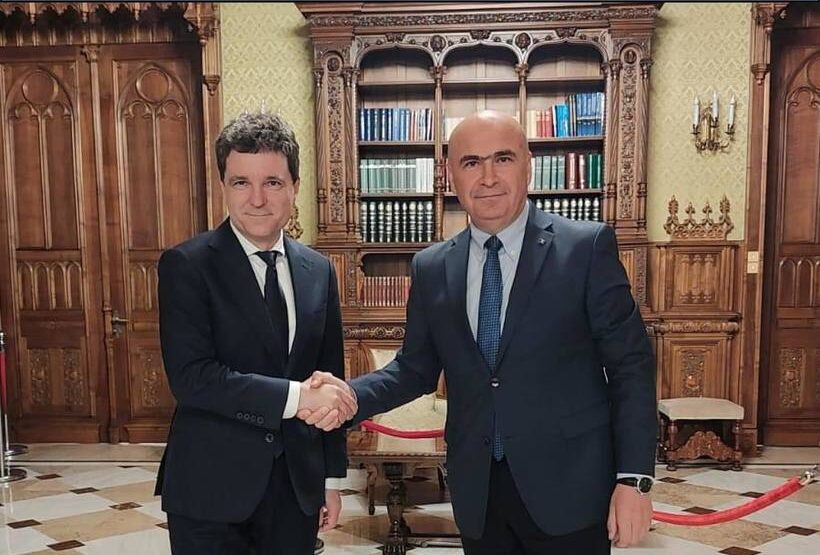
In the post-revolution years, Romania has never had a president and prime minister who are as united as they are in fighting against incompetence and theft in the public system.
In the last 35 years, no prime minister has exposed with the clarity of Ilie Bolojan what is structurally wrong, and what the prospects are for Romania if nothing substantially changes, and what measures the government is willing to take.
I don’t remember any team at Victoria Palace (Eds: the government offices), which has gone public the way Prime Minister Bolojan did, to expose the true realities that they are dealing with in government.
Of course, the current government is not perfect and the current ruling coalition isn’t working in flawless harmony, but it should be stated that the Bolojan government has set off on the right foot.
Of course, there are no automatic guarantees that the actual implementation of the measures, painful for all citizens and companies, or merely irritating for the networks that cap public money, will proceed efficiently and without major setbacks.
Even less certain is the fact that the political will from Victoria Palace will be reflected, in the medium and long term, in a political capacity to transform its will into reality, something that will only be seen through concrete results.
Even so, the early signs are promising, and in the early phase in which we find ourselves in, this is core to their future success.
At the same time, no other government since 1990 until now has benefited from such a favorable context: the degree of awareness among the general population of the moral and economic gangrene in the public system is at an unprecedented level.
This can be identified both in terms of the general indulgence about the way the state apparatus functions and low expectations voters have of decision-makers.
All of this – awareness, indulgence and expectations – were manifest during the presidential election campaigns in November 2024 and May 2025.
Regardless of how people voted in the election, it was clear that, it was not only polarization (which was mostly artificially created) that had a say, but also something that united all voters, regardless of their options – the common denominator of awareness, lethargy and expectations.
These are the real aces that the current government has, and it is up to the government to exploit this asset to the maximum, for resistance to the radical changes announced by Bolojan from within will be unprecedentedly high, and in such a conjuncture, no ally is more precious than the entire population.
Lastly, from the way the government began to clean up the murky areas of the Romanian state, it seems that, for the first time, there are real grounds for an authentic and robust joint-venture between the Victoria Palace and the Cotroceni presidential Palace.
Cooperation between the two palaces is mandatory if results are really to be achieved. And above all, the two palaces need to have a keen sense of self-preservation.
After Prime Minister Ilie Bolojan was installed at Victoria Palace and President Nicușor Dan at Cotroceni Palace, some speculated that the two leaders would enter some kind of rivalry.
This may be true in the future if both politicians want to compete in the 2030 presidential elections. But there is flaw in this kind of thinking: if they prematurely and mutually become adversaries, both Bolojan and Dan risk excluding themselves prematurely from the electoral competition five years away.
What is important for their game is precisely the fact that, regardless of their future plans, Ilie Bolojan and Nicușor Dan are forced by circumstances to cooperate with maximum openness and strident honesty, at least for the next three years.
The dream of Cotroceni in 2030 – elected (in the case of Bolojan) or re-elected (in the case of Dan) has to be put on hold and both leaders need to work on the strategic objective of the moment: getting the country out of the water.
For the Bolojan government, presidential endorsement will be of vital importance in the years to come, because although the government’s objective is economic recovery, the instruments on which it depends are of a profoundly political nature.
For the Dan administration, the success of the Bolojan government is also of vital importance, because although its objective is fundamentally of a political nature, the instruments for achieving it are intrinsically economic.
This is why, as far as I am concerned, I expect we will witness some years of careful and deep collaboration between the pair until the time comes when they decide to go into an electoral competition.
In an ideal world, this would happen because it is the principled and honest approach to Romanian citizens, But in the real world, by nature a slightly meaner one, this will happen because of the reasons I described that connect the prime minister and the president to each other. If one of them fails miserably and prematurely, the other one will be dragged into the void.
As both leaders seem ambitious, it would be surprising if they were not as realistic about this reality and what they need to do to avoid failing now and at the same time ensure a political future.
I recently wrote that Romania, in its current situation, is doomed to have both a strong prime minister and a strong president, even if this leads some people to think that in these circumstances the two will go head-to-head.
What unites Ilie Bolojan and Nicușor Dan them is stronger than what separates them. They are united by a systemic crisis, with the prospect of default a possibility until yesterday. They are separated by possible personal ambitions.
Both the prime minister and the president possess strong analytical skills and are highly proficient with numbers. They are also politicians who know the ins and outs of the political and electoral world. And both have built their political careers by betting on everyday achievements, but also with an eye on the long term.
It would be inexplicable for Ilie Bolojan and Nicușor Dan, to abdicate from this modus operandi just now when they have the right conditions to build their long term political careers.
