






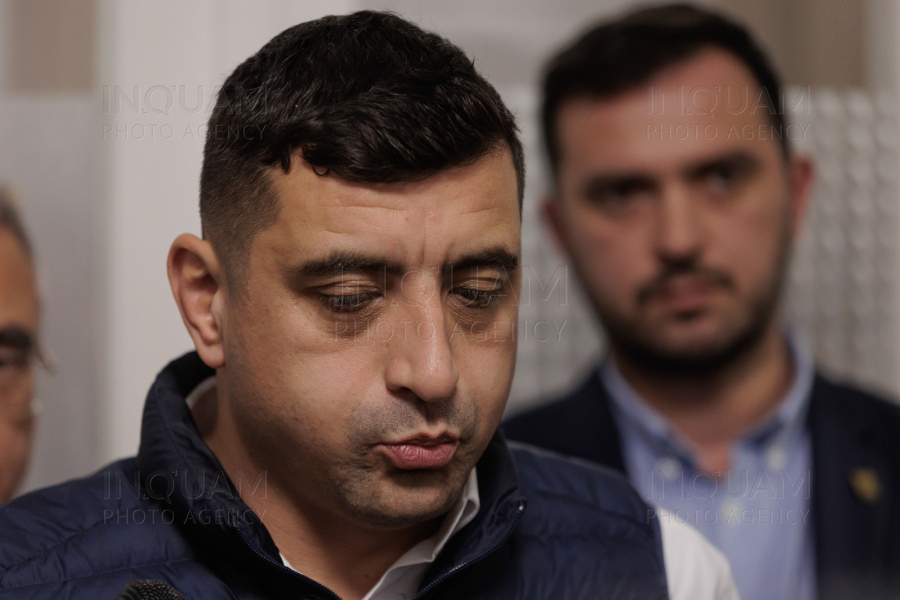
George Simion, the leader of the AUR (Gold) Party, may get into the second round of Romania’s presidential elections, giving his party the opportunity to benefit from extra momentum in the parliamentary elections the following Sunday.
AUR leader George Simion is one of the ‘golden’ supporters of Russian propaganda narratives in Romania, and a fervent critic of Romania’s support for Ukraine. He is a fierce critic of the pro-Western leadership and Western path that the Republic of Moldova has embarked on. At one point he even demanded that Bucharest cut off the support provided to Chisinau, all the more revealing because at the time Moldovans were facing growing pressure posed by the war in Ukraine and Moscow’s interference. In the meantime, the pressure and Russian meddling have reached fever pitch and are still increasing,
This aspect related to Simion’s attitude towards the Republic of Moldova is particularly interesting, as Moldovans have, for the most part, a completely different opinion from George Simion.
In recent years, Moldovans have twice voted Maia Sandu president and recently approved the pro-EU referendum she organized. There are, of course, Moldovans who did not vote for Maia Sandu, and instead voted for the candidate supported by the Kremlin.
Three observations are worth highlighting:
1. Can George Simion be credible when he attacks the pro-West administration in Chisinau, in the context in which the majority of Moldovans voted twice for this administration to remain in power? Does George Simion know better than the Moldovans themselves what is good and what is not good for them? Is Simion better equipped than the Moldovans living across the Prut (the river that forms the border between Romania and Moldova) to measure the toxicity of Russia’s influence in the Republic of Moldova?
2. Then, isn’t it suspicious that an individual who claims to be a great Romanian patriot and fond of the Romanians here and across the Prut has a vision close to that of the pro-Russian electorate across the Prut, regarding the direction that the Republic of Moldova has under Maia Sandu’s leadership?
3. Finally, George Simion claims to be a unionist, as does his party. His party colleague, Claudiu Tard, even has plans on how to achieve the union: by talking to Moscow. Well, the matter is simple here too: Russia’s long-term policy has always been to detach territories and become, in order to dominate, peoples. With Romania he really succeeded, taking over 80 years ago what today bears the official name of the Republic of Moldova. But Russia succeeded, 50 years later, with the Republic of Moldova, cutting out of it what today bears the name of cardboard, Transnistria. How can anyone, among those who go to the polls on Sunday to vote for a new president of Romania, believe that Simion, Tarziu, and AUR want the union and will make the union, when they, gasp, serve the interests of the power that first carved up Romania, then prevented both the reunification and the return of the Romania’s national treasure?
Next, let’s go back to Ukraine for a moment.
George Simion’s anti-Ukrainian position is already well known.
It is also well known that, in September, AUR MEPs voted against a resolution of the European Parliament, which called on the US to lift the restrictions imposed on Kyiv to strike legitimate military targets on Russian territory (restrictions finally lifted by Washington).
It is also a fact that Claudiu Tarziu caused a stir in the Russian press, which appreciated his desire to snatch territories from Ukraine.
Probably, compared to Simion and Tarziu, even Sergei Lavrov sometimes seems repetitive to Putin, in terms of sincere adherence to Russia’s imperialist interests and the efficiency of promoting them.
Last but not least, the pro-Russian position of candidate George Simion becomes glaringly obvious as it is projected in the current context.
A context in which we already see many countries, other than traditionally the leading Baltic states, which have started preparing the population, the business environment and the army for a possible military confrontation with Russia, in case Ukraine falls. Germany, Poland, Sweden, for example, are in the midst of intense and detailed preparations.
So we running for the presidency of Romania we have, I repeat, with chances of entering the second round – an individual who, on the contrary, is enabling Russia in Romania, the Republic of Moldova and Ukraine.
George Simion is a real danger for the country and for his fellow citizens. If he were to become president, George Simion would also put Romania in an unprecedented situation: he is banned from entering two key countries, the Republic of Moldova and Ukraine.
It’s hard to imagine what kind of relations we could have with these two neighboring countries if this individual became the head of state. It is impossible to imagine how such a president could serve the interests of his own country in the two countries to which we are so intimate, strategically and, by virtue of geography and history, so inevitably and irrevocably linked.
At the beginning of the year, the Prime Minister of the Republic of Moldova, Dorin Recean, clarified Moldova’s position with the AUR candidate: “The state institutions have determined that George Simion is part of the destabilization effort in the Republic of Moldova and I have communicated this to Prime Minister Ciolacu as well.”
But Ciolacu has completely different plans. And cultivating Simion’s image is his piece de resistance.
