















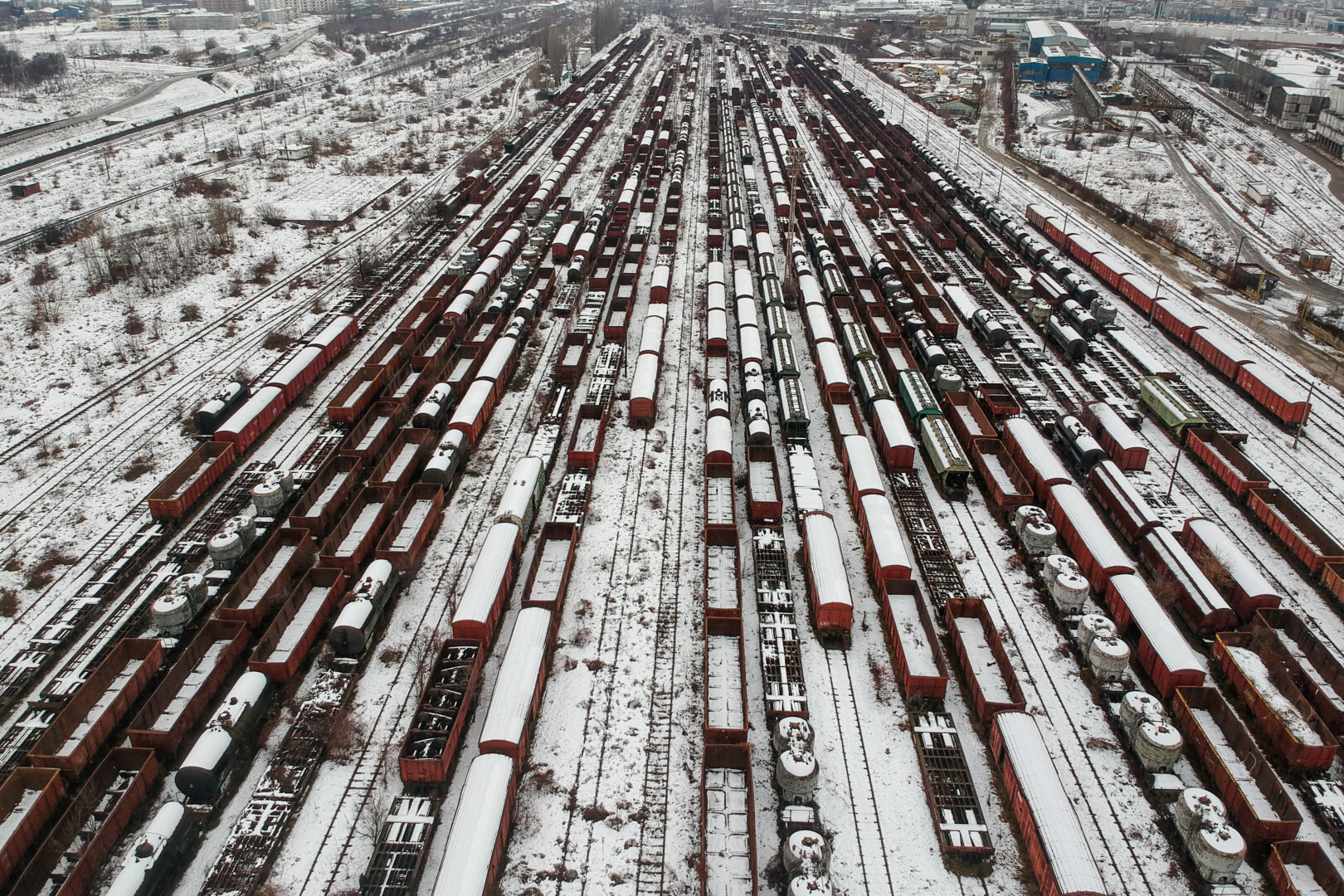
Freight trains in Romania are so slow that it takes them a week to go from east to west, a journey of under 1,000 kilometers.
They run at an average speeds of just 15–16 km/h, three times lower than passenger trains which themselves are already slow by European standards.
This makes them expensive and impractical. Rail freight traffic has decreased by more than 25% in the last five years, Simona Istrate, head of the employers’ association of private rail freight transport companies told news outlet, HotNews.
It’s a problem for future business as Romania is unattractive for the large logistical flows in the region she said.
We risk being unattractive for logistics flows in the region
“Freight trains do not have priority at crossings with passenger trains… In normal rail traffic management, the railway network was designed with many lines ….All modernizations were made with the objective of improving rail passenger transport. No one mentions the improvement of rail freight transport”, Istrate said.
Explaining the conundrum she said that a freight transport from Constanta in the east to the Hungarian border in the west can take up to a week.
Part of the problem comes from long stops, Istrate said. As a result rail freight transport decreased by more a quarter since 2019.
Executives of major foreign investors such as Dacia and Ford have drawn attention to the issue in the past, with one Ford company boss Josephine Payne claiming she rode her bike faster than the freight train.
Evern animals are quicker. African giraffes and elephants run at 25 kilometers per hour, and when they travel long distances they do so at averages of 16 km/h.
“In Romania, the freight train is much slower than it should be and much more expensive than it should be, because it does not benefit from any support. Not even by compensating for the access to diesel that road workers have, for example,” Istrate lamented.
She says that “urgent measures” are needed, because at the current pace, the railway network in Romania risks becoming totally unattractive for the large international transport companies that, as far as possible, will orient themselves towards neighboring countries. And Romania risks becoming unattractive for the large logistics flows in the region.
Train speed is also related to works on the line and trains have to take detour routes, sometimes 200 km longer, Simona Istrate told Hotnews.
“When the distance is longer, the total commercial speed is low and additional costs also intervene, because if the distance is longer – then the traffic time also increases and the transport costs (with fuel, but also with personnel) increase”.
Most problems are in the west because the Cluj – Oradea line has been closed for modernization since 2024 and it is unlikely to be reopened before 2027.
A freight train can be stationary for hours and even stay for days in a station, before receiving the departure signal.
Between Curtici on Romania’s western border and the capital Bucharest, some trains take the 100 Timisoara – Craiova line, and others are re-routed through Brașov, via Deva.
There are two areas with big problems for freight trains:
- The Balota area on line 100, where there are high slopes, the line is in a bad condition and there are speed and tonnage restrictions for freight trains. On large sections, trains go under 10 km/h.
- The Constanta area, where there is ongoing work to allow freight trains easier access to the port. Recently, works on the Palas tunnel were also announced, to open a new access road.
