









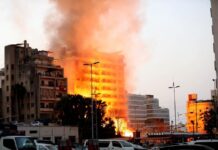
Iran’s regime deserved to be crushed. But going to war without a serious plan for the Strait of Hormuz may rank among the great strategic blunders of modern history.
The war against Iran’s regime was justified. The Islamic Republic spent decades as the principal engine of instability in the Middle East, funding and directing proxy militias from Lebanon to Yemen, arming Hezbollah and Hamas, destabilizing Arab governments, attacking maritime commerce, massacring its citizens and pursuing nuclear weapons under clearly false civilian pretenses.
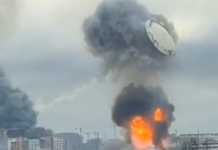
And militarily, the campaign achieved what its architects intended. Iran’s leadership was devastated. Ali Khamenei and dozens of his lieutenants were eliminated. Major elements of the IRGC command structure, Basij oppression police, intelligence services, missile infrastructure, navy and much of the missile and nuclear program were mauled. The Islamic Republic suffered a massive blow.
But.
Astonishingly, the regime survived and is currently acting like a victor because of an American blunder that stands as one of the greatest strategic mistakes in recent history. This lies in the incomprehensible fact that the US appears to have launched the war without a coherent and internationally coordinated plan for the Strait of Hormuz, even though it was obvious Iran would try to block the critical waterway in order to upend the global economy. That failure is so glaring that it scarcely seems believable. It belongs among the great examples of strategic folly that historians study for generations, like Napolean invading Russia without a plan for the winter.
For decades, CENTCOM planned precisely for this scenario. Entire careers inside the American military establishment revolved around the possibility that Iran, unable to defeat the US conventionally, would turn to asymmetric maritime warfare in the Gulf. Naval strategists studied mines, anti-ship missiles, drones, swarm attacks, sabotage operations, proxy strikes, tanker harassment, and insurance disruption. The Strait of Hormuz was the central contingency, since it is the artery through which a massive share of the world’s energy supply flows.
Also, it should have been clear Iran would fire across the Persian Gulf at the Gulf petrostates that have become important US allies, and whose business model — attracting expats, in large parts — depends on not being fired upon by anyone.
And yet the political leadership appears to have entered the war assuming that overwhelming force alone would solve the problem. That assumption now looks extraordinary in its recklessness.
When it comes to stupidity, history offers parallels. Germany resumed unrestricted submarine warfare in World War I believing Britain could be strangled before the United States fully mobilized; Instead, Berlin brought America into the war and transformed the strategic balance against itself. Japan achieved a spectacular tactical triumph at Pearl Harbor only to awaken the industrial and political fury of the United States. Napoleon, as suggested, marched triumphantly into Moscow while failing to grasp that Russia merely needed to survive, retreat, and stretch French logistics until the seasons changed.
More recently came Iraq, perhaps the clearest American example of all. The United States destroyed Saddam Hussein’s regime in a matter of weeks. Yet Washington entered the war on false intelligence about a supposed Iraqi weapons of mass destruction program, with no serious political blueprint for the order that would emerge afterward, and then made every conceivable mistake (mainly eliminating the entire bureaucratic structure of governance, as if Saddam’s Ba’ath had been an actual popular movement). The result was a massive jihadist insurgency, sectarian disintegration, and an Iraq dominated by its neighbor Iran.
The current crisis increasingly feels like another chapter in that same tragic pattern because the problem was never simply whether Iran could be hurt but what would happen after Iran absorbed the blow.
The answer is now becoming clear. The regime survived just long enough to adapt. Early rhetoric from the White House reportedly framed the campaign almost as a short punitive operation, something measured in weeks rather than months. Trump also promised the Iranian people would have their country back.
But Iran did not require battlefield victory. It merely required endurance. And once the regime endured, the entire political structure inside Iran transformed.
The old clerical facade largely collapsed under the pressure of war. The supposedly “elected” politicians of the Islamic Republic had always functioned largely as theatrical figures operating within an absurd system of ideological vetting controlled by unelected clerics and security institutions. As long as the regime maintained stability, these fictions could survive. But existential crisis stripped all illusion away. As always, the men with guns took over openly. So Iran today increasingly resembles a pure military dictatorship dominated by the IRGC and organized around regime survival. In Trumpspeak: Not very nice people.
Ideological regimes at least maintain some stake in governance, economic management, and social legitimacy. Survival regimes are more ruthless, more erratic, and more dependent on asymmetric leverage because they no longer believe prosperity or legitimacy can preserve them. And in Hormuz, Iran discovered exactly the kind of leverage it needed.
The closure of the Strait of Hormuz, almost immediately upon the launching of the war, triggered precisely the predictable cascading systemic shock. Roughly one fifth of globally traded oil and global LNG supplies normally transit the strait, along with enormous volumes of petrochemicals, fertilizer inputs, aluminium, and refined products. The shutdown removed or disrupted between 20 and 33 percent of critical seaborne energy and industrial commodity flows almost overnight. Tanker traffic collapsed. Freight insurance exploded. Hundreds of vessels began operating “dark” by disabling transponders while others rerouted around Africa at immense cost and delay.
The damage extended far beyond fuel prices. Fertilizer exports through Hormuz account for more than 30 percent of global urea trade and major shares of ammonia and phosphate flows, immediately threatening agricultural markets and food inflation. Aluminium exports from the Gulf, critical to manufacturing and energy infrastructure, were severely disrupted. Asian economies, especially Japan, South Korea, India, and China, suddenly faced acute exposure because roughly about five-sixths of oil and LNG goes to Asia. The crisis exposed a central vulnerability of the Western alliance and the broader liberal economic order: the entire system still depends on a handful of maritime chokepoints protected — in theory — by American naval supremacy and geopolitical stability.
Once Iran demonstrated that even a weakened power could throttle one of those arteries through asymmetric warfare (meaning a few cheap drones and rockets), the illusion of secure globalization looked fragile. And the US looked ridiculous. A country in the position of the US cannot afford to look ridiculous.
So how could a war against Iran have been launched without an overwhelming, detailed, allied-backed Hormuz strategy already in place from the first hour?
Well, for one thing, the US entered the crisis diplomatically weakened. Rather than leading a broad coalition, the US approached the war after unnecessary friction with allies, including repeated confrontations with NATO partners over issues such as Greenland — over which Trump had, insanely, threatened to invade alliance member Denmark — and burden-sharing.
It might have required a military occupation of part of mainland Iran around the strait. It might have required a more determined push to truly bring down the regime, with asstes in place and prep work done to take over power centers. It might have required a global willingness to endure months of economic pain while the regime was decisively suffocated by a total land, air and sea blockade — which would have needed careful messaging and persuasion. It certainly requires coalition management, shared maritime patrols, insurance guarantees, coordinated economic stabilization, logistics cooperation, and global legitimacy.
Instead, America was isolated while global markets panicked.
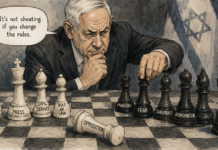
That helps explain the growing frustration inside the White House. Trump is plainly looking for an exit ramp and reportedly exploded during a phone call with Benjamin Netanyahu this week when Israeli escalation in Lebanon caused Iran to threaten a walk-out on the cease-fire talks. As we have reported, Trump screamed at Netanyahu, demanded to know “what the fuck” he was doing, accused Israel of worsening the situation, and raging that the world now hated both Israel and Netanyahu. The emotional outburst reflected the no-good-options scenario.
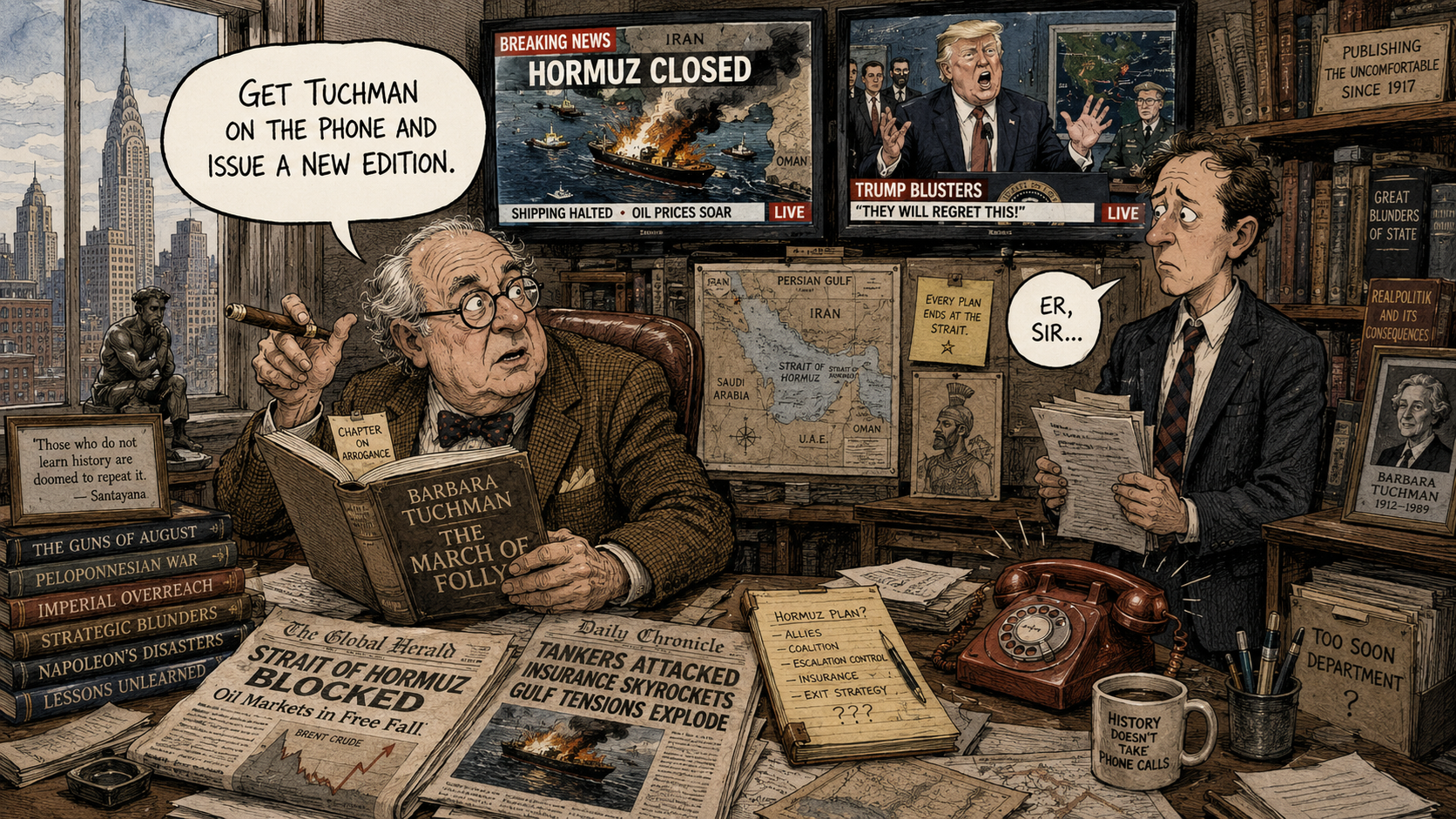
Historian Barbara Tuchman called such mistakes “the march of folly” in her iconic 1984 book by that name (one of the best-named books, I think, of all time): governments pursuing policies contrary to their own interests despite abundant warnings and obvious dangers. Again and again, leaders convince themselves that military superiority can substitute for political foresight. They focus on the opening strike and neglect the chain reaction that inevitably follows.
Incredible as it may seem, and justified though their effort is, the United States and Israel, in having no plan for Hormuz, have written a perfect chapter for an updated edition. I supported the war, because I assumed there was a plan. Absent such a plan, it is one of the great strategic blunders of the modern age.
