













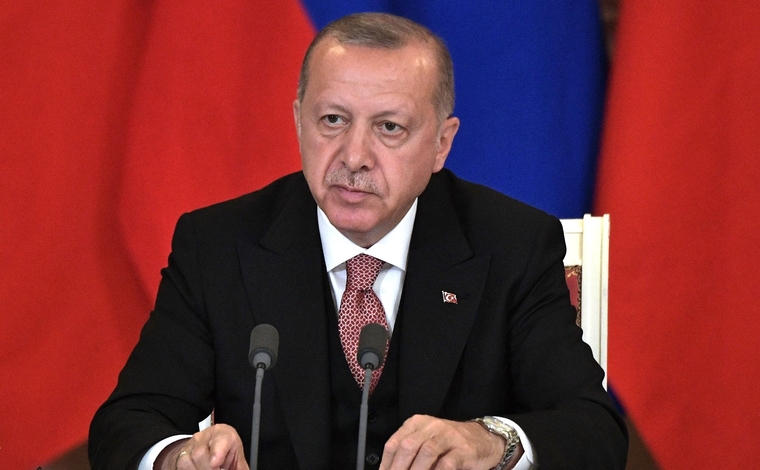
Turkish President Recep Tayyip Erdoğan has criticized Israel over its recent decision to move towards officially recognizing the Armenian Genocide, accusing the country of using what he called “slander” to distract attention from its actions in Gaza.
He also falsely asserted that Turkey’s history contains no genocide, massacres, oppression or colonialism.
In June, the Israeli government unanimously approved a resolution recognising the Armenian Genocide. The measure must still pass the Israeli Parliament before it becomes official state policy, but it has already sparked anger in Turkey.
Armenia itself, meanwhile, has responded cautiously to the Israeli initiative. Prime Minister Nikol Pashinyan declined to comment directly on the proposal, suggesting instead that the issue was being “weaponized” for political purposes.
Speaking on Tuesday, Erdoğan claimed that throughout Turkey’s “thousands of years of glorious history”, the country had been defined only by justice and compassion.
“Our history is one of extending a hand to all oppressed people, regardless of their religion, ethnicity or identity. It is the history of protecting those fleeing the Inquisition and Nazi persecution,” he said.
His remarks contradicted the widely documented history of the Ottoman Empire’s mass killings of Armenians between 1915 and 1923, as well as atrocities committed against Greeks, Assyrians and other minority groups, which many historians and governments recognise as genocide. Turkey has also long faced criticism over its treatment of the Kurdish population. Although many Jews fleeing the Spanish Inquisition did settle in the Ottoman Empire, historians have argued that pro-government narratives have exaggerated Turkey’s role in sheltering Jewish refugees during the Second World War. Today, Turkey’s Jewish community numbers about 14,000 people.
Separately, Turkey’s state broadcaster TRT published an analysis on Tuesday arguing that Israel’s recognition of the events of 1915 was motivated less by a genuine effort to confront history than by a desire to retaliate against Turkey over its criticism of Israel’s actions in Gaza.
The article said the recognition was intended to provoke Ankara rather than commemorate Armenians, claiming that a century-old tragedy was being used as a political tool to punish Turkey for its position on Gaza, and ended with a carefully worded criticism of Israel’s decision, suggesting that Israeli leaders should reconsider the resolution.
