






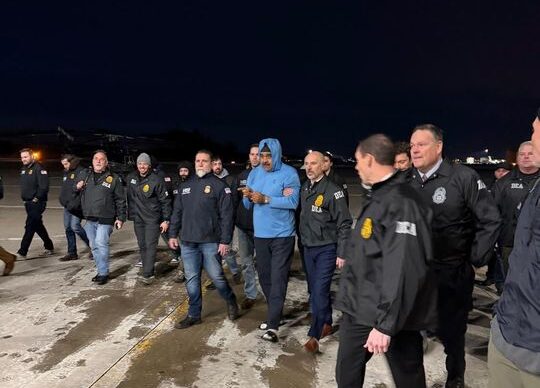
US President Donald Trump’s spectacular move in Venezuela, airlifting troops and capturing the dictator Nicholas Maduro, has an unpleasant sub-story to it and it’s hard to imagine that it could have a very different outcome.
For a president who ran on a so-called pacifist platform, slamming costly wars and excessive spending on foreign affairs, Donald Trump immediately grasped, in the first year of this second term, the taste of the use of force not only domestically, but also abroad. .
He mobilized the army in politically difficult cities, under the pretext of fighting crime, and in the name of fighting migration; he proceeded to a kind of urban safari among those suspected (sometimes unfounded) of being illegally in the US. Finally, in the name of fighting terrorism and the like, foreigners who enter the US legally will have their social media posts searched– and God forbid if they denigrated the “king”, because they can say goodbye to visiting the United States!
Abroad, Trump threatened Greenland and Canada with becoming part of the U.S., he bombed Iran, attacked Venezuela and captured its dictator.
It’s true, also on the foreign affairs front, Trump has so far fled from Putin, something to be expected even when the Russian wasn’t nice to the American king. On the rare occasions when he didn’t run away from Putin, Trump went out of his way to serve him on Ukraine.
But at the moment, the Venezuelan issue seems to surpass everything. Because the public information we currently have is likely to point to the following conclusions:
- The operation to capture Maduro was built on a thin pretext and a series of fake news bullet points. The pretext: the fight against drug traffickers who flood American cities with drugs. The pretext is flimsy since Venezuela was considered neither the source nor the preferred route of drugs destined for US markets. Then, the fake news was striking: Donald Trump himself claimed as early as the fall that the sinking of four boats of so-called traffickers (so-called, because he never presented conclusive evidence) would have saved 100,000 American lives. According to the US president, a single boat carrying enough drugs to kill more than 25,000 Americans. The problem is that existing federal data for 2024 suggests that in the U.S. the number of overdose deaths exceeds 80,000 per year at most. So, in Trump’s narrative, from four boats you solve the problem for a year or so. But what do you do with the other boats that left Venezuela, what do you do with the drugs coming from Mexico and Colombia plus the drugs exported through China? It is dizzying and threatening that in 2025-2026, the president of America allows himself to treat the intelligence of national public opinion and that of the international community as you would treat the intelligence of a parrot. But, here, in the era of the high-tech boom, that’s exactly what happens, at the point we are now.
- Trump needed to construct a false narrative – drugs in Venezuela – to anesthetize the senses of his electoral base to his new foreign military adventures. The fact that the political legitimacy of his actions, in this case Venezuela, was built on a forgery is therefore easily verifiable and at the same time difficult to take by surprise. In the end, his rise to the White House was based, in both successful election campaigns, on blatant and non-stop lies. In other words, Trump governs the same way he ran for the White House.
- Members of the U.S. Congress were not exempt from lying either. The Democrats, through the voice of their Senate leader, Chuck Schumer, accused the Trump administration of saying in three confidential briefings that it would undertake neither military operations nor regime change in Venezuela. On January 3, 2026, however, both took place.
- After consummating the special military operation (what an unfortunate echo of Putin’s special military operation!), Trump left it softer with fake news (drugs) and finally put the truth on the table (we will take the oil and take over the leadership of Venezuela).
- In the first phase (immediately after the explosions in Caracas and other areas were observed, as well as immediately after Trump had confirmed on his social network the capture of Maduro), ordinary Venezuelans (from and outside Venezuela), as well as members of the democratic opposition (including the widely recognized leader, Corina Maria Machado) expressed their joy and hope that the country could finally follow a path worthy of their aspirations for freedom, democracy and sovereignty. Well, the joy may be short and thin, because Donald Trump has meanwhile sketched the contours of Venezuela’s future: it will be led from Washington in a kind of partnership with members of Maduro’s criminal regime. At the same time, Trump downplayed Machado’s significance and legitimacy among the Venezuelan population. In other words: maybe it will be a little better in Venezuela without Maduro, but not necessarily by much, because America will be patting itself on the shoulders with Maduro’s people, not with the anti-Maduro opposition. Then, goodbye sovereignty, since the guidelines of Venezuela’s politics, economy and diplomacy would be dictated by the US through local and unscrupulous proxies. It is as if in Romania in December 1989, Moscow had accepted the removal of Ceausescu, but Romania had continued to be piloted from Moscow through the other peaks of the former regime (for a while, in fact, this happened to us).
In any case, the Venezuelan people are nowhere to be seen in Trump’s post-invasion plans, just as the American people had not been anywhere in their president’s pre- and post-invasion plans (he was neither consulted nor actually informed).
Instead, Trump’s plans outline a symbiosis between an American oligarchic clique and a Venezuelan nomenclaturist clique; a forced, but possibly mutually beneficial love, maintained by petro-dollars.
For the Trump administration, the Venezuelan Securitate and nomenclaturists will be as precious as the black gold in the country’s soil.
Why? Because they are the most effective mechanism for America to run and milk Venezuela’s oil, with minimal costs and at the same time without the risks associated with a significant presence, including a military presence, on Venezuelan territory. The co-optation and co-interest of the Maduro regime, but without Maduro, dramatically limits the possibility of the coagulation of formidable forces hostile to the Americans.
It remains to be seen, however, whether the plans on paper will work just as well on the ground, as potential variables, for alternative scenarios less friendly to the White House’s intentions, may still emerge.
For Europeans, the Trumpist kidnapping in Venezuela will generate new problems in the transatlantic alliance, new security problems because of Russia, new strategic concerns about the threat that hovers (now more than ever) over Greenland.
For the Russians and Chinese, on the one hand, what the Americans have just done in Venezuela is blowing an unexpected wind in the sails of revisionism. And on the other hand, Washington’s forceful gesture creates financial and influence holes for Moscow and Beijing, and this will only cement an already extremely damaging Russian-Chinese relationship internationally.
Because in the wake of Trump’s operation, in order to compensate for the losses thus suffered, Putin and Xi find themselves in a position to imagine and implement new channels and new instruments to sabotage the US and to sabotage Europe.
