











After a year of lickspittle “handling” of Trump, the Europeans are realizing that a new approach is needed if the free world is to be saved
By Robert Hamilton and Dan Perry
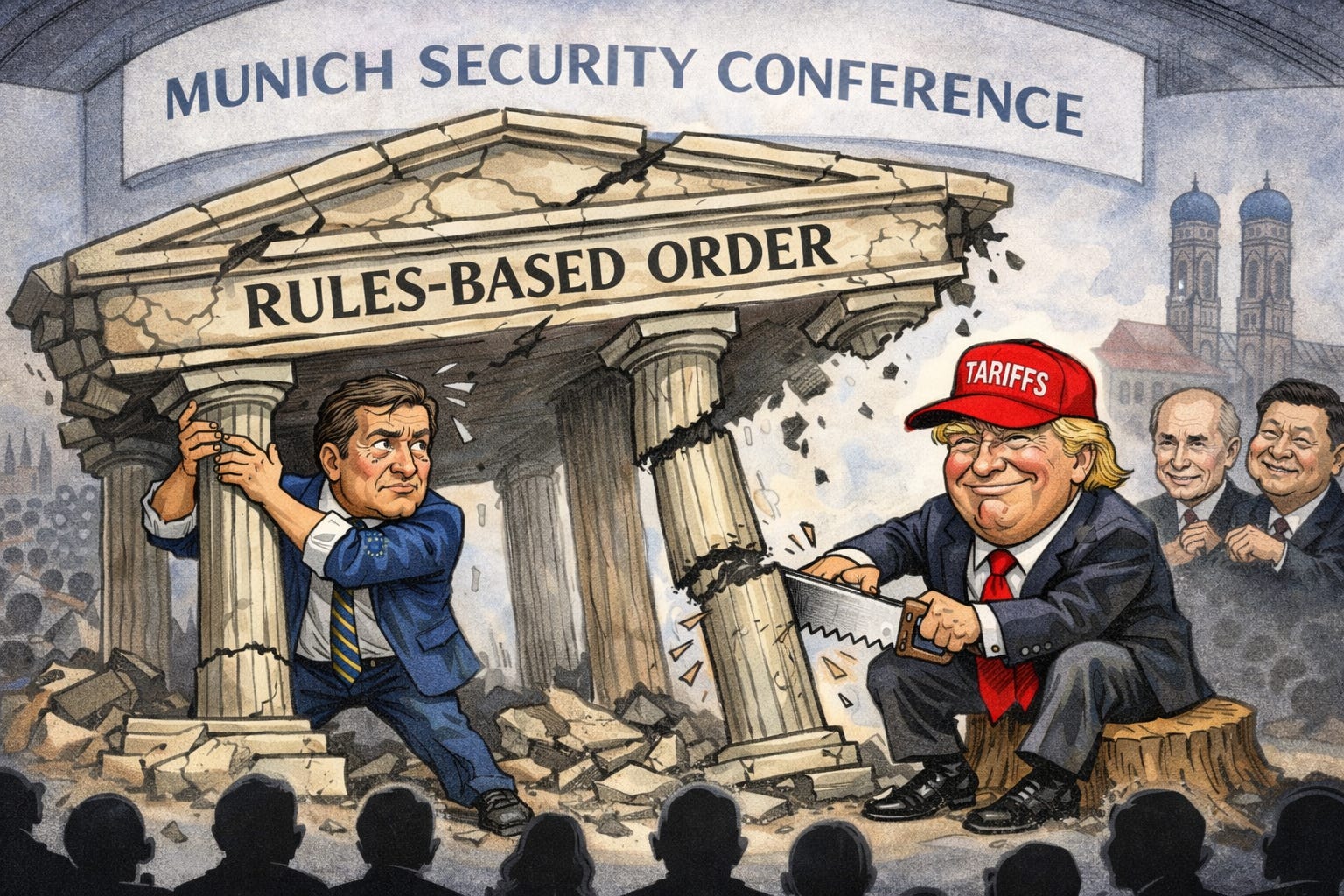
The Munich Security Conference has always been the West’s annual audit of threats. But at this year’s meeting — from Feb. 13 to 15 — the most urgent conversations will not be about Russia or China but about the US. The premise that US leadership is legitimate, predictable, and mostly benevolent, which held for 80 years, has been shattered by Trump. After a year of politely “handling” American disdain, culminating in last month’s implied threats to attack NATO ally Denmark over Greenland, look to Europe to start making itself heard.
Expect America’s erstwhile allies to try to preserve as much of the rules-based order as possible, reduce vulnerability to U.S. coercion, and at least try to keep the door open for America to return — if and when it chooses to do so. But expect also economic and strategic workarounds, and the beginning of a campaign to project to American voters, with an eye to November, that their clueless leadership is engaged in terrible self-harm.
That’s because the dense web of institutions and alliances built after World War II were not only primarily underwritten by the United States – the central architect has also been arguably the main beneficiary. This reality clashes violently with Trump’s narrative – cynical and seductive, but also stupid – that our allies have taken us for suckers.
The widespread Western belief in America’s good will made its leadership easier, cheaper, and more durable than power alone could achieve. The direction of travel is now toward a polarity-and-power system of spheres of influence — less law and fewer constraints, more bargaining and coercion. This is Trump’s comfort zone in all things, and can look stable for a while. But a dog-eat-dog system, when power shifts, becomes conflict-prone.
The shock to the system was evident during last year’s conference, when, just two weeks after Trump returned to office, Vice President JD Vance delivered remarks that landed with unusual force among European leaders. Rather than the customary reassurances about shared values and alliance cohesion, Vance’s tone was sharp and confrontational, questioning Europe’s political direction and openly criticizing what he framed as constraints on speech and democratic debate (which referred to efforts to curb far-right parties that aim to break up the European Union and are supported by Putin’s digital skullduggeries).
What rattled delegates was the sense that this was not rhetorical improvisation but an early glimpse of governing philosophy that breaks with eight decades of partnership. The speech quickly became the dominant topic of conversation. Munich, which was once a symbol of capitulation to Hitler but then turned into a stage for Western unity, became a venue for European unease and recalibration.
For much of the year that followed, European leaders appeared to settle on a strategy of managing rather than confronting Washington. High-profile visits to the White House carried a carefully choreographed warmth, heavy on praise for the American president and light on public friction. NATO chief Mark Rutte, a former Dutch PM, flirted with absurdity by at one point calling Trump “Daddy.” Europe even tolerated an openly unequal tariff arrangement, abandoning the long-standing ideal of free trade in favor of damage control and stability.
For their lickspittle efforts, the Europeans were rewarded with a National Security Strategy, released in December, that not only downgraded traditional alliances and stressed transactionalism, but also scolded Europe in civilizational terms, portraying the continent as adrift, weakened, and emblematic of Western decline. The NSS also hinted that the US would try to destabilize those governments in Europe it sees as too “woke” (or facing “civilizational erasure”) by working with far right parties in those countries. As, indeed, American officials have met with the AfD in Germany, a hardline nationalist grouping on the rise.
And then came the Greenland episode. Trump, reviving his long-standing fixation on the Danish island and spent weeks declining to rule out the use of force against this NATO ally, while insisting the United States would acquire Greenland one way or another. This caused genuine alarm, and while Trump’s attention appears to have wandered, it is hard to overstate the rupture.
So great is the dismay, that something new is almost certainly coming.
Europe’s emerging strategy will not be to replace the U.S. as hegemon but to prevent collapse — by keeping institutions alive, reducing dependence on American whim, and assembling a coalition of “rule preservers” that will include countries like Canada, Japan, Australia, and South Korea. These are states with different interests but shared preference for rules over brutishness, as their prosperity and security depend on predictability.
So Europe will probably go around America to keep the foundations of Western strategy functioning. That means sustaining Ukraine materially even if Washington walks away, with Trump parroting Vladimir Putin; maintaining the credibility of NATO through European-led capacity and planning; and continuing support for multilateral mechanisms such as the World Health Organization, which the U.S. recklessly walked out of last month.
The second pillar is economic insulation through diversification. This is already taking concrete form in Europe’s push for trade deals beyond the Atlantic — strengthening ties with Latin America, deepening engagement with India (last month’s deal created a much freer trade zone of two billion people), and broadening trade and investment relationships in Asia and elsewhere.
The third pillar, and the most politically potent, is communication aimed not only at Washington but at the American public. Munich will likely mark the beginning of a clearer European message: we want the alliance; we want American partnership; we are not “choosing China” – but the United States has very much to lose from estrangement.
This message should be delivered carefully, because European leaders still want to preserve the possibility that the United States returns to sanity. Many see Trump as a horrific aberration rather than America’s permanent identity. But American voters headed to the polls in November need to know the truth.
For example, they should know that transatlantic trade in goods and services reached $2 trillion in 2024, making it the largest and most integrated economic relationship in the world, supporting American jobs, corporate revenue, and the stability of U.S. capital markets. Europe is the largest source of inward flows into the American economy, with transatlantic investment exceeding $5 trillion and supporting more than 16 million jobs on both sides of the Atlantic.
U.S. defense firms depend heavily on European procurement and joint production tied to NATO modernization, anchoring the American defense industrial base. European arms imports surged in 2020–24, that more than half of Europe’s arms imports in that period came from the United States, and that U.S. global export share rose to 43 percent. European pension funds and insurers are major holders of U.S. equities and Treasurys, while U.S. sanctions power itself relies on European financial enforcement. Undermining this relationship risks direct damage to American economic and security strength.
And that is before you get to the strategic infrastructure. Trump’s favorite narrative is that Europe “free rides,” and Europe should indeed continue to expand its military capabilities. But the fixation on defense spending as a share of GDP obscures a central fact: the United States is NATO’s only truly global military power because it serves U.S. interests to be so. Large portions of the American defense budget advance U.S. strategic priorities in the Indo-Pacific, the Middle East, and beyond — priorities Washington would pursue regardless of Europe. Most European militaries, by contrast, focus on forces for their own region, which are also immediately available to the U.S.
It is mind-bendingly foolish to rattle this cage – and for what? For the ego of one not very-well-informed man, and for the obsessive and almost certainly illegal imposition of tariffs that are in any case paid for not by these countries but by American consumers and companies.
It is in this context that the grandees of geopolitics gather in Munich. Among them should be France’s President Emmanuel Macron, UK Prime Minister Keir Starmer, Germany’s Chancellor Friedrich Merz, Ukraine’s President Volodymyr Zelenskyy, Finland’s President Alexander Stubb, Poland’s Foreign Minister Radosław Sikorski, NATO Secretary General Mark Rutte, European Commission President Ursula von der Leyen and UN Secretary-General António Guterres.
US Secretary of State Marco Rubio will probably discover that among this crowd, the realization is dawning that there’s not much to be done about his boss Trump. Until US voters rein him in, the goal will be to get around the US and preserve what can be preserved. The question is this: When a future US administration comes back and says it wants to lead the free world again, will there be enough trust left? After the monumental Trump betrayal, that’s not at all so clear.
Colonel (Ret.) Robert Hamilton, a former professor at the US Army War College, is President of the Delphi Global Research Center, has headed Eurasia Research at the Foreign Policy Research Institute, and served in a variety of overseas posts.
