






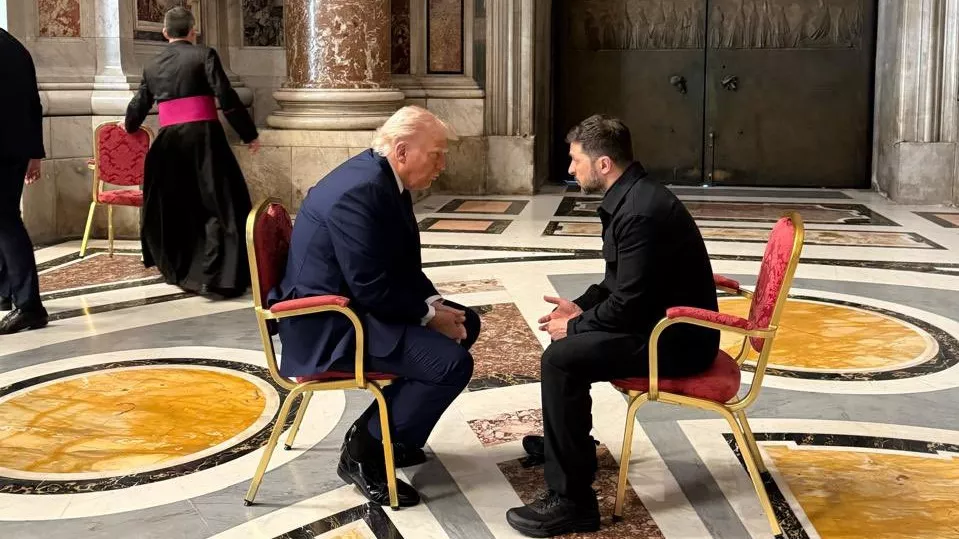
Now the Russian dictator Putin must be forced to choose
Hard as it is to take Donald Trump at his word, he and NATO Secretary General Mark Rutte this week gave Vladimir Putin something to focus his mind. Their announcement of a new NATO-backed weapons corridor into Ukraine, routed through European allies and structured around arms sales rather than grants, ends for now the prospect of a wholesale American abandonment of Ukraine.
That’s actually something, and the Russian dictator must be pissed. Even if the new arrangement is cloaked in political deniability for Trump with his Ukraine-skeptical and Putin-appreciating MAGA base, and though it reinforces Trump’s shamefully transactional nature, it does also mean, if you cut through all the nonsense, that the US-European alliance to support Ukraine is in a way back on.
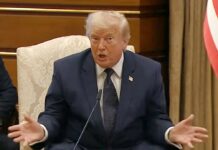
In their Oval Office meeting Monday (video below), Trump and Rutte repeatedly referred to a staggering figure: 100,000 Russian soldiers killed since January alone. It marked a rare moment of strategic clarity from Trump. He’s trying to rattle Putin having apparently noticed he’s in no rush to settle for a mere slice of eastern Ukraine, as candidate Trump clearly had expected he would. What Putin wants is a puppet in Kyiv so that Russia can control all of Ukraine.
This suggests that Putin really is serious about trying to reestablish the former Soviet Empire. This cannot be allowed. On the other hand, however, Putin’s regime has shown a willingness to engage in nuclear blackmail, and a cornered Kremlin may not be bluffing. That’s a problem too. Either way, the new NATO structure for arming Ukraine grants Ukraine’s Volodymyr Zelensky time, and it also places NATO — which Trump once disparaged as obsolete — back as the centerpiece of a Western alliance that might actually still exist. That too should alarm Putin, who, like Trump, made his own miscalculation that there is no limit to his ability to manipulate the simpleton in the White House.
What now? Well, to end the war without another three years of attrition, more is needed — and Trump, ironically, is uniquely suited to deliver it.
Trump has the political license to challenge his base, scorn for diplomatic convention and a certain form of credibility — however grudging, fearful and disdainful — with leaders across the political spectrum. He can make a bold offer to test Putin’s seriousness and unstick this war.
Before going on, I need to make one thing clear: From early on in the war, as longtime readers may recall, I concluded with some regret that it would end with Ukraine ceding some land in one form or another. I have also reasoned that while allowing borders to change by force is a bad idea, this is also the way they have generally changed throughout the ages; in addition, the internal borders of the republics of the Soviet Union, which Ukraine’s map represents, were far from sacrosanct and at times were either random or engineered to cause trouble. I fully understand Putin must not be seen to be victorious, and therefore if borders end up moving Ukraine must be handsomely rewarded and convincingly protected.
Suffice it to say that as my reward for these musings, and despite my obvious preference for Putin to be overthrown and for Russia to receive nothing, I have taken abuse from certain quarters of pro-Ukraine purists. Either way, sadly enough for the world, my views matter less than Trump’s, and he was always going to try to “do a deal” by trading away Ukrainian land. So for as long as he’s around, this is the paradigm, whether we like it or not (and I certainly do not).
Understanding that, here’s what Trump should do now that he has disabused Putin of the idea that Ukraine will be completely abandoned:
- Trump should say he is willing to recognize Russian sovereignty at the current battle lines, including a narrow land bridge to Crimea through parts of Zaporizhzhia, Luhansk and Donetsk that Russia already holds (about one-fifth of Ukraine’s land). This would not be moral approval but sober acceptance of military reality. Ukraine is unlikely to retake these areas without years of fighting; the Ukrainians will likely grumble, but not much more than that, and many will be relieved the war is over.
- Moreover, Ukraine would formally agree not to join NATO — addressing Russia’s central (if overstated) security concern and removing one of Putin’s main justifications for war. This was never that crazy; how happy would Washington be if Mexico joined a defense alliance with Russia or China?
- In exchange, Ukraine would receive immediate bilateral security guarantees from major Western powers (similar to U.S. guarantees to Israel) and a fast-track path to joining the European Union — the actual engine of prosperity and guarantor of alignment with the Western democracies.

No, Trump cannot unilaterally promise EU accession. I know that, of course, but it doesn’t matter. He thrives on pressuring systems into doing what they otherwise wouldn’t — like getting the Europeans to spend what they promised on their own defense. If he throws his political weight behind Ukraine’s EU integration, European capitals will scramble to find a way forward. Ukraine will find a way to address concerns about corruption, its fiscal policies and so on.
Russia might even be offered amnesty and an end to economic sanctions, much as that makes the blood boil. On the other hand, rejection of this deal could come with 500 percent US tariffs on anyone still trading with Moscow. Decisive, outrageous, transactional — Trumpian. It would be a bit reminiscent of Trump’s announcement last month that the war between Israel and Iran was over, seemingly before the parties knew anything about it.
Versions of such a plan may have been discussed already, but not in public by the parties involved in this conflict. Words said publicly have another weight altogether. This is true in geopolitics in general, even if Trump’s own words (such as his Great Gaza Riviera plan from February) can at times be absurd.
Critics will invoke Munich, where Western powers handed Hitler the Sudetenland in a failed attempt to prevent war in 1938. But that analogy, while powerful, isn’t always instructive. Indeed, history offers examples where land concessions to aggressors — painful as they are — have helped end wars and preserve the sovereignty of the nation under threat. These include the deals that helped to end the Korean War, multiple wars between India and Pakistan, the Bosnian War in 1995 and the 2000 war between Ethiopia and Eritrea. Syria’s problematic new regime is said to be considering conceding the Golan Heights to Israel for various advantages. And, again, all of history is conquest and aggression.
When done with clarity, backed by deterrence and paired with rewards that preserve and strengthen the sovereign state, an apparent capitulation can stop a war and sometimes even open paths to peace.
So, yes, Putin may declare a victory. But if Ukraine gains EU integration, security guarantees and a Western future, then the core outcome of the war would still be a loss for Putin. And if Putin refuses even that deal? Then Trump’s supporters might at last understand that the Russian dictator is an outlaw who must be thoroughly resisted. You cannot run away from every fight, tough guys.
