

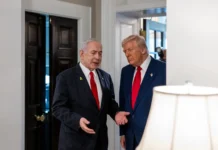











After the June 2025 bombings of Iran’s nuclear sites, the American and Israeli leaders, Donald Trump and Benjamin Netanyahu, were categorical in their assessment of the result: brothers, it was a great success.
Trump has repeatedly claimed that the Iranian program had been completely destroyed, that it had been set back decades, and even compared the (conventional) American bombings in June 2025 to the American (but nuclear) bombings of the Japanese cities of Hiroshima and Nagasaki in 1945.
The meaning of this last comparison was one that could not be clearer: that an end had been put to the state of affairs.
Moreover, the White House and his top, most loyal officials, made a common front when internal assessments were leaked to the press suggesting that the June triumph had actually been significantly more modest – not a destruction of the Iranian program, but at the most, a slowdown of several months.
The criticism of the critics was therefore meant to deliver the same message: that the June strikes had been, for Iran, irreversible.
For his part, Prime Minister Benjamin Netanyahu said last year that the 12-day war, in June 2025, had rolled back Iran’s ballistic missile program by years. Moreover, that the existential threat to Israel had been removed for “many generations.”
But the two leaders are acting, just eight months later, in a way that suggests the exact opposite of what they said, in a way that suggests that in the summer of last year and immediately afterwards, they had either lied or did not know what they were talking about.
But there is also a version in which they had neither lied nor had been incompetent. Trump and Netanyahu simply have non-transparently changed their strategic objective and the nuclear story now being exploited is merely a populist pretext to justify another maneuver – regime change in Tehran.
I repeat: since Trump and Netanyahu unleashed a massive local war in February 2026, one with a huge potential of expanding regionally, it automatically means either that the result of the June 2025 attacks was just hot air, or that their agenda is completely different today.
Of course, regime change would be a boon for Iranians, but the way Trump and Netanyahu pursue it is likely to muddy the waters, not clear them.
It should also be noted that in June 2025 and February 2026, Washington allowed the weapons to take the initiative while they were in negotiations with the Iranians – a very clear sign that, from the American-Israeli perspective, openness to diplomacy had been mimicked, in stark contrast to official comments.
Donald Trump has, as of Saturday, a big problem of legitimacy, in relation to the international community (from the perspective of international law and the obvious attack on world stability), and in relation to the American citizens. Given the contradictions listed above, it is clear from Trump’s statements that the reasons for the US involvement in the present major conflict have not been fully explained or clarified.
In an armed confrontation on the scale of the one with Iran and at the same time marked by domestic political constraints that diminish the US military’s potential for action_for example, Trump cannot afford to send troops on the ground, and the current operation does not even provide for such a component_ it is unclear how it begun, how it will end and especially how the story could derail.
Two essential elements reveal the extraordinary complications:
- The US and Israel are heavily bombing Iran, but it can’t be excluded that Iran will cause casualties and material and political damage to Trump’s America, and its allies in the Middle East (from the Gulf to Israel).
- The US and Israel can try to decapitate the bloody regime in Tehran, but this does not automatically mean the path to genuine regime change, nor can it prevent Iran from sliding into a civil and religious war.
With all their military and intelligence might, as well as the cutting-edge technology at their disposal, Trump and Netanyahu are still incapable of controlling the universe of variables that could arise. The additional drama is that a potential settlement will weigh on the shoulders of many other states.
In fact, the US has a terrible “criminal record” in terms of wars in the Middle East, and Israel still has a hard time with Hamas, although Netanyahu did not give up on anything during the war in Gaza; It practically leveled the strip over two years of military intervention from the air and on the ground.
Donald Trump is a fierce political animal and a poor geopolitical thug.
The testimonies of those who worked closely with him in the first term and also his activity in the second, highlighted one thing: he cares about nothing and is limited by his modest intellect and his fat ego. Not only does he not know, but he is also not curious to learn about international politics and history.
From this point of view, it almost goes without saying that we try to increase our understanding of what Trump triggered on February 28, 2026 by reminding ourselves of the essential elements of the context in which President Trump found himself on that day.
- Sliding in the polls and risking to drag the Republican Party down with him, just a few months before mid-term elections.
- Widespread dissatisfaction among Americans due to the economy and living standards.
- Disgraced over his handling of the immigration issue.
- Hit by the Epstein affair.
- In a full crisis over his tariff policy, following the resounding decision of the US Supreme Court a few days ago. I recently anticipated that we can’t rule out a link between an unfavorable decision on tariffs and the untimely bombing of Iran (link HERE).
In January 2021, Trump was able to encourage an insurrection in the US to avoid losing power. In February 2026, why would he have been more timid, in blowing up the international scene, also for deeply personal reasons?
Trump’s collapse continues unabated. The Iranian affair gives it a fresh boost.
