












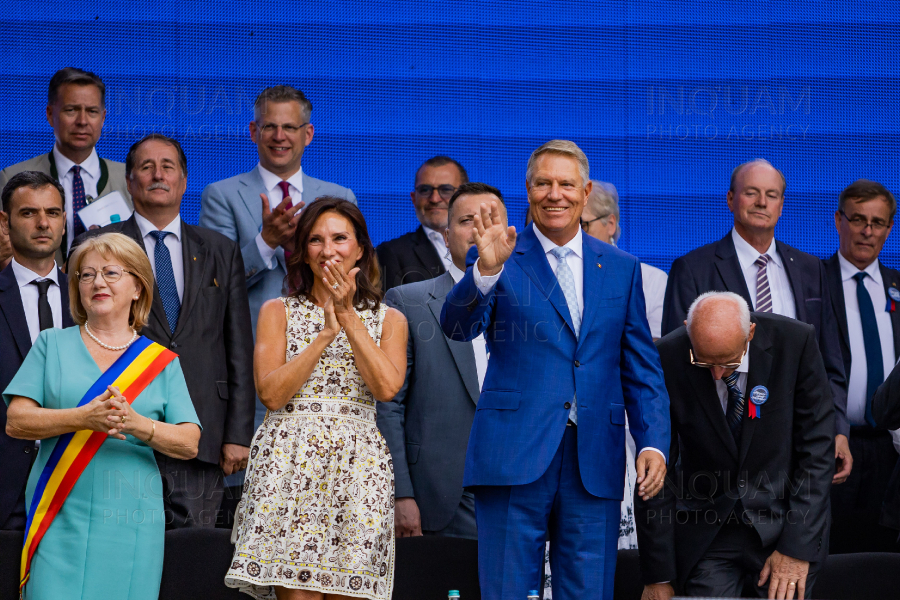
President Klaus Iohannis made an emotional speech on Saturday to thousands of ethnic Saxons who had gathered in his home town of Sibiu, central Romania, to celebrate 800 years of residence rights in Transylvania.
Addressing the crowd of as many as 15,000 who had traveled from Germany, the U.S, Canada, Australia and Romania to mark the anniversary, the Romanian president, said: “It is in the DNA of the Transylvanian Saxons that wherever they are, they never forget their homeland”
“We are the representatives of a community that throughout history, fought for freedom, built fortresses, and established towns built on prosperity, justice and good governance,” the Romanian president, himself a member of the small but active minority, told his audience.
The Golden Charter of the Transylvanian Saxons was issued by Hungary’s King Andrew II in 1224 and granted provisional autonomy to the Saxons or Germans living in Transylvania which was then part of the Kingdom of Hungary.
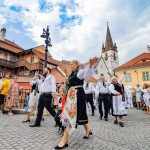
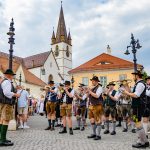
The two-day International Meeting of the Saxons was held in Sibiu’s medieval Great Square, a symbol of the ethnic Saxons presence in Romania, who arrived more than 800 years from an area which is today’s Luxembourg.
The Romanian president’s speech focused on the historical importance of the community. He said his Saxon ancestors were settlers in search of freedom and defenders of European civilization.
Most ethnic Saxons are the descendants of Conrad Haas, Samuel von Brukenthal and Hermann Oberth, the president said. He has generally avoided openly embracing his roots since he was elected president in 2014, seeing his role as the leader of all Romanians.
However, he says the community’s values and pro-European stance have guided him during his decade in office.
He invoked the importance of the King Andrew II Diploma, also known as the Golden Bull, which established an administration for the Saxon community, to further the region’s economic, social and cultural development.
“When the Saxons gathered in (the Transylvanian city of) Medias, in 1919, and joined Romania’s Great Union, they brought to the Romanian nation a centuries-old civic experience, a rich industrial tradition and a sparkling cultural heritage, which we are still proud of today,” Iohannis said.
“We are the representatives of a community that, throughout its history, has fought for freedom and built fortresses, built cities for prosperity, justice and good governance, and built churches to confess their faith and glorify God,” the president said.
The title of the meeting, “Heimat ohne Grenzen” (Homeland without borders) reflects reality of many Saxons, who wherever they live, proudly strive to keep the Transylvanian spirit burning and pass it on to future generations.
Modern Romania which was founded in the aftermath of World War I after the collapse of the Austro-Hungarian Empire, was welcomed by ethnic Saxons, also known as Romania’s German minority.
The 65-year-old president who leaves office this autumn after serving two terms as president concluded his speech by recalling the Sibiu Declaration of the European Council five years ago which underlines the commitment to a free Europe, democracy, prosperity and competitiveness, based on wide public contribution and cultural diversity.
“We will develop a Europe of freedom and democracy, a strong and secure Europe, a prosperous and competitive Europe,” the president said.
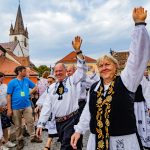
Participants, many dressed in national costume, applauded and cheered Mr. Iohannis as he later walked through the square with his wife, Carmen Iohannis, to the German Forum.
Among the guests were Sibiu mayor Astrid Fodor, Culture Minister Raluca Turcan, Eric Beißwenger, the Bavarian Minister for Stater for European and International Affairs, Jürgen Porr, the head of Romania’s Democratic Forum in Romania, Martin Bottesch, the vice president of the German Forum, Rainer Lehni,the president of Transylvanian Saxons in Romania and Bernd Fabritius, a lawmaker of the Christian Social Union of Bavaria and former of the Bundestag, the German Parliament.



Saxons tap into their roots and rhubarb in a bid to make centuries-old villages sustainable
