








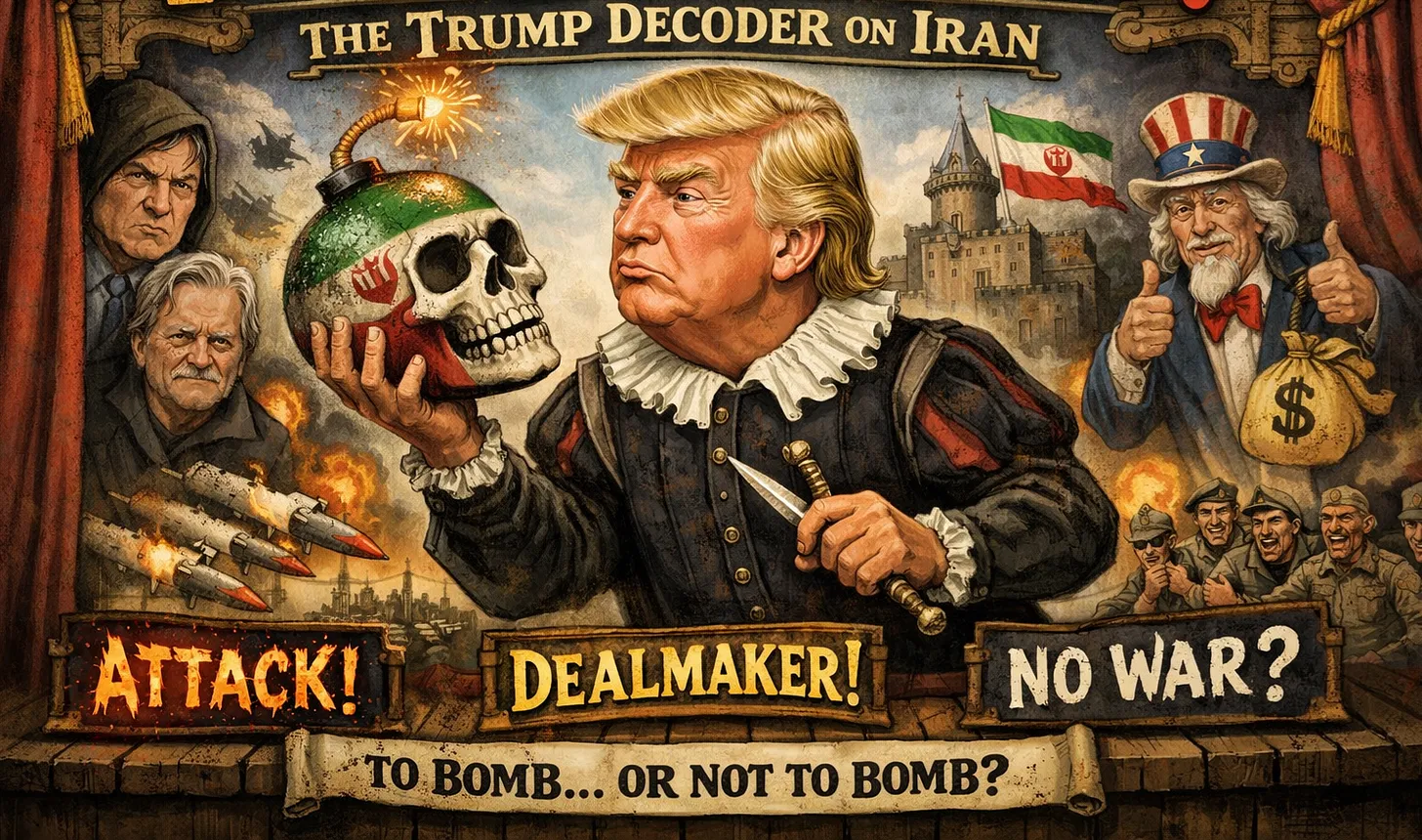
The Trump Decoder on Iran
Right now the most consequential question in the world is whether Trump will attack Iran. Prediction markets hum, television panels churn, and analysts speak with crisp authority. Much of it is a charlatan’s game.
Forecasting the behavior of large groups is often possible. Electorates, markets, and publics generate patterns; averages create trajectories. But predicting a single individual is different. Any one person can be an outlier. And when that person is an outlier by temperament, impulse, and worldview at the level of Trump, prediction can be guesswork and little more. But to even try, one must first decode this extremely bizarre personality.
First, he is an egomaniac. Everything runs through the prism of self. He rarely discusses policy without detouring into how brilliant he is, how incompetent his predecessors were, or how grievously he has been wronged. Old obsessions surface regardless of relevance: the lie about the 2020 election, imagined slights from international bodies, grievances about prizes not awarded. It means that for Trump, outcomes matter less than the ability to frame an outcome as a personal triumph. He needs wins, real and imagined, the way most people need oxygen. If a confrontation with Iran looks like a stage on which he can appear decisive, historic, Churchillian, that matters. If restraint can be packaged as a masterstroke of dealmaking, that works too.
Second, he is a liar — but not in the routine political sense. Most politicians shade facts; none score perfectly when fact-checked. Trump’s relationship with falsehood is different. He lies the way advertisers exaggerate: not to conceal reality but to create a new one. Words, for him, are tools of construction. A claim’s value lies not in its truth but in its usefulness. Moreover, even obvious lies become a sort of loyalty test for his cult – a password with which followers prove allegiance by mulish repetition. What astonishes is not just the volume of falsehoods but the absence of embarrassment. Where most people retreat when caught, he doubles down. Truth becomes falsehood; falsehood becomes truth. Shame never enters the equation. That matters when threats of war are issued, denied, reissued, and reframed within days. It can be useful.
Third, he is genuinely a negotiator. His instinct is always to demand more than he expects to receive, to stake out maximalist ground and then retreat while declaring victory. It’s elementary bargaining psychology, it does not require a high level of intellect, and he practices it relentlessly. That matters for Iran. He can demand absolute nuclear capitulation — terms that beyond what the Nuclear Non-Proliferation Treaty requires. Then, if an eventual deal permits tightly monitored civilian enrichment and inspection regimes, he can present it as an unprecedented triumph. Structurally it might resemble Obama’s 2015 nuclear deal, which he derided and walked away from in 2018. Narratively it would be portrayed as the opposite. In Trumpworld, what he says happened matters more than what happened.
Fourth, his political survival depends not on majority approval but on maintaining a devoted core. He knows many and probably most Americans dislike him and always will. They are irrelevant to him; he can call them “very bad” and “not very nice” and then say “but that’s OK” and move on. What matters is the fervent base that dominates his party. Control that base and you control the party; control the party and the electoral map becomes navigable, because of America’s ridiculous system that hands the republicans almost half the states pretty much automatically. So the real strategic question is not whether Americans as a whole want war with Iran, but whether his most loyal supporters do. Within that camp there is tension. Isolationist voices such as Tucker Carlson and Steve Bannon warn against foreign entanglements, while intervention-friendly figures such as Mike Huckabee frame confrontation in moral or civilizational terms and care about US leadership still. If Trump bailed on his promise to help the Iranian protesters in January, this was probably the reason.
Fifth, he is strikingly uninformed about history, science, economics and international affairs. Sometimes his misstatements may be deliberate provocations or signals to his audience. Sometimes they appear to be genuine misunderstandings. He speaks of the Arab-Israeli conflicts as if they have lasted “thousands of years,” probably thinks Greenland is as big as it looks on a flat map, has no clue about the real size of immigration in Europe, and seems to genuinely not understand tariffs. This lack of knowledge can be constraining in ordinary leaders, who care about avoiding stupid moves; in Trump it can be liberating. Unburdened by detail, he improvises freely. Combined with his indifference to factual accuracy, ignorance becomes a kind of strategic asset. He can invent reality as he goes and message it appropriately. In a crisis with Iran, where history, sectarian politics, nuclear doctrine, and regional alliances intertwine, such improvisation is both unpredictable and potentially dangerous. But at least you’re not in the weeds, paralyzed by an excess of understanding.
Sixth, he has the air of a corrupct profiteer. Over the years, watchdog groups, journalists, and congressional inquiries have documented a pattern critics describe as pay-to-play politics: foreign governments and private actors patronizing Trump-branded properties, licensing deals involving countries with policy stakes before Washington, and business ventures pursued by his family while he held power. The cryptocurrency venture linked to his political brand, during his presidency, would have been unimaginable before Trump, yet the Republicans simply allow it and they control Congress. NPR and others reported that the Trump family made $4 billion during the one year of his presidency. The point for prediction is about incentive. If a decision about Iran could plausibly enrich him, his family, or his business environment — or harm rivals who threaten those interests — that possibility belongs in any serious forecast. With Trump, personal benefit and state policy have often appeared unusually intertwined.
Seventh, he is unmoored from values, ethics or ideals. He does not champion democracy, nor has he aversion to authoritarians. Systems of governance seem, in his rhetoric, less matters of principle than of utility, optics, and personal chemistry. His December National Security Strategy explicitly walked away from the democracy promotion that had been a bipartisan consensus. In Venezuela he was happy to leave the Chavista mafia in place, once it was domesticated and Nicolas Maduro had been impressively kidnapped. In Iran, it’s safe to say he doesn’t care much about rescuing the people from the vile Islamic Republic. The world he evokes is Hobbesian — a landscape of strength, dominance, and perpetual contest — though there is little indication knows who Thomas Hobbes was. Order, loyalty, and advantage overshadow any ideal.
Eighth, he is a virtuoso manipulator of attention and emotion. In what is his one undeniable genius, he understands branding, ridicule, spectacle, and provocation as political instruments. Consider his stylistic tics: random nouns capitalized for emphasis, as if they were sacred objects —Country, Enemy, Victory. Consider his embrace of deliberately outrageous imagery, including an AI-generated video depicting him as a crowned combat pilot dropping excrement on people in Times Square or depicting opponents in grotesque fashion. These are bait, because his opponents’ outrage delights his supporters. He violates norms because the violation itself pleases a base that is unusually angry. This loops directly back to the earlier points: he cares intensely about his base, he is untroubled by falsehood, and he seeks constant aggrandizement.
Therefore any attempt to predict whether Trump will attack Iran has to pass through these eight filters. He will be obsessed with getting a win, and if he has to distort reality to present it as a win, that will not trouble him. He is unlikely to choose a course that impoverishes his inner circle or damages the financial ecosystem around him. He prides himself on manipulation and will assume he can outmaneuver Iranian negotiators just as he believes he has outmaneuvered domestic rivals. He carries fixed ideas about world affairs — including that nation-building is futile, dictatorships are no big deal, and long wars are disasters — which strongly suggests he would recoil from anything resembling an Iraq-style invasion, occupation, or prolonged regime-change project.
Yet the same psychology leaves room for something dramatic if it promises instant glory. He craves victories that look cinematic, decisive, undeniable. If he believed a short, sharp campaign — say, days or weeks of bombardment with no quagmire — could topple this nastiest of regimes and let him claim historic credit with actual truth, the temptation would be immense. Such an outcome would, in his mind (and not only), transform his reputation from something approaching a dangers idiot to a world-historical figure, a status he plainly desires.
More likely, though, he will gravitate toward a deal he can exaggerate. That agreement could follow a brief clash or precede one; either sequence could be spun as proof of dominance. The open question is what he would demand as proof of victory. The nuclear file is one track, but missiles and regional proxy forces are another, and they need not be treated identically. The wheeler-dealer instinct might settle for curbs on one in exchange for concessions on the other. The proxy militias – which have been badly hobbled by Israel – may be the easier target, with partial limits on missiles packaged as sweeping success.
The main point is this: Prediction requires, in this case, not mere traditional geopolitical analysis but psychological filtration. The outcome will hinge on what Trump thinks he can sell as a colossal triumph that Sleepy Joe could never have managed. It’s gonna be such a huge triumph, there never was such a triumph.
