













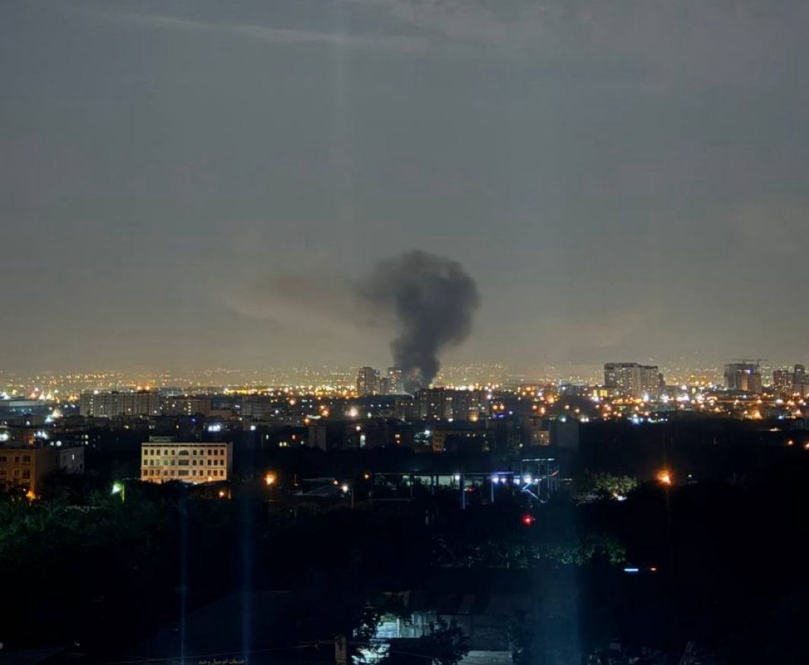
Incredible as it may seem, the beleaguered Islamic Republic regime has more to worry about from Israel than from Trump
As Team Trump weighs ordering military action against Iran — with officials from both sides scheduled to meet Friday to pursue a diplomatic resolution —Tehran has issued a familiar warning: Attack us, and we will strike Israel.
Although this makes little sense – Israel is not responsible for Iranians’ miseries, nor for any American attack, and the Iranians know it – history suggests the warning is credible. The longstanding logic is that a Muslim country can turn any confrontation with America into one with Israel, hoping to fracture a regional coalition backing Washington by shifting the narrative to one of “resistance.”
Saddam Hussein attempted exactly this in 1991. Facing a broad US-led coalition that included Arab states, he fired Scud missiles at Israel (in those quainter times it was shocking). If Israel had retaliated, Arab partners would have been forced to choose between coalition discipline and hatred of Israel, and the coalition might have collapsed. Israel, urged by the US, showed extraordinary restraint, absorbing the attacks without response. Saddam’s gambit failed and he was booted out of Kuwait.
But much has changed. Israel is angrier now and its leadership less cautious, and its accounting with Iran is overdue despite the 12-day war in June. The Islamic Republic is explicitly committed to Israel’s destruction and has spent decades constructing a “ring of fire” around it — Hezbollah in Lebanon, Hamas and Islamic Jihad in Gaza and the West Bank, the Houthis in Yemen, militias in Syria and Iraq, precision-guided munitions aimed at Israeli cities.
That, combined with the very bizarre Trump factor, could make for a dangerous combination.
Let’s look at the surprising landscape — basically unimaginable just a year ago — and at the reasons why an Iranian attack on Israel may spectacularly backfire.
Tehran’s unpopular and illegitimate regime is surely noticing that Trump has no apparent appetite for long wars: From the Iraq and Afghanistan entanglements he has concluded, like many Americans, that invasions become quagmires, quagmires become political disasters, and “nation-building” is hopeless. He wants moments that can be spun as big achievements, not long, complicated and costly campaigns.
And he is generally impatient. After the 12-day-war in June, in which Iran was revealed to have no effective air defenses and absorbed a serious of humiliations, the Iranian regime was badly exposed, and I was calling on these pages and elsewhere for the US to demand surrender terms: an end to uranium enrichment, abandonment of ballistic missiles, and the end of Iran’s support for the utterly indefensible proxy militias. Trump instead rushed to declare that everything had been “obliterated” by his big beautiful planes so totally that a deal might no longer be necessary, turning his sights elsewhere: threatening to attack Denmark over Greenland, tariffs, sending the National Guard to mess with Gavin Newsom.
Moreover, despite Trump’s initial passion for protecting the Iranian protesters seeking regime change, all signs suggest that he is unlikely to really pursue a democratizing project. For the first time in modern history, America is led by a president who does not care about democracy abroad — and barely pretends to care about it at home. Trump’s National Security Strategy, published in December, abandoned eight decades of bipartisan consensus that framed the promotion of democratic governance as at least a nominal American interest.
Previous presidents would have at least preferred preferred to see Iran transformed into a democracy and the Islamic Republic dismantled. Trump, if anything, admires authoritarians. He courts them and does his best to govern like them, begetting the growing agitation at home.
All this creates room for Iranian calculation — and miscalculation — in which Israel is apparently factoring. So are the threats real?
It is possible that the Iranians are bluffing about attacking Israel. In any case they may also be threatening to do so as part of a certain logic, which might look like this: As last summer’s war showed, an American strike targeting the nuclear system is in itself survivable. Perhaps it can be absorbed. Limited concessions — caps on enrichment, revived nuclear negotiations, even the quiet removal of expendable officials — might allow the system to plow on.
Consider that the Venezuelan regime survived, for now, the abduction by US special forces of the president, Nicolas Maduro, which gave Trump a noisy win. Trump doesn’t care much about the type of regime that rules Iran or Venezuela; as long as the ruling mafia in some “shithole country” is domesticated, Trump will happily cast himself the capo di tutti capi, perhaps with “access” to oil. (By the way, if Trump can somehow deny China oil from Venezuela and Iran both, that is a kind of win.)
But since Trump is unpredictable, and may get carried away, the threat to strike Israel could serve as a way of cautioning the US to not take things too far. It could be seen as warning that, should Trump not stick to the script, Iran has the ability to potentially mire him in a far more drawn-out and messy conflict.
If this is the case, the Iranian regime should tread very carefully indeed. That’s because Israel’s interests in this situation diverge fundamentally from those of the US (or at least from Trump’s), and not in the regime’s favor. Actually making good on the threats, and handing Israel an excuse to pursue those interests, might be exceedingly unwise.
Let’s start with firepower. The US military is formidable, and two carrier strike groups can field roughly a hundred attack aircraft, and other assets are nearby, but America’s regional posture is not unlimited.

So it is far from irrelevant that Israel’s air force alone fields roughly 600 aircraft, of which about 250 are capable of attack. It is forward-deployed, highly motivated, and battle-tested. Last June suggested Iran’s air defenses are effectively incapable of stopping it. Of course, bringing down a ruthless regime with air power alone would be difficult – but Israel also is believed to have significant intelligence assets in the country, considerable cyber abilities, and years of planning for precisely this opportunity.
So whereas Trump may want a quick win for his hubristic claims of unparalleled greatness, for Israel, regime change in Iran is a very serious, real and rational goal. The benefit of a post-theocratic Iran — one no longer devoted to Israel’s annihilation — would be transformative, not only for Israel but for the Middle East itself. Indeed, across the Arab world, a quiet realignment is underway. Saudi Arabia, the Gulf states, and even parts of the broader Sunni establishment increasingly view Iran — not Israel — as the primary source of regional instability. Normalization with Israel is no longer taboo.
Moreover, Israelis genuinely yearn for peace with Iran, and believe that feeling is at least partly reciprocated. The Netanyahu government is unpopular, and with any luck (for Israelis) they will be binned in the coming election, but it is are aligned with the public on the idea that eliminated the regime is a favor to Iran.
Before 1979, they were discreet partners. Under the Shah, Iran was one of the few Muslim-majority countries to maintain pragmatic, if quiet, relations with Israel. Intelligence was shared. Oil flowed. Trade and military cooperation followed. Israel saw Iran as part of its “periphery doctrine”—a non-Arab ally on the edge of a hostile region. Iranian Jews lived securely. Tehran was a modernizing capital, not a fanatically backward-looking one.
The Islamic Revolution destroyed that world overnight. Ayatollah Khomeini rejected the entire regional order and transformed Israel from a useful partner into a civilizational enemy. Anti-Zionism became a core pillar of regime legitimacy. In its grotesque mutation of Islam, “Death to Israel” became the regime’s identity as much as “Death to America.”
Yet Israeli singers performing in Farsi have followings in Iran. The occasional Iranian dissident has visited Israel to much acclaim. The Crown Prince in exile, Reza Pahlavi, has called for a democratic Iran at peace with Israel and the West. There are also more than 200,000 Iranian Jews in Israel, and they remember a different Iran, and consider that its rebirth should be no fantasy.
Israel, in short, is more focused than the US, potentially more ruthless where necessary, possibly more patient where required, and far more invested in the outcome with Iran than Trump is ever likely to be. So, counterintuitive as it may seem, provoking the US may be survivable but provoking Israel would be far more dangerous.
If Tehran is thinking clearly, it may conclude that its safest move is quite the opposite of escalation. And in a weird way, comprehensible only to jihad apologists and certain professors, the Islamic Republic is said to be rational. But then again, it has just massacred many thousands of its citizens. And desperate dictators can do very stupid things.
