









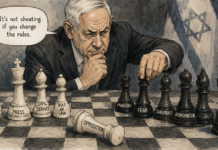




Karl Marx once wrote that history repeats itself, “first as tragedy, then as farce.” He referred to the Napoleonic era, but today’s Middle East offers an update: Tragedy and farce, irrevocably intertwined, at one and the same time.
The two seem compressed into a single reality: unimaginable suffering alongside grotesque political theater. From Yemen to Gaza to Jerusalem to New York, fools and fanatics wreak havoc while opportunists abroad turn calamity into stagecraft. The result is a region where tragedy and farce no longer alternate, but coexist.
And no few of the sad protagonists, like Israel’s diminutive but hugely self-assured “finance minister” Bezalel Smotrich, can be said, without the slightest undue cruelty, to have Napoleonic complexes of their own. This week he proposed a plan for Israel to annex almost the entire West Bank, as if he feared that the mayhem of the past two years may otherwise be coming to an end.
In today’s briefing, we shall analyze that nonsense, along with the insane situation of Yemen’s Houthis, whose implacable radicalism would be comic at a Monty Python level had they not caused the deaths of close to a half million people, the debate over genocide, and, sadly, so very much more to boot.
The Houthis: Death as a Creed
Few spectacles embody this more vividly than the Houthis of Yemen.
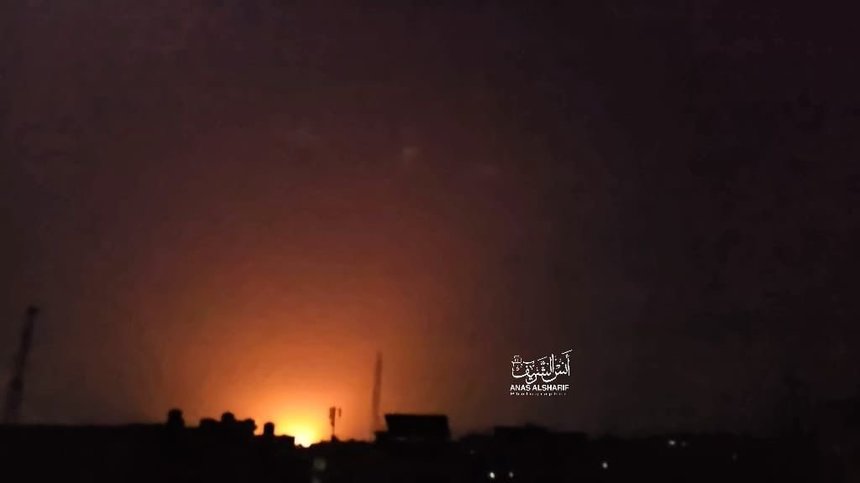
In one of the most audacious strikes of the two-year war, Israel recently assassinated half of this mafia’s cabinet, including the “prime minister” and multiple senior ministers. For any normal government, such a blow would invite collapse. For the Houthis, it was met with a shrug and vows of escalation.
This is a movement that has brought Yemen to ruin. Since seizing Sanaa in 2014, they have presided over a catastrophe that the UN estimates has killed some 400,000 people through war, famine, and disease. They tax aid, conscript children, and funnel scarce resources into drones and missiles supplied by Iran. Their slogan is unambiguous: “God is great, death to America, death to Israel, curse on the Jews, victory to Islam.”
Donald Trump’s return to power brought a temporary lull when he secured a deal halting their attacks on commercial shipping in the Red Sea. But the deal conspicuously left Israel out of the equation. The Houthis continued their two-year campaign of firing missiles and drones at Israel, a country 1,000 miles away that has no quarrel with Yemen, to signal their place in the jihadist pantheon.
The Houthis illustrate the tragic persistence of movements that equate death with triumph. They are also a farce of governance: a supposed “state” that produces only ruin for its citizens. At the very least, the Arab League should treat this as an emergency and give the remaining forces of the recognized previous Yemeni government every conceivable support to rid the world of this scourge.
Gaza: Tragic War, Farcical Semantics
Despite Hamas’s public reiteration of its offer to release all hostages in exchange for an end to the war, Israel has refused to accept the deal, citing its (not unreasonable) insistence that the group fully surrender and disarm its military wing as preconditions. This indicates that the immediate obstacle is disarmament, since Hamas has already signaled a willingness to hand over control. Indeed, most of the world including the Arab League want this. But an alternative strategy to Israel’s imminent planned military escalation could focus on conditioning post-war reconstruction on disarmament.
Meanwhile, the tragedy in Gaza is undeniable: tens of thousands dead, whole neighborhoods obliterated, hundreds of thousands displaced into ever-smaller “safe zones.” Israel insists it is fighting a mafia in religious garb, Hamas, which massacred 1,200 Israelis on October 7 and still holds about 20 living hostages. Hamas insists on “resistance” even as its fighters hide in tunnels (and their leaders root in the lap of Qatari luxury) while the population suffers.
The farce comes in the international discourse. This week, the International Association of Genocide Scholars voted to declare Israel’s conduct a genocide. But membership in this august-sounding body requires nothing more than a $30 fee. No debate was held, only a quarter of members voted, and journalists proved that anyone with a credit card could join and vote.
Many real war crimes experts had never heard of this club, but that did not stop top media from labelling it the top group of genocide scholars in the world. The Guardian, gunning for the advocacy journalist gold standard, ignored that three-quarters of the members did not vote and that there was no debate, and declared that 86% of those who did vote convicted the Jewish state.

Genocide is the gravest of crimes, and Israel’s campaign in Gaza is legitimately criticized for excessive force and possible war crimes. But to collapse it into genocide — when the war would end tomorrow if Hamas surrendered — is to cheapen the term and muddy the moral waters. The tragedy of Gaza is real. The farce is that unserious actors are hijacking the vocabulary of international law to score political points.
The Palestinian Authority: Flawed but Salvageable
A bunch of Western governments are preparing to recognize Palestine. But unlike the hasty UK and France, Belgium at least has set conditions: Hamas must cede power and the hostages must be released.
The recognition is in any case somewhat nonsensical. The Montevideo Convention of 1933 still provides the standard checklist for statehood: a permanent population, a defined territory, a functioning government, and the capacity to conduct foreign relations. Palestine can plausibly claim, if we’re being very generous, the first and last — millions of Palestinians live in the West Bank and Gaza, and the Palestinian Authority maintains embassies and diplomatic missions worldwide. But the second and third criteria remain disputed. Its territory is fragmented and partially occupied, and governance is divided between the PA in the West Bank and Hamas in Gaza, undermining the idea of a single effective government. This is why many countries recognize Palestine politically, but others hesitate legally: it sits in the gray zone where the aspiration to statehood is clear, but the Montevideo conditions are only partially met.
This reflects an important distinction that too many ignore: the Palestinian Authority (PA) is deeply flawed but at least recognizes Israel, runs civil institutions, and coordinates on security. Hamas is irredeemably committed to destruction. Yet the problems with the PA — a corrupt autocracy that pays stipends to the families of terrorists and fails to educate children for peace — offers a useful cudgel to Israeli right wingers who want to bury hopes for peace. That inability (or refusal) to identify the the less-bad option, and indeed the only alternative to Hamas, was on full display in my debate on ILTV this week.
The tragedy is that decades of corruption and authoritarianism have hollowed out the PA, leaving Palestinians skeptical and Israelis dismissive. The farce is that in rejecting the PA outright, Israel ensures there is no credible Palestinian partner — guaranteeing endless cycles of violence that undermine its own security.
And perhaps the welding of the two is happening in the United States, which apparently will deny Palestinian leader Mahmoud Abbas a visa for this months UN General Assembly. That’s not exactly in like with the spirit of the commitments America made in 1947, when it was allowed to host the UN. You’d almost think Trump doesn’t care about making America look like a cheater.
Annexation Fantasies: Smotrich’s Bantustans
While war rages in Gaza and missiles fly from Yemen, Israel’s Smotrich is pushing for de jure annexation of almost the entire West Bank, leaving Palestinians confined to scattered enclaves (the yellow islands of territory in the below map). The plan echoes South Africa’s Bantustans — islands of autonomy meant to disguise an apartheid reality.

The tragedy would be the death of Israel’s democratic identity. The farce is the timing: at the very moment Israel is fighting for legitimacy abroad, it flirts with the one move guaranteed to isolate it completely. Europe, Israel’s biggest trading partner, would almost certainly end Israel’s valuable status as an associate member; the Abraham Accords would be discredited and may fall apart; even Trump could not be counted on.
The Holy Land has 15 million people, equally divided between Arabs and Jews. Annexation would turn Israel into a bi-national state without democracy — precisely what its founders sought to prevent. Those who push for this without wishing for that outcome are catastrophically misguided.
Nuclear Shadows: Dimona’s Ambiguity
Satellite images now reveal new construction at Israel’s Dimona nuclear site. Officially, Israel neither confirms nor denies having nuclear weapons, but decades of exposes, the kidnapping and imprisonment of whistleblower Mordechai Vananu, and slips of the tongue by leaders like Shimon Peres have rendered the ambiguity paper-thin.
The tragedy is that the Middle East is once again slipping toward a nuclear arms race, with Iran seeking the very capabilities Israel has long reserved for itself. The farce is that Israel insists on legalistic denials that convince no one — while demanding absolute transparency from its foes.
Thus, in short, does the Middle East today fuse the tragic with the absurd. The Houthis devastate Yemen while posturing as liberators. Hamas sacrifices civilians while clinging to power. Israel courts international disaster with annexation dreams even as it fights existential battles. Trump bans Palestinian leaders from the UN while proposing fantasy schemes for Gaza. Scholars, real and fake, cheapen the gravest of crimes with unserious votes.
Marx was right that history repeats as tragedy and farce. What he did not anticipate is that in the Middle East, they would come at once — a deadly farce, a grotesque tragedy, and a reminder that unless realism prevails, history will keep repeating.
