




As a nervous Romania votes, I recall being beaten up there by secret police, mocked by drunks in a paddy wagon, and tricked by the scheming president.
The air was damp with the weight of a December evening in the heart of Bucharest. On one side of the central boulevard stood the brutalist National Theater and a cement tower known as the Intercontinental Hotel. On the other were relics of the interwar period, faded facades whispering of a bygone elegance, flaking under the decades of communist neglect. The year was 1991, this was my first AP posting, and one of the relics was my home.
The boulevard pulsed with tension as I crossed it. Protesters crowded nearby University Square, clutching signs scrawled with Jos Iliescu — Down with Ion Iliescu, the post-communist president, and “neo-Communists” and such. Opposite them, a wall of police stood rigid, clutching black shields and clubs, faces obscured by masks. The two sides seemed poised on the brink of violence, but I strolled between them, feeling mostly entertained.
The absurdity of it all — the ghosts of communism grappling with a fledgling democracy — felt less threatening than it did exhilarating. Militaries all over the world rely on the stupidity of young men; news agencies, perhaps, as well. I was 27.

Out of the crowd on the sidewalk burst a man, his movements sharp and deliberate. He wore civilian clothes but exuded the authority of someone who needed no uniform. His arm shot out, finger pointed at me. “Him!” he barked, his voice cutting through the din.
The wall of police splintered. Boots clattered against the pavement as they descended upon me. Sometimes your instinct is sharper than conscious thoughts. I leaped toward the heavy glass door of my apartment building, but it was locked from inside, my neighbors looking on. Hands grabbed at my arms, my shirt, my bag. My press card, my foreignness, my imagined immunity — none of it mattered much and they clubbed me on the head.
Making matters worse was my ability to speak Romanian, courtesy of parents who had emigrated from the country before I was born. It wasn’t very convincing to the police when I protested in this language, while trying to deflect the blows: “I’m an American correspondent!” They hurled me headfirst into a paddy wagon, nearly breaking my leg as the door slammed shut.
I felt the van bouncing wildly over potholes and lurching this way and that, and in the darkness I could smell much alcohol on the breath (or was it hair?) of fellow detainees. “What did you do?” one of them demanded. “Nothing,” I replied, disconsolate and disoriented. “I’m an American correspondent.”
My associates found this hilarious and began to chant as one, in their melodic, Latin-based tongue: “We’re also American correspondents! We’re all just American correspondents!!”
I did not feel so respected on that day.
At the police station the other detainees exited the van and dutifully proceeded between two rows of awaiting fresh policemen who pounded them on the head once more with clubs. Everyone seemed familiar with the routine and obedience was assumed, so no one paid attention to me when I stepped to one side, entered the building and sought out the station chief.
This man was slightly more intelligent than his g
oons. He examined my blue press document, considered with an expert eye my bruises and torn clothing, called the foreign ministry. Stoically did he listen, for quite some time as I recall, to loud shouting coming at him from the other end.
The chief took down my statement. When I got to the part where a man gave the order to attack me, I noticed, reading upside down, that he had quoted me as saying it had been a security officer. “I said a civilian,” I protested. He looked at me in silence, sighed unhappily, and asked: “Would you like me to change the statement?” I reconsidered; the police did know their craft.
They actually took a mug shot, then sent me on my way, ripped short and all. AP ran a picture of me on the wire. In the days before journalists being beheaded by Islamic State, this felt like quite the thing.

Close encounter with Romanian police, 1991
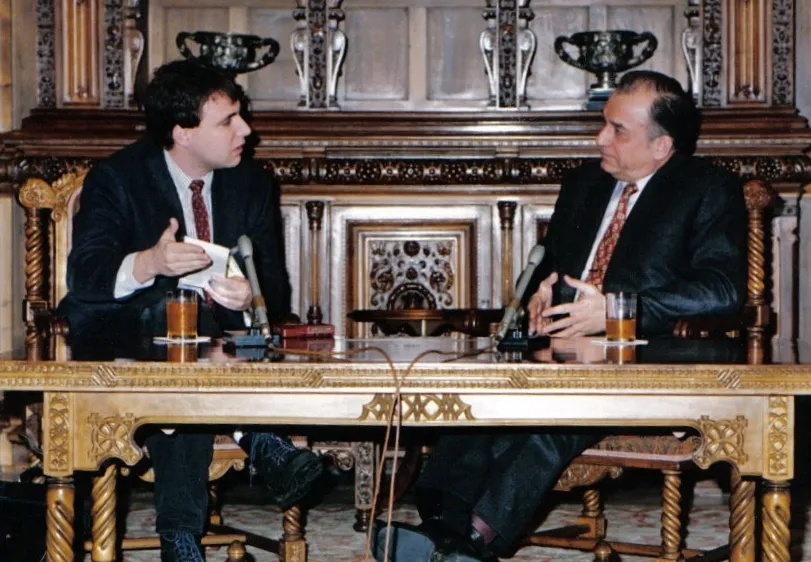
It was perhaps to compensate for these indignities that I received days later a personal summons to interview the president at Cotroceni Palace. Iliescu marched out of his office and went straight to the AP photographer, an Irishman who was more age-appropriate for the occasion, and greeted him by my name. Some confusion therefore had to be resolved, and after a flutter of handshakes and earnest welcoming we proceeded to a stately-looking library, settling into absurdly ornate chairs with wood carvings and the like.
It was at the small-talk stages that a huge TV camera was suddenly wheeled in. AP had no TV service then, and I asked what’s going on. “Nothing,” Iliescu assured me. “It is for the presidential video archive.” The interview commenced.
Here one must understand the context.
The communist regime of Nicolae Ceausescu had collapsed two years before, and it did so in an interesting way that created much global press frisson. With the Warsaw Pact regimes falling all around and demonstrators amassing in the streets of Romania as well, it seems with hindsight that Communists staged a palace coup.
The dictator and his imperious wife Elena, who had run the place as a fiefdom, were captured fleeing Bucharest in a helicopter. On Christmas Day of 1989, at a barracks in the sticks, they were condemned by kangaroo court of high crimes, lined up against a wall, and shot faster than a cameraman could film. A group calling itself the National Salvation Front declared it was in charge after commandeering the TV station, and promised elections. Democracy embarked upon an odd, unsteady path, with Iliescu, a former apparatchik respected to being hated by Ceausescu, at the helm.
For several weeks inexplicable shootings continued in the streets of various cities. State media, now controlled by the NSF, reported that “terrorists,” remnants of Ceausescu’s Securitate secret police, were trying to stage a counter-revolution. About 1,000 people were killed before the “terrorists” appeared to vanish into thin air.
The theory quickly spread that the shootings had been organized by the new authorities to befog and obfuscate the coup, painting it with the prettier brush of a popular revolt. It was my first experience with conspiracy theories, and I was skeptical; I’ve met few people smart enough to carry out a plot, cover their tracks, and resist boasting of it in some bar.
I became less skeptical after meeting Iliescu. He was a slick talker (despite a bureaucratic style typical of his demographic), and a genius at persuasion. For many months he had assumed a fatherly pose as he tolerated the near-daily protests near my apartment, where his government was pilloried as “crypto-communists.” (Because, well, they were almost all former communists.)
So in the interview, I asked how it could be that two years after the revolution no terrorists had been prosecuted and mystery still prevailed. Iliescu’s explanation was pretty clever, if you’re a moron.
“Consider, sir, that the assassination of John Kennedy remains a mystery as well,” he said. I guess, in a way, that’s true: I couldn’t swear there was really no more to it than Lee Harvey Oswald. Registering my non-protest, Iliescu continued: “If America, with all its resources, cannot solve the murder of just one man, in almost 30 years, how can we possibly solve 1,000 deaths in just two?” Iliescu smiled broadly; logic this winning should put all doubts to rest.
I have since discovered the following: In a TV interview you challenge utter nonsense, even if you know you’ll get no answer. It serves to underscore the need for skepticism. Under such an approach, I might have noted that logic in fact points in the other way altogether: A massacre is actually harder to cover up than a single murder. But this was an interview for text purposes and our time was limited, and so I let it go. A schoolboy error, as they say in Britain.
That’s because the entire interview with Iliescu – over an hour – was broadcast that night on the only TV channel in the land, courtesy of the “presidential archive.” This was before social media and the cloud of inattention, ill-focus and impatience it begat. Close to the whole country was watching this channel, and they saw me accepting everything Iliescu said with seeming equanimity — even nodding, as you do.
The Associated Press was widely appreciated in Romania back then; during the long night of communism, such US brands represented a dream that the nightmare might someday end. Acquiescence by a foreign correspondent had value for the scheming politician. Not that much, but also not that little.
We met again on numerous occasions, and he seemed to be fond of me. I could never shake the feeling that Iliescu considered me an idiot. But that was OK; I think he considered most people idiots.

On the occasion of that broadcast, I surely looked like an idiot to many others too. But on the other hand, for months I was mistaken for a close associate of the president, which can be fascinating. In the early years of democracy, when the role of journalists was not so clear to people, I found myself listening to many a solicitation to organize an apartment, or the renovation of a school. “Please, tell Mr. President that we have suffered…”
Iliescu was a brilliant politician. Lies flowed like honey from his silver tongue; in a way, he was a trailblazer in a dark art that by now has been perfected. The uneducated seemed especially entranced by his urbane, entitled ways. He drove liberals and intellectuals up the wall, but these are a minority at all times in all places. He strode the stage as the indispensable man, won several elections without blatantly falsifying counts, and seemed eternal for a time.
Of course, it was not all wine and roses. I recall one peasant whose critique of Iliescu’s economic policies was so scathing that it cannot be translated in this family publication. The industrious reader will find a way.
Those policies, in retrospect, are hard to unequivocally condemn. In the end, Iliescu stood for slow change in all things, which bolstered the “crypto-communism” charge but avoided chaos all the same. The peasant may have changed his tune.
Under Iliescu’s rule, which lasted on and off for almost two decades, many structures and people stayed in place or simply were reshuffled. The International Monetary Fund was rebuffed in its push to enact a shock therapy variant of capitalist reform; statist economic policies, and some protections, remained. So did corruption and cronyism, of course. Everybody grumbled, but Romania was spared the snap privatizations that caused mass impoverishment and the rise of a tiny oligarch class in Russia. It was slow to be admitted to the European Union, joining only in 2007. But there was no Putinesque backlash either, and democracy now is reasonably entrenched.
I’ve written in these pages about absurd encounters in high school with music great Leonard Bernstein and baseball legend Pete Rose, and as a foreign correspondent with the likes of Yasser Arafat, music icon Bono, Queen Elizabeth, Tony Blair and Mikhail Gorbachev (whose abdication of the Soviet empire elevated Iliescu himself). Despite his not being as well-known around the world, I think that for pure absurdity Iliescu may take the cake.
Romania is electing a new parliament today, and a president next week. There are new troubles and new troublemakers. Despite a sedate campaign, which I wrote about last week, an ultranationalist nutjob has made it into the final round, and in theory might soon occupy that stately library in Cotroceni Palace (though probably not). Some people are quite upset and nervous; there are recounts, suspicion of Russian interference, even talk of annulling the first round. But this too shall pass. Everything shall pass.
Iliescu, who made opponents seem like squabbling children once, is a distant memory now. He’s still around, of course; only the good die young. Five years ago he was finally charged with crimes against humanity for the “revolution file” and his use of rampaging miners to quell dissent. “He denies wrongdoing,” as journalists would say; the trial has been “plagued by procedural delays.” Another Balkan mystery! Well, the guy is 94.
Sic transit gloria mundi.
Dan Perry in Bucharest: Romania votes amid minimal drama (and concerns about appeasing Russia)
