











(Like gun control, like healthcare, like abortion rights, like the ERA, like electoral reform)
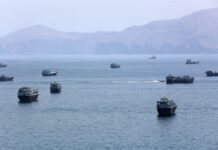
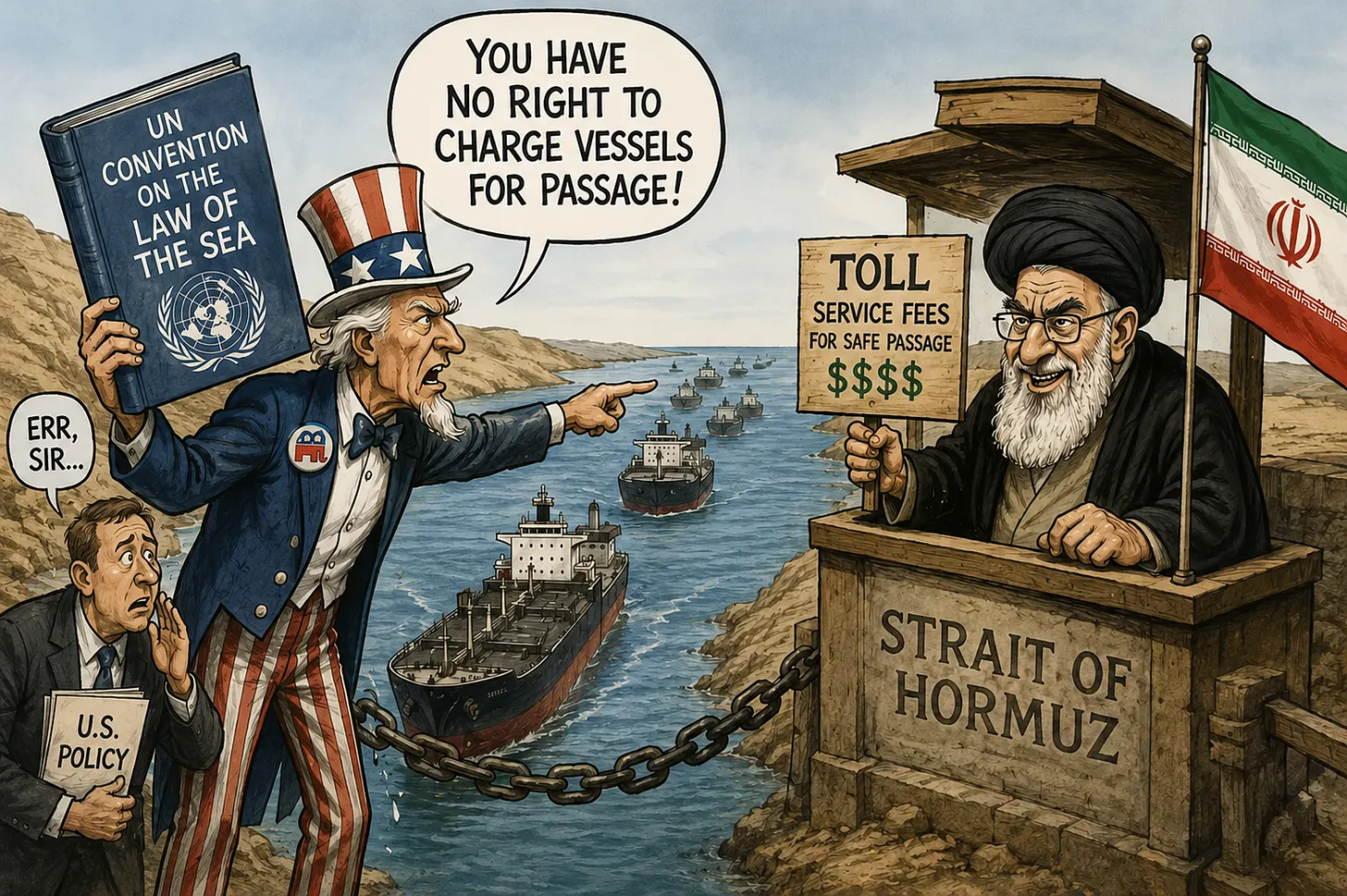
The United States is telling Iran that it has no right to charge vessels for passing through the Strait of Hormuz, through which a fifth of global oil and natural gas flows. That position is urgent, necessary and correct, and Iran’s insistence to the contrary is a declaration of economic war on the world that plainly comes from a hubris that could backfire. Indeed, as we have argued, NATO should immediately make clear that it stands with the Trump administration in refusing to tolerate any Iranian attempt to turn the Strait of Hormuz into a toll booth.
But there’s a problem: the strongest legal foundation for denying Iran the right to charge for passage is the international Law of the Sea, embodied above all in a treaty the United States helped shape and relies upon daily – yet has refused to ratify, because of Republican short-sightedness, for four decades.
The current conflict boils down to this: Despite being thrashed militarily by the U.S. (and Israel), Iran is not only conceding little on its nuclear program and proxy militias but doubling down on plans to impose payments on ships passing through the Strait. It says it “service fees” would cover safe passage, supervision, and environmental costs.
There are numerous arguments against this, mainly deriving from long-standing state practice and the simple global interest in keeping vital waterways open. The attempt to describe compulsory payments as fees for maritime services rather than tolls also deserves skepticism, especially if the charges function as a condition for passage. But the clearest legal answer to Tehran is the doctrine of transit passage through international straits, a doctrine codified in the United Nations Convention on the Law of the Sea.
The doctrine exists precisely because of places like Hormuz, and here’s why.
At its narrowest point, the strait is only about 21 nautical miles wide, meaning the territorial seas claimed by Iran and Oman overlap and leave no high-seas corridor. UNCLOS therefore guarantees ships and aircraft a right of continuous transit passage through the strait, allowing coastal states to regulate safety but not to impede passage.
The vast majority of the UN member states – 168, including China and Russia as well as the European Union as a non-state party – are now bound by UNCLOS. You know who is not? The United States, and Iran. Yet this is the principle Washington now invokes against Tehran.
The United States uses the Law of the Sea when it challenges China’s claims in the South China Sea, Russia’s maritime assertions in the Arctic, and Iran’s threats in the Persian Gulf – yet it remains outside the treaty that gives those principles their fullest legal form.
Washington argues that transit passage has become customary international law and therefore binds even non-parties. That may be legally plausible, but it is an awkward position for a country that has spent four decades refusing to ratify the treaty itself.
Virtually every serious institution in the American national security establishment — from the Navy and military leadership to the shipping, energy and telecommunications industries — has long supported ratification because it strengthens American freedom of navigation and legal certainty.
Republican and Democratic administrations alike have supported ratification since reforms addressed Ronald Reagan’s original concerns. This has never been a partisan project but a basic instrument of American power.
Republican opposition gradually transformed the treaty into a symbol of resistance to international institutions, despite revisions that addressed Ronald Reagan’s concerns over seabed mining. The debate became less about the treaty itself than about reflexive hostility to multilateral cooperation. Those concerns, of course, align with Trump administration instincts.
Yes, the treaty includes dispute mechanisms. It regulates seabed mining in areas beyond national jurisdiction. In the 1980s, Ronald Reagan objected to parts of the original seabed mining regime, and some of those objections were serious. But the treaty was later revised to address those concerns. That is precisely why later Republican administrations supported ratification.
The old argument survived even after the text changed because the issue became less about the treaty itself and more about a reflexive hostility to multilateral cooperation. For a wide swath of the modern Republican Party, international law became suspect simply because it was international.
The failure to ratify the Law of the Sea Convention does not stand alone. It reflects the same impulse that has driven skepticism toward NATO, withdrawals from international institutions, rejection of multilateral treaties, and a broader “America First” preference for national discretion over international rules.
All this is unpopular and fits a familiar pattern: on issue after issue — from universal background checks and abortion rights to the Equal Rights Amendment, healthcare expansion, and electoral reform — the Republicans have often stood against policies supported by national majorities, or just plain logic.
Iran’s attempt to monetize Hormuz demonstrates the cost of America’s self-inflicted weakness. Ratifying UNCLOS would strengthen Washington’s position not only against Tehran but also against China in the South China Sea and Russia in the Arctic. The Senate should finally correct this unnecessary mistake. And until it does, and even after, count this as one more reason to punish the “GOP.”
