







Where did Pope Francis’ relationship with Romania begin? It started in Buenos Aires, the capital of his native Argentina. His vision of Romania expanded and deepened when the pontiff visited predominantly Orthodox Romania in 2019. Stopping in the northeastern city of Iasi, the Pope called Romania “our home”. What are the features of the ecumenism promoted by the pope who took his name from St. Francis of Assisi? And when did the Holy Father’s passion and interest in building friendly relations with the Orthodox communities actually begin?
Even after Pope Francis passes, his spirit of ecumenism will continue, Romania’s Ambassador to the Holy See, George Bologan predicted:
“The epidemic madness of woke culture, ultra-progressivism, on the one hand, and mystics and ultranationalists on the other, will awaken the numbed consciences of many Christians.”
Bologan discusses these topics in an exclusive interview with Universul.net where he talks about the personality of Pope Francis. The dialogue took place at a delicate time for Pope Francis after his health deteriorated this month and he was hospitalized.
Why is there a special relationship between the Pope and Romania, especially since Romania is an Orthodox country?
The Pope’s relationship with Romania… few know that he started in Buenos Aires where, at the Catholic University, he met the monsignor and professor, Dan Ioan, a cleric originally from Bihor (Eds: a county in western Romania), who was a member of the United Romanian Church, the Greek-Catholic church, which at the time was illegal (Eds: the communists outlawed the Greek-Catholic or Eastern rite Catholic church). This relationship allowed him to deepen (his knowledge) of the cultural and spiritual horizon of the Romanians, and to understand the vicissitudes to which those who were in exile were subjected. The 2019 visit was a providential meeting of the Sovereign Pontiff with the Romanian people, a moment that allowed people to get to know him better, and for His Holiness to express appreciation for our people, including the raising of the altars of the united bishops, martyrs and confessors of the faith under the oppression of the communist regime. On the occasion of the speech he made in Iasi, he said: “Here with you, I feel the warmth of being at home and part of a family, surrounded by young and old alike. In your presence and looking out at you, it is easy to feel at home. (…) Romania is the ‘garden of the Mother of God’ and young people are “pilgrims of the twenty-first century, capable of imagining afresh the bonds that unite us”. Also in Iași, the Pope quoted Eminescu, made references to national culture, making a concrete gesture of appreciation and sensitivity for the Romanian people. He mentioned that Romania is in a new historical phase and needs the positive collaboration of all segments that make up society, moving forward on the path of diversity and respect for each other because we belong to each other, condemning “the hypocrisy of concern for appearances”. Also, on the same occasion, he stressed the importance of giving children the right to the future.
Can you also give me some personal impressions about Pope Francis?
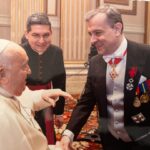
I had the opportunity to have a personal meeting with him four times, the last time being on the occasion of this year’s meeting with the members of the diplomatic corps. Each time he surprised me very pleasantly with his very developed sense of humor. He spoke enthusiastically about his visit to Romania in 2019, and his eyes instantly lit up. At the last meeting, he confessed to me that “Romania is a democracy because they all have a place – both the royal family and the republican political class”. It was a statement that took me by surprise. Pope Francis has many qualities, among them one is that of carrying the light of hope in the darkness that surrounds us, and the second is the style of communication, direct, pragmatic and to the point, removing the temptation of superficiality. I appreciated the choice he made to be called Francis, the first pope with this name, (to reflect) the teaching of St. Francis of Assisi. This became the program of his papacy, putting simplicity, peace and care for creation (the environment) at the center of the Church. For those who want to know better who Francis of Assisi was, I suggest you pay a visit to one of the Humanitas bookstores and enrich your reading with the book “The Franciscan Patrician”. It will help many to know even more deeply the value of the spirituality and thoughts of the Sovereign Pontiff.
Will his era of openness and ecumenism disappear after him?
One of the most relevant aspects of Pope Francis’ pontificate is his commitment to ecumenism and inter-religious dialogue. Since his time as Archbishop of Buenos Aires, Bergoglio (Eds: the pope was born Jorge Mario Bergoglio) has built friendly relations with the Orthodox, Lutheran, Pentecostal and Muslim communities, and as Pope, he has continued this direction through concrete gestures and prophetic words. He was the first Bishop of Rome to enter a Pentecostal church. His first meeting with the representatives of the other Christian confessions marked a turning point: he reaffirmed the desire to continue the path of dialogue, not only at the theological level, but above all through an ecumenism of charity. His participation in ecumenical events with leaders of other confessions (namely: Patriarch Bartholomew, Patriarch Daniel, the Archbishop of Canterbury, the delegation of the Lutheran World Federation, other evangelical leaders, etc.) A meeting from which he expected more than what happened was with Patriarch Kirill in Cuba. But the spiritual agenda of one did not coincide with the “political” one of the other. The gestures of the Bishop of Rome bear witness to this desire to overcome historical divisions and to walk together towards full unity.
A distinctive element of his ecumenical vision is his emphasis on common action. Pope Francis stressed that Christian unity is not built only through academic dialogues, but above all through collaboration in serving the poor and defending human dignity. If we talk about ecumenism, as a Romanian I am pleased to mention that from the Orthodox world were the first hierarchs (Eds: church leaders) to send a message of solidarity, after the Pope was hospitalized,namely the Patriarch of Constantinople and the Patriarch of Romania, Daniel. These are gestures that make all the difference. The two lungs of the Christian Church have had the opportunity to bridge the divide between Western and Eastern Christianity, but most of the time, the gestures have been unilateral, and the ecumenical dialogue, with a few exceptions, has regressed and not progressed. For example, the Pope has raised the need for a common date of Easter several times, but unfortunately, so far, without success. Ecumenism, whether or not it pleases fundamentalists who fear diversity and otherness, will continue because Christianity will be increasingly subject to challenges to which it will have to act in a unified way. The epidemic madness of woke culture, ultra-progressivism, on the one hand, and mystics and ultranationalists on the other, will awaken the numbed consciences of many Christians. Dialogue and the exchange of ideas in the spirit of ecumenism will help us to value even more the balance and temperance to which Christianity urges us.


Laurentiu Mihu contributed to this article.
A year after his visit, statue of Pope Francis to be unveiled in Romanian capital
