













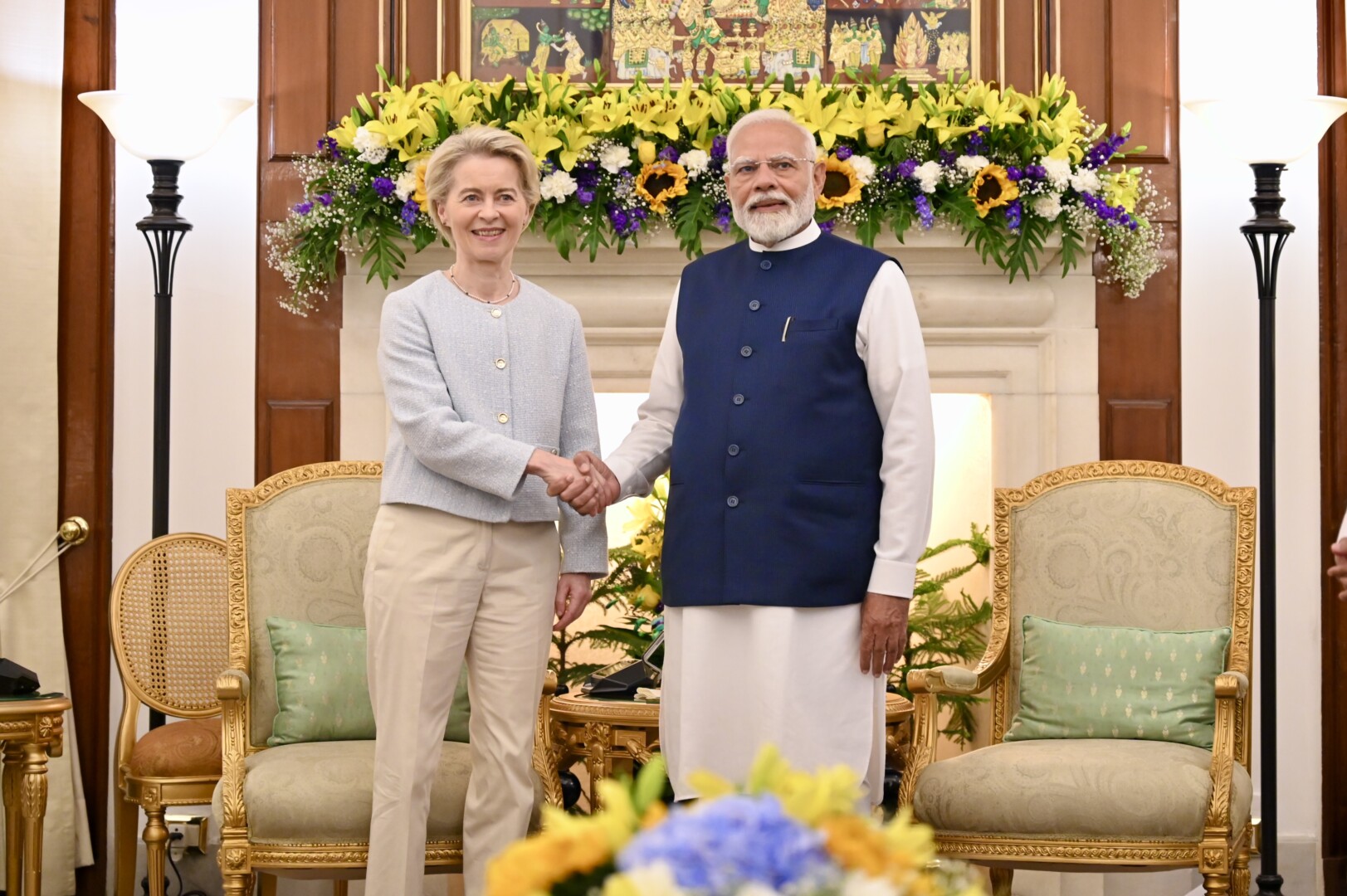
The landmark trade agreement signed this week between the European Union and India has been in negotiation for nearly two decades. Talks that had stalled, slowed, and periodically collapsed were rapidly concluded. Why, I wonder, is that?
No one serious is even trying to deny that this is the global system being forced to adapt to the behavior of the United States. Washington has turned trade into a political weapon, tariffs into instruments of pressure, and predictability into something partners can no longer assume. When the anchor of the global system begins to behave this way, reorganization is imperative.
This may be only the beginning, and in itself it’s huge. Trade between the EU and India already stands at roughly $190–200 billion a year in goods and services and has been growing. The EU is India’s largest trading partner. India is one of several major partners for Europe, alongside the United States and China.
The agreement creates a combined market of nearly two billion people and eliminates or sharply reduces tariffs on roughly 97 percent of traded goods. And it is far bigger than would at first appear to be the case.
At a base level, the agreement reshapes incentives for manufacturers, investors, and supply chains across Asia and Europe. In the near term, Indian consumers are the biggest winners. European food and beverage products, pharmaceuticals, medical equipment, luxury goods, and advanced manufactured items will become significantly cheaper. Choice will expand and purchasing power will rise.
Of course, for parts of Indian industry, the picture is more complicated. Domestic producers will face tougher competition from European firms that are larger, better capitalized, and often more technologically advanced. That is, of course, a core feature of trade liberalization, forcing productivity and modernization. There’ll be losers, possibly job losses. Such reasons are why Trump has support.
Still, while this is a tradeoff and any choice is legitimate, many American brains are by now scrambled by all the nonsense coming from the White House. Trump has spent years claiming tariffs make other countries “pay” while they do not. They make Americans pay, as they make Indians pay when India imposes them, and Europeans pay when Europe does. Stuck with Trump’s tariffs, Americans will face higher prices and less choice while goods from India, the EU and elsewhere migrate to other markets where they’re not priced out of competition.
To put things in context, global trade in goods and services is roughly $30–32 trillion a year. Three actors dominate it: The EU accounts for about 15 percent of global trade; China accounts for roughly 14–15 percent; the US accounts for about 10–11 percent. The US share will drop if Trump mulishly sticks to his plans, and that is also money left on the table. Together, these three shape most of the world’s commercial rules, standards, and flows. When any one of them behaves unpredictably, the consequences are systemic. That’s what’s going on.
The EU–India deal not only creates a major commercial axis that does not depend on the United States, but is explicitly paired with a security and defense partnership, which is unusual move for a trade agreement. As Europe accounts for a huge proportion of US military exports, to the tune of hundreds of billions, Americans will feel the pain if that business too is diminished.
Trump’s reaction has been, of course, to double down on tariffs. In recent days he threatened 100 percent tariffs on Canada because Ottawa was considering broader trade engagement with China. That would not punish Canada. It would devastate the American housing market, which depends heavily on Canadian lumber. It would raise construction costs, deepen shortages, and drive home prices higher. Yet it was floated as if it were a routine negotiating move.
But Canada, whose citizens are not pleased with Trumpy tweets about the ennexation of their country, is lookint to at least stabilize its relationship with China. China is laughing all the way to the bank, deepening trade ties with Europe, Britain, and Asia as well, forming new bilateral and regional frameworks.
Trump can be stopped. One avenue is for the Republicans in Congress to grow a spine – but you’re not likely to lose money underestimating that motley crew. The other is the Supreme Court. Under US law, tariffs are the power of Congress. A narrow loophole created in the 1960s allows presidential action in specific emergencies. Trump has turned that loophole into a blank check by treating all of global trade as an emergency. The Supreme Court is now being asked to decide whether that interpretation is lawful. If it is upheld, that would institutionalize instability and guarantee that partners keep building around the United States.
If the court does the right thing, then the diruption may prove temporary. Meanwhile, though, we see (as we wrote yesterday) Canadian PM Mark Carney needlessly declaring it game over for the world order.
Americans seem none to happy about any of it, as evident in the latest numbers on consumer confidence:

