














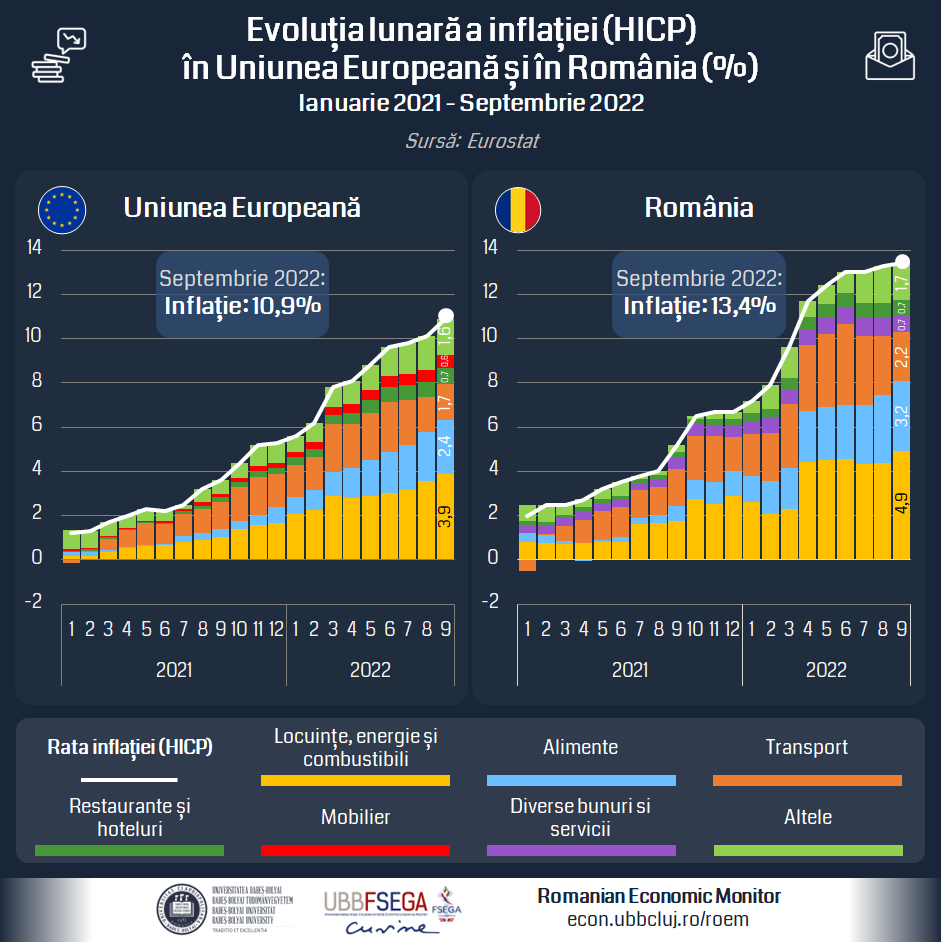
Despite its continuous deceleration over the last seven months, the yearly inflation in Romania was the second largest in the European Union in September at 8.83%, after Hungary (12.2%) and before Slovakia and Poland, both at 8.2%.
But the fight with inflation is not won yet, with central banks still keeping the interest rates high, writes eToro analyst for Romania, Bogdan Maioreanu.
In Romania, prices eased for both food (10.36% vs 11.88% in August) and non-food products (6.68% vs 6.98%). Housing utilities decreased also by almost 3% due to a reduction of electricity prices. Meanwhile, services inflation picked up (12.1% vs 11.72%). The largest increase in services prices in the last 12 months were in air transportation (24.32%) followed by water and sewage (20.83%) and hygiene and cosmetic services (17.6%).
On a monthly basis, consumer prices crept up 0.79%, the highest in six months, following a 0.54% rise in August. Overall, Romania’s inflation was at its lowest level since February 2022.
Despite Poland having the third highest inflation in the EU, its National Bank started to decrease interest rates two months ago, reaching 5.75%. Currently Hungary is having 13% interest rate placing it above the country’s 12.3% yearly inflation rate.
Romania’s interest rate is the third highest in the EU still at 7% and most likely will be kept at the same value in the next NBR meeting. Same as Romania, the Czech Republic is at a 7% interest rate but with an inflation rate of 6.8%.
Across the Atlantic, the US yearly Consumer Price Index rose to 3.7% from 3.6% a month before. Progress in lowering inflation is starting to stall, with much of the strength in CPI being due to energy prices.
The year-over-year pace of services inflation outside of rent – the measure that Fed officials are watching closely – has slowed for nine straight months, so this inflation report may not be a catalyst for more rate hikes.
Services inflation has heated up on a monthly basis, but it’d be difficult for that trend to continue much longer. The Fed’s job clearly isn’t done yet. Stubbornly high inflation – even at 3 or 4% – makes the chance of a US recession still significant as the Fed is more likely to persist with high interest rates, affecting consumer and industry investments.
For Romanian investors, inflation is not anymore the first worry when it comes to their portfolios like it was in March this year. Only 6% of the investors participating in the eToro Retail Investor Beat survey are still worried by the inflation. Now, for the last three months of this year, they are worried by the state of the local economy followed by the state of the global economy and the possibility of a recession.
The latest IMF Report however, is not seeing recession but a deceleration of the global growth from 3.5 percent in 2022 to 3.0% in 2023 and 2.9% in 2024, well below the historical pre-pandemic (2000–19) average of 3.8%.
But this decrease will happen at a different pace, with advanced economies expected to slow to 1.5% in 2023 and 1.4% in 2024 as policy tightening starts to affect economies. Emerging market and developing economies are projected to have a modest decline in growth to 4.0% in both 2023 and 2024.
Prospect of recession jumps above inflation as chief concern for retail investors
