















EXPLAINER: The occupation is unfair to the Palestinians and the settlements are foolish, but Israel’s security concerns are real and legality is not the issue.

Fresh from examining claims of genocide in Gaza, the International Court of Justice in the Hague has just spent a week considering whether Israel’s occupation of and Jewish settlement in the West Bank and Jerusalem are illegal under international law.
Most countries seem to think so, and people everywhere are obsessed by Israel and the Palestinians, so the UN General Assembly asked the ICJ for an opinion (but not about Iran executing people for “sodomy” or China enslaving Uighurs). Speaking against Israel’s occupation in recent days were Russia (which occupies and trashes swaths of Ukraine) and Turkey (which oppresses the Kurds). With such advice in hand, the 15-judge panel should rule in a few months.
I myself call for a “two state solution” for Israel-Palestine, and have taken some heat for it. But on Al Jazeera this week, I was asked how Israel can ignore the ICJ’s investigation of illegality; well, is Al Jazeera viewers deserve an answer, then so do our readers here! International law is even fuzzier than justice itself — but I shall try.
Some history is needed, and I shall keep it short. Israel “proper,” the West Bank and Gaza can be reasonably viewed as one entity: a vertical wedge between the Jordan River (barely a stream) and the Mediterranean Sea (more of a little ocean). It is about 400 km north to south, and an average of 50 km across, on a generous day. But it’s valuable, boasting a location at the intersection of historic trade routes, ground zero of the monotheistic religions, and decent nature including a beach facing west, some rolling hills, the world’s two lowest lakes relative to sea level and a first-class desert.
It was ruled as one entity by the British until 1948, who did their best to deal with squabbling Jews and Arabs. Back then, it was mainly the incoming Jews who were called “Palestinians,” while the Arabs were thought hardly distinct from others in the Levant. Before that it was part of the Ottoman Empire, and many other things.
What happened since then is messy, but there is not a lot of “law” involved – not even “international law,” which is kind of an invention of the post-World War II era.
In 1947, the UN Security Council proposed a map dividing the area into a Jewish state and an Arab state (again, not referenced as “Palestinian”). The Jews accepted it; the Arabs did not. Either way, the General Assembly does not have and did not then claim the force of law.
The Jews declared the state of Israel in May 1948 as the Brits were departing, with the implication being that they’d suffice with the UN map. Arab nations invaded and Israel improved upon its borders. No Arab state emerged, nor was demanded by any party. Jordan grabbed the hilly area in the central eastern part, and that became the “West Bank” (of the Jordan River).
Egypt took a sliver of beachfront abutting its border with what had been Palestine; behold, the Gaza Strip. Both areas were majority-Arab before anyway, and they took in refugees from the war. The pre-1967 borders between Israel and these two areas, which some people today sanctify, are nothing more and nothing less than the 1949 cease-fire lines. Demographically somewhat logical, a little bit random nonetheless, and in no way relating to any law.
Jordan tried to annex the West Bank, granting citizenship to all. This was somehow nice of Jordan; the other Arab countries, supposedly friends of the now-re branded Palestinians, mostly refused to give them citizenship; in Lebanon, their descendants are denied basic opportunities from education to employment. That should be illegal.
Israel seized the two areas in the 1967 war that it launched but was provoked by Egyptian and Syrian provocations (which are not in debate as a casus belli, not even in those countries). That’s your “occupation.” Is it illegal? Let us see.
Generally speaking, an occupation refers to the seizure by one country of lands from another, when the borders between them are widely accepted — let’s say, by the United Nations or international treaties. Israel has argued that there is no other country — that the territories are “disputed.” Is there are law that says otherwise?
By this point, the UN Security Council (a sort of UN central committee with some permanent member states) had come to be regarded as a body that has the force of law. Its Resolution 242 (and 338, some years later) urges Israel to withdraw “from territories” it took in the war. But it does not say “the territories.” The definite article is missing for this precise reason: to maintain flexibility and avoid establishing the 1949 lines as absolute and permanent.
And there is a reason why outside powers had some sympathy for Israel’s potential future claims on at least part of the West Bank. That’s because the lines leave Israel less than 20 km (12 miles) wide at its narrowest point, and that is a problem when your enemies are as vehement and resilient as Israel’s have turned out to be.
The Arab states were at this point, in the late 1960s, still refusing negotiation with Israel. The new Palestine Liberation Organization claimed all of Palestine for a “secular, democratic state.” Meanwhile, Israel annexed the eastern part of Jerusalem, which is really just the heart of the West Bank, and it has filled it with Jewish neighborhoods to the point that a renewed division is difficult to contemplate. There are more Jews than Arabs now in the ““occupied” and annexed part of Jerusalem.
That contentious annexation is the first law in this story — an Israeli law. But almost no countries around the world have recognized it. So it’s a flimsy law.
Meanwhile, Israel has not annexed the rest of the West Bank, which is the vast majority of it. Annexation would require offering them citizenship (if Israel wants to stay a democracy), and it doesn’t want the three million Palestinians there as citizens.
That said, it has built towns for Jews — which the world calls “settlements” – on that territory. This is very strange indeed, since Israel by its own laws is building on foreign land. Moreover, since the Israeli settlers have Israeli citizenship and nearby Palestinians do not, it looks like some looking-glass version of apartheid. Not exactly, since it’s not race-based; but to many, close enough. It’s extremely hard to defend.
Lording over this messed-up situation for 56 years badly undermines Israel’s claim to be a democracy. But is it illegal under international law? Last I checked, the world is full of non-democratic regimes like those in China and Russia and most of the Middle East, and the ICJ has not deemed them illegal. So, not against the law.
Most of the half million Jewish settlers live in communities very close to the old border – so a fairly simple fix (compensated for elsewhere, presumably) could incorporate them into Israel; but about a fifth live deep inside, and they tend to be the radicals, and they are the real problem. Moreover, the settlers are sitting ducks, and the effort to protect them from the angry Palestinians is ugly, and it is often deadly.
Israelis have a special word in Hebrew for these “settlements” as well (hitnahaluiot), and even the right-wingers use it; that suggests they know they are bizarre. But are they actually illegal?
If so, the illegality would stem from Article 49 of the Fourth Geneva Convention, which is another set of documents that are considered a bedrock of “international law.” It forbids moving an occupier’s population into occupied land. But Israel calls the land disputed, and Resolution 242 suggests the same. International jurists cannot agree; this is not a fake dispute, like the one invented over global warming – it is truly a uniquely odd and vexing situation. Because of this lack of clarity, the law does not indisputably apply.
In 1988, the PLO finally got around to declaring an independent state in West Bank, Gaza and East Jerusalem. The PLO itself was not a country – nor was it even present in the land at the time (the organization sat in Tunisia). Some countries have recognized Palestine along these borders; the UN General Assembly did so as well, in 2012. None of that has the force of law; the Kurds could declare a state; the reader could declare a state; the world still has no agreement on whether Kosovo is a state.
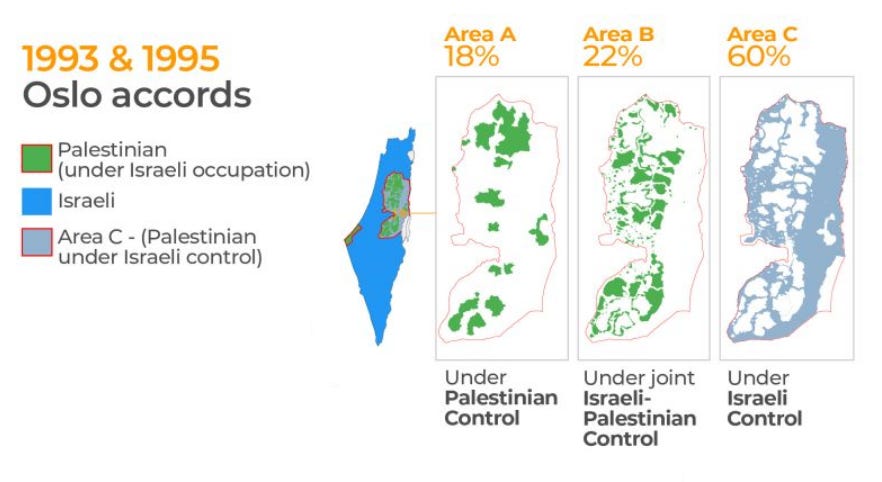
In 1994 Israel and the PLO signed an agreement to establishment an autonomy setup called the “Palestinian Authority” in parts of the West Bank and Gaza, and they even drew a map creating a non-contiguous hodgepodge of Areas A (fully controlled by the PA, except when Israel feels it must raid them), Areas B (joint control) and Areas C (still “occupied” by Israel). That was meant to last five years until a final status agreement. The sides could never agree on a final status, and the whole thing expired in May 1999. Except that it’s still around. The so-called Oslo Accords were in a way violated by the failure to reach a final deal; they were violated again when everyone agreed to extend the racket informally. But they are not international law.
A deadly Palestinian uprising broke out in late 2000, featuring suicide bombings by the jihadi group Hamas and others, and Israel built a massive security barrier which ate into the West Bank, slicing off about 10% and with that most of the settlers. The ICJ condemned that move in a toothless advisory ruling in 2004 – yet the barrier, while cutting off many Palestinian farmers from their fields, has saved lives.
Israel pulled out all settlers and soldiers from Gaza in 2005, again violating the spirit of the Oslo Accords, as it was unilateral. Certainly, though, no laws were broken. Israel had concluded that the small amount of land in question did not justify dealing with 2 million pesky Palestinians highly motivated to attack the 8000 settlers. I bet that if the PA had declared a state in Gaza, Israel would have recognized it, and the Security Council would have followed … voila! The force of law.
Instead Hamas took over the strip by force in 2007. The group is dedicated to Israel’s destruction, opposed the Oslo Accords, and has for years been trying to perpetuate war through terrorist attacks. It has used Gaza to rocket and provoke Israel ever since, launching a particularly barbaric invasion that killed 1,200 last Oct. 7 of last year. That was a serious, global-historic violation of international law, but the ICJ is not examining it, since Hamas is not a state. Bureaucratic mandates must be respected.
If you tell Jews, as many delegations did this past week at the ICJ, that their presence in the West Bank is illegal, they will ask for guarantees that Hamas won’t take over that territory as well, and from that nearer position commence attacking not a hinterland but Jerusalem and Tel Aviv. Can Russia provide such a guarantee? If not, Israelis might advise them to worry about the legality of their occupation of Donbas.
As for me? I think Israel should do everything possible to bring about a partition, even it if is unilateral. The Holy Land, or historic Palestine, with 15 million people, is almost exactly half Jewish and half Arab. If Israel wants to be a Jewish state, it cannot control all these Arabs. If it wants to be a democracy, it cannot control them without equal rights; its non-annexation trick does not impress me. The settlements in the West Bank create a disgraceful situation in which Jews and Arabs in what looks and feels like a single territory have unequal rights.
The only way out other than a partition is to annex the West Bank and give the Palestinians full voting rights in Israel. Would that be illegal? No, it would not. And it would also be the end of the Jewish state. If the Palestinians were smart they’d be demanding this right now.
The current situation is unsustainable, unfair to the Palestinians and unwise for Zionist Israelis. Attack it on those grounds, and you’ll get no argument from me. It will become a discussion about security arrangements, and some reasonable border adjustments to address the settler conundrum. But the legality issue seems a nonsense.
How to make progress? Israel, the Arab states and the entire world should unite to crush the rejectionists of Hamas, come up with a plan offering peaceable Palestinians something real and good, and provide the Israelis the sense of security that enables them to pull out of most of the West Bank. It is about security, not the law.
* * *
And just as a coda: no group of people has natural rights to particular land, even if some Jews imagine a deity making promises. There is no clear “Palestinian land” or “Israeli land” or “French land.” There is only the objective situation, which through all of history has resulted from conquest and negotiation and deals that bring a sense of justice to some and violence that seems unjust to many. Most of the lines in the Middle East sands were drawn by French and British colonizers, and few correspond to ethnic realities, which is why Syria and Lebanon and Iraq are so unstable. There are no indigenous people anywhere except for Africa; human history is a story of migration. So ignorant people obsessed with justice and rights and decolonization might open up a book or two, as unfashionable as that may sound.
