









There hasn’t been a single occasion when Donald Trump’s occasional, vague and timid criticisms of Vladimir Putin were not followed by aggressive and deeply defiant replies from Moscow (we have constantly inventoried them in editorials).
But the Kremlin’s tone was ratcheted up after the diplomatic PR exercise in Tinjin, a summit in which Russia proudly showed off China’s support, and Putin and Xi showed off their new ally ad member of the club, Indian Prime Minister, Narendra Modi, into the club.
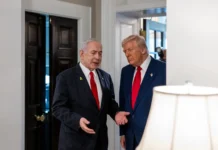
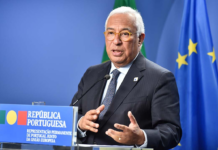
But then we had truly fantastic evidence of Putin showing the stick to Trump 24 hours after the US president, during a press conference with his British ally Keir Starmer, admitted, in a rather naive fashion that he had been hoodwinked by the Russian dictator.
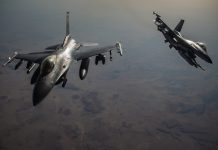
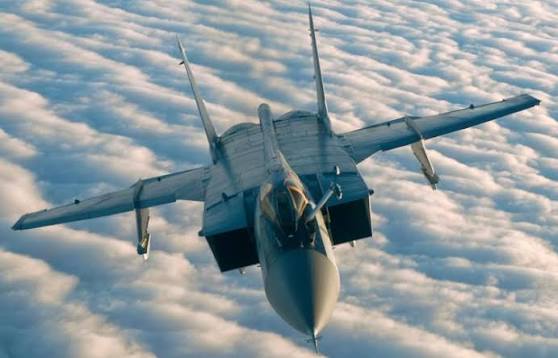
Three Russian MiG-31 aircraft, capable of launching a Kinzhal air-launched ballistic missile, penetrated the airspace of NATO member, Estonia, headed towards the capital and lingered for a few minutes in the area.
Coming just days after Russian drones violated Poland’s airspace, followed by a single incursion into Romania (again, two NATO allies), the Estonian case suggests that Russia is in the midst of a campaign of testing, aggressively gathering information and challenging Ukraine and America’s allies.
And the incident occurred the very day after Trump complained about Putin’s attitude. The the episode in Estonia can only be interpreted as a targeted message from the Russian dictator saying he doesn’t give a ruble for what the American president says.
After blaming the Biden administration for starting the war in Ukraine, claiming that Russia took this step because Democrat-led Washington was no longer to be feared and respected in Moscow’s eyes, Trump now has the opportunity to feel firsthand the total contempt and absence of fear with which he is personally treated by the very one with whom he felt he had a warm relationship; by the one to whom – and directly, and through the bizarre emissary Steve Witkoff – sung his praises, for his wit, his cleverness and desire for peace.
At the same time, it should be added that Donald Trump, beyond the curious and shameful posture of being totally humiliated, is also in the profoundly unhealthy posture of a deer blinded by the poacher’s headlights, at night, in the middle of the road: he neither dodges nor lies down, but lies resigned, on the ground.
Tested by Putin, as the president of the United States, as he has never been tested by anyone, as a real estate developer, Trump position to the world is simply devoid of reaction, as simply alien to what is going on, and totally divorced from the initiative.
Trump is unable to defend Ukraine, reassure U.S. allies, or protect and promote America’s interests in terms of influence and security.
But at the same time, Trump is not able to sell out Ukraine or to break definitively and “honestly” with US allies. I don’t suspect that this doesn’t cross his mind, instead I suspect that even if he wanted to, he kind of understands that he can’t – at least, not without devastating costs, internally and externally, for himself personally and for the MAGA current he embodies.
From Donald Trump’s rhetoric you can easily deduce that he does not distinguish between words and deeds, between how much you can say and how little you can do.
From his action, or rather, his inaction in the face of Putin’s systematically violent and defiant responses, you can figure out that the president of America is losing the use reason in general and geopolitical reason in particular.
All the while, Moscow’s rhetoric is crystal clear – the war will continue, Russia wants NATO to withdraw to the limits of the mid-1990s, the West is a mortal enemy. All this time, Russia’s action is no less explicit: a classic war in Ukraine, a hybrid war with all of Europe and the US, the precursor to a possible armed aggression against Ukraine’s neighbors and Russia, a “constructive” relationship with China in case of aggression against Taiwan and, similarly, with North Korea, in case of an armed conflict with South Korea.
Russia has neither the (conventional) military strength, nor the multitude (respectively, diversity) of allies, nor the economic capacity that the United States of America enjoys today.
But Russia’s historical chance lies in the fact that in Washington there happens to sit today a president so weak, so unstable and incompetent that his flaws can undermine the comparative advantages, objectively speaking that the US has.
The recent Russian aggression in Estonia is, after all, a stark and very dramatic reminder of this.
Russian fighter jets violate NATO-member Estonia’s airspace upping tensions with Moscow
