












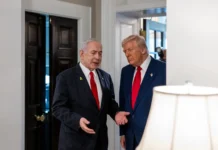


President Volodymyr Zelensky announced that he will be received by President Trump over the weekend to discuss the latest peace plan.
In his recent messages, the American leader had pointed out that a meeting with the Ukrainian leader will take place only when there are chances of real progress, as he does not want to waste his time. Therefore, the fact that Trump says he’s now ready to receive Zelensky would automatically suggest that the progress desired by the US president has been made.
But is it really so?
Is the miracle of peace possible by the New Year, or at least is the progress made in the meantime seen as real by by all three sides (including Russia) or will the latest Trump-Zelensky meeting rather mark just another stage on the complicated road to ending the war?
At the moment, it seems that the Mar-a-Lago episode will be another stage rather than the destination.
The following question arise:
1. President Zelensky stated, in the context of the announcement of his trip to the US, that “many things can be decided before the New Year”. Fair enough, but not guaranteed. His chosen words give some hope, but they also seem professionally vague, and prudent enough not to create an exaggerated horizon of expectations.
2. It is worth noting that the meeting announced by Zelensky is not taking place in the Oval Office, at the White House, but at Trump’s private property, at Mar-a-Lago. Of course, Donald Trump is a guy who is unconventional enough with protocol and does not want his holiday to be disrupted, yet at the same time, he remains, a businessman at heart that it is no longer seems out of the ordinary to use every opportunity to advertise his famous Mar-a-Lago property. Even so, it is worth underlining that the meeting with Zelensky will not take place at the White House – and this suggests to me once again that the meeting of the two leaders will not yet herald peace in Ukraine. Instead, it will be an opportunity for Trump to build a positive PR moment for himself, showing the American public, which mostly supports Ukraine, that the president of the Americans is still making efforts for Kiev, not just Moscow. It will clearly be a more than welcome opportunity for Zelensky to plead the cause of Ukraine directly to Trump.
3. Questions also persist regarding the level of commitment that Washington has extracted from Moscow for this version of the peace plan that will be discussed with Zelensky at Mar-a-Lago. Because, from what is publicly known, it is clear that some Russian demands that the Kremlin had always presented as non-negotiable have remained unresolved, including the total territorial concessions in Donbas that Moscow is trying to force on Kiev. From this perspective, it is quite suggestive that the first reactions of the Russian side to the announcement of the Trump-Zelensky meeting were not enthusiastic enough to suggest that what could be nailed down by Trump and Zelensky will not be dismantled immediately afterwards by Putin. It should be noted that no peace plan that does not fit into Putin’s maximalist demands will interest the dictator enough to give his approval. For Putin, he knows it all too well, a reasonable peace for Ukraine has the potential to take a dangerous step towards destabilizing the Kremlin regime. On the other hand, it is hard to imagine that, at Mar-a-Lago, Zelensky will accept a peace that is not reasonable for Ukraine (it would be suicidal for the Ukrainian people, and for the Zelensky regime). But will the discussions at Mar-a-Lago be oriented in such a direction? For this would mean that Trump would show himself over the weekend as never before unconcerned about the maximalist claims of the Russian dictator. And in such a scenario if it were agreed at the end of 2025, the onset of 2026 would be marked by a new approach by Trump. He would start to put optimal military and economic pressure on Putin, until Putin accepts reality and gives up something he had never conceived he would have to give up. Once again: does the Mar-a-Lago moment have the potential for such a thing? It’s hard to believe.
Of course, in the incendiary Trump era, there is also the risk of the “last minute” cancellation/postponement of the Trump-Zelensky meeting, at Trump’s initiative.
However, it is to be hoped that this remains only a marginal risk, because for Ukrainians and Europeans any opportunity for direct Trump-Zelensky talks is in itself a step forward and creates an opportunity to open up new perspectives in pursuit of ending the war on reasonable terms for Ukraine and Europe; or at least to provide constructive perspectives for the conditions in which Ukraine is waging this odious war in which it defends its territory, its sovereignty, its own existence as an independent and viable state.
Perhaps Mar-a-Lago will not be able to bring the peace much desired by the Ukrainians or deliver the necessary stability on the continent, desired by Europeans. But there will definitely be no time wasted for either party. Not even for Trump, who can create whatever kind of narrative he wants at the expense of the meeting.
Even in the worst possible version of the outcome of these talks, Ukraine and Europe will at least understand even more clearly where the alliance with the US is.
And as far as Russia is concerned, the Mar-a-Lago moment will be an additional and welcome litmus test of Moscow’s genuine desire to reach peace – as it will make it even more accurate to measure the distance between the Kremlin’s official line and its actual actions.
