


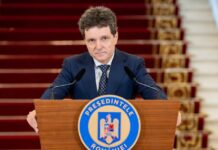


- << Moldova cannot run away from its geography. We feel the long arm of Russian aggression.
- We have a border with Ukraine of more than 1,200 km — longer than any of your countries. And the reason why Moldova enjoys peace today is because Ukraine is resisting. Ukrainians are fighting to defend their country and freedom. And, at the same time, Ukraine protects Moldova. We owe them our peace. But their sacrifice is also a warning: peace is never guaranteed. That is why our European path is not just about values – it is about survival.
- Today we are facing a hybrid war without limits – on a scale not seen until the full-scale invasion of Ukraine. The Kremlin’s goal is clear: to capture Moldova through the ballot box, to use us against Ukraine and to turn us into a launching pad for hybrid attacks against the European Union.
- A Russian bank under sanctions has opened 138,000 accounts to influence the outcome through direct payments. It’s not something to be proud of, but it shows how Russia identifies and exploits vulnerabilities. Here is democracy itself turned into a target. >>
Above we have listed only a few passages from the speech delivered on Tuesday by the President of the Republic of Moldova, Maia Sandu, in the European Parliament.
The picture presented by the Chisinau leader was, of course, significantly broad, and generous too in revealing details regarding Russia’s tactics and strategy for recapturing the small republic.
At the same time, far from being an isolated cry for help, Maia Sandu’s speech represented a historic and universa warning, a useful warning to every country on the troubled European continent. (Full speech – HERE)
Maia Sandu’s voice is not out of tune.
Her Finnish and Polish counterparts struck a similar note, almost simultaneously with the Moldovan president’s message, about the same thing: Moscow’s appetite is not limited to Ukraine, the military threat from the Kremlin extends far beyond the region in which the Republic of Moldova, Poland, Finland, of course Romania are located.
Eloquently and worth noting, is that when Maia Sandu ended hers speech, she was torpedoed by a pro-“Russian”MEP, an amplifier of the Putinist agenda.
“Moldova is Romania”, shouted the extremist MEP Diana Șoșoacă, at the end of Maia Sandu’s speech, a gesture that was loudly booed in the European Commission halls, a gesture that illustrated once again that the caviar nibbled by Diana Șoșoacă at the Russian Embassy in Bucharest, partly feed the guest’s culinary appetites, and partly feed the host’s geopolitical appetites.
In the European Parliament, Șoșoaca demonstrated once again how deep her commitment (as well as the domestic so-called “sovereignists” in general) to Russia’s agenda is, but also the fact that light years separate the ‘patriotism and sovereignty’ of the Romanian “sovereignists” from the ‘patriotism and sovereignty’ of the Polish sovereignists, to give you an example.
On the one hand, the Russian agenda has been served by the roar of the diaphanous Putinist creature, not so much by the strident intention to ridicule the legitimacy of Maia Sandu, right in the heart of Europe, but especially by eating her own words.
The distinguished extremist yelled “Moldova is Romania”, but did not go on to say that Moldova has not been Romania for over eight decades because it was annexed by the Russians; nor did she go on to say that Moldova did not subsequently return to the borders of the mother country because the Russians, from Stalin to Putin, prevented this – with weapons, and with spies, and with agents of influence, and with money, and with propaganda.
Patriotism by omission, lying by omission – they are the same thing after all.
In any case, if any public opinion in Romania is seduced by the purity of the nationalist feelings that Șoșoacă, Simion, Georgescu sell, then they have all the available data to unpack and discover the hidden meaning of the obscene contrast between the unionist slogan of the three and their systematic sabotage of any political force across the River Prut in Moldova (Eds: the Prut forms the border between Romania and Moldova), which courageously opposes the games played by Moscow on this territory.
In short, Moldova will never be Romania as long as an autocrat like Putin reigns in the Kremlin and as long as politicians and parties that act in line with Russia’s imperialist interests and continue to gain traction in Romania.
On the other hand, Diana Șoșoaca’s roar in the European Parliament has involuntarily put the spotlight on the light-years that separate the Romanian “sovereignists” from the Polish sovereignists.
Our sovereignists are opening Romania’s doors to Russia, while their counterparts in Poland (of which one was recently elected president) are pulling hard to close Poland’s gates.
“We believe that Vladimir Putin is ready to invade other countries,” the nationalist leader in Warsaw said, almost at the same time as a similar warning was issued in the European Parliament by Maia Sandu. “That is why we are developing our armed forces, partnership and relations with our allies,” the Polish president added.
Regarding the particularly advanced stage in which Poland’s anti-Russian game has reached, including under the presidency of the nationalist and sovereignist Nawrocki, for whom the pro-Russian “sovereignist” leader of the AUR had campaigned, I recommend this recent analysis by George Friedman.
“The dramatic expansion of Poland’s economic and military power has created a new reality, in which Poland, with the support of the US, is the pivot and counterweight of the future Russian aggression, with or without the help of other European states,” according to the American analyst who the last thing he can be accused of is an aversion to deep realism in geopolitics.
“Moldova is Romania”, of course, and this truth, a historical one, remains valid regardless of the current situation that the two countries currently find themselves in.
But Moldova will never again become part of Romania as long as the Kremlin has enough servants in politics and groups of useful idiots among the electorate and civil society.
