













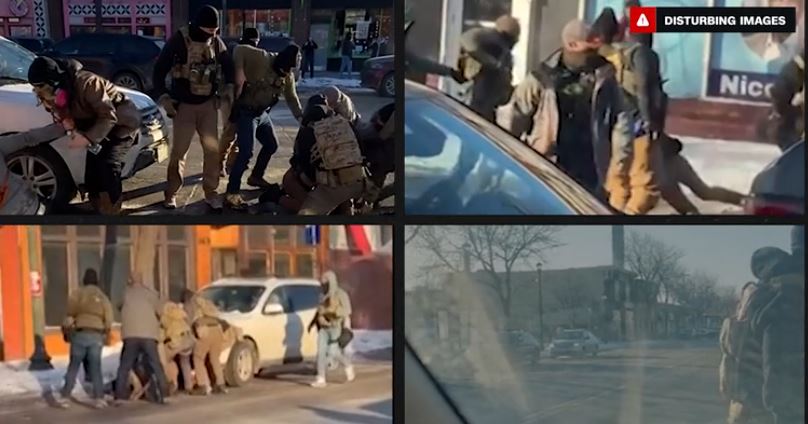
Some say the US immigrant-deporting agency should be defunded. A debate exposes the collision between constitutional limits and a government increasingly unwilling to concede facts visible on video
The legitimacy of state power rests partly on restraint — on law, proportionality, and the willingness to admit error. When that erodes, you get something darker. I examined this is a Global Eye debate on i24, with Andrew R. Arthur, retired immigration judge sympathetic to Trumpism, and Rekhma Sharma-Crawford. VP for the American Immigration Lawyers’ Association, who is much less so.
Two recent killing by ICE (the US force for rounding up illegals), followed by sweeping official lies, ignited a confrontation over politics in law enforcement. Critics argued that federal officials rushed to judgment, contradicting visible evidence while covering up. Defenders countered that enforcement decisions must be judged only after investigations conclude, warning against substituting outrage for legal analysis. Plus they love the deportations.
Beyond the specific incidents, the discussion widened to ICE’s broader tactics: warrantless arrests, aggressive street operations, and a posture that blurs legitimate border control with political signaling aimed at Democratic-run cities. At stake was a larger question: when a government doubles down instead of reflecting, does enforcement remain lawful — or does it begin to look like coercion untethered from democratic accountability?
Moderator Ellie Hochenberg: The state’s monopoly on force — legitimate when accountable, radical when unchecked. Where is the line?
Dan Perry: Monopoly of force is legitimate as long as it’s constrained by the law and by oversight and by the principle of proportionality. And as long as it’s accountable to the courts and the voters and independent oversight. It doesn’t hurt if you occasionally have the ability to concede error. But when you have what looks like two successive cases of extra judicial killings by masked men, ill-trained, operating with immunity, and the government responds with lies and calumny and then doubles down, in utter indifference to public opinion and to basic decency, then it looks like it crossed the line from operating as a government to operating as a mob.
Ellie Hochenberg: Let’s begin from the point you’ve just made, Mr. Perry, both in the cases of Alex Pretty and Renee Good. The dispute is not even over narrative, but over facts, meaning that someone is simply not telling the truth. If I am to be more blunt, someone’s lying.
Dan Perry: The people lying would appear to — there appears to be a monopoly of lying on the part of the federal government. And it’s extremely inelegant. And it not only troubles me, it perplexes me because I’m not used to this level of — frankly and forgive me — stupidity. I mean, when Kristi Noem, the Secretary of Homeland Security … calls the latest victim within minutes a “domestic terrorists,” and when others talk about his alleged intention to “massacre” everyone present, when the video right before our eyes shows something completely different, I am stunned by this level of audacity. And it’s since I don’t think it’s stupidity, I have to conclude that it’s a it’s a feature and not a bug. And they basically just want to upset their political opponents.
Andrew Arthur: In an incident like this, we wait until all the facts are done till the investigation is completed before we determine whether or not the agents acted appropriately or inappropriately. Now, whatever the Secretary of Homeland Security may say, or DHS spokesperson may say after the fact, doesn’t actually implicate whether these officers acted appropriately or not. I think it’s crucial to separate out those two things. And I think it’s important to keep that in mind.
Dan Perry: Well, but I think there is a political component here with respect. I mean, how can you ignore the fact that a very importan,t one of the two or three top federal figures, involved in all this, clearly rushed to judgment and issued what looked like libelous calumny that was completely indefensible given what we all saw on video? Would you be prepared to concede that that was at the very least unwise?
Andrew Arthur: But that becomes a political issue. That’s not a law enforcement issue.
Rekha Sharma-Crawford: Before we take this in a different direction, we have to keep in mind that this is an administrative code enforcement civil action. Like this is not the same as law enforcement in its truest form. So I think that it’s unfair to say that, you know, the attorney general is going out there or even Kristi Noem is going out there and trying to control what what the perception is. I think what it is, is it is an actual attempt to create a narrative that is consistent with their propaganda, which we’ve always seen them to do. The video footage is the video footage. This is a code enforcement agency that is acting in a way that even law enforcement is not authorized to act.
Andrew Arthur: It is one of those things where proportionality is Dan referred to, you know, the right to use force in that instance is one of those things that’s generally determined after the fact. You have to separate out the political noise from whether or not those officers acted appropriately. And if they felt that in some way they were endangered, the line blurs. I mean, there is no line anymore. Self-defense by officers is self-defense and they have the right to use it. Again, I just I would advise not to rush to judgment on any of these things. I don’t agree with Kristi Noem rushing to judgment. I don’t agree with anybody else rushing to judgment. Wait till the facts are done. This is hard work. It’s difficult to figure out what happened in an incident. You could say, oh, I looked at the video and I know what happened. I’m probably the only person here who’s ever taught Fourth Amendment law, taught use of force. And even I’m going to sit and wait.
Rekha Sharma-Crawford: I’m a former prosecutor. So I’m very, very well aware of the Fourth Amendment, whether it was appropriate or not. It’s one of those things that is a forensic analysis done after the fact, based upon the reasonable fear.
Dan Perry: With with due respect to both of your experience in the law, I think it’s fair enough to also speak as a citizen, as a human being. Tens of millions and hundreds of millions of us have seen those videos. And whereas I’m not saying rush to judgment at the level of convicting anyone, I am certainly saying that the video suggests something very, very strongly, something that almost obviously contradicts the narrative being put forth by the officials at hand who are themselves the ones who are rushing to judgment. And may I also add, you can get lost in a weed sometimes, and it isn’t such a terrible idea to zoom out a little bit and see the big picture. This isn’t just about these two killings, horrific and indefensible, though I assess that they were.
The entire modus operandi of ICE, which could have deported the same almost 400,000 people that they have deported or turned around, minus a few, and not gone the extra step of the egregious cases of detentions of five-year-olds that have never seen another country, or of 20-year-olds that don’t remember where they came from, or of non-convicts sent to horrific jails in Central America for maximal security, and of the, you know, home violations and beating up people and pepper spraying people. It’s so clear that when this is done with a president more than hinting that these are moves aimed specifically at not just sanctuary cities, but Democrat-run cities, there has been a total blending together of legitimate law enforcement and very legitimate border security, which I’m the first to support, and what looks like, I hate to say it, but like I said before, the actions of a mob.
Rekha Sharma-Crawford: I think that’s exactly right. I think that’s exactly right. I think part of the problem that makes it look and feel so much like an actions of a mob is that they continue to act in a way which enforces warrantless arrests. They have tried to say that they have the authority to go into people’s homes without warrants. They basically said the Fourth Amendment does not apply to them, and with respect, I just don’t think that’s a good look for the government, and it’s certainly not in consistence with what the Constitution allows, and I think that, you know, local law enforcement and local communities should be pushing back hard against that question of whether or not this kind of action is permissible or even acceptable or even reasonably, objectively reasonable in these communities, and I don’t think it is.
Andrew Arthur: There’s so many straw men here. I feel like I’m in a high school production of The Wizard of Oz. You know, we talk about the arrest of a five-year-old. There’s actually a discussion as to whether or not that five-year-old was abandoned by his father. When we talk about warrantless arrest, Counsel, you know that warrantless arrests are permitted under the Fourth Amendment, and they’re permitted under the Immigration and Nationality Act. This is a simple issue. If Minnesota were to allow ICE into its jails, none of this would be going on. ICE doesn’t want to be out in the streets in minus-16-degree weather looking for people. They don’t, and quite frankly, it’s incumbent upon the government of Minnesota and Minneapolis to provide for security. They didn’t. They pulled back security, which is why you have so many immigration officers in Minnesota right now. They have to protect the officers who are carrying out the actions, and then they have to protect the people who are protecting the officers.
Ellie Hochenberg: Dan Perry, as for the policy itself, is it working?
Dan Perry: Look, you’ll hear some people say, and I’m sure Art would contradict this, that Obama was a champion of deportations, as if that is something to be proud of, and that Trump has deported surprisingly few. I’m not sure I buy that. That has to do with definitions and whether people turned around at the border count or don’t count. I look at the bigger picture. We know what it looks like when a government is trying to spread terror and create disunity, and we know what it looks like when they’re trying to restore decent karma. And when I see the government doubling down on everything ICE does, refusing to concede the tiniest error, having their supporters like Mr. Arthur over here shamelessly blaming the authorities and suggesting that ICE doesn’t want to be out in the icy streets and this is somehow forced upon them by restrictions created by Governor Walz and the local Mayor Frye, I mean, it is laughable. We all see what’s going on. Enough of it is caught on video. I know what it would look like if they wanted to do this reasonably, and it’s very, very clear to me that the entire political edifice built around ICE, including the rapid doubling of the force with minimal training that was guaranteed to lead to this, is a dog whistle to the mega beast.
Andrew Arthur: When you use dog whistles and things like that, it’s offensive. You know, this is one of those situations where the local authorities could help or they can hinder. Right now, they’ve chosen to hinder, which is why ICE is in Minnesota right now.
Ellie Hochenberg: When federalism collides with enforcement and what happens when neither side is backing down, what happens to the republic?
Dan Perry: Generally speaking, in a federalized state, the federal side is going to prevail if there really is a conflict. However, the US, from the beginning, jealously preserved the rights of states in a variety of areas to do, to basically determine what life is like in those states. But I do agree with Art that the country called the United States has every right to protect its border, even to deport people who come in illegally, even if they stayed for a long, long time.
Ellie Hochenberg: As for policy itself, the US wanting to protect its borders, is this the way to go, Dan?
Dan Perry: Well, I would ask whether a state should have the ability to provide sanctuary to immigrants that the federal government wants to either keep out or to deport, given that they’re inside. This is the fundamental tension. And I think I would tend to come down on the side of the federal government, even though my own understanding, and I’m not a legal scholar, is that you could find justifications for either way, probably. But logically, it comes down to the question of, do we believe the US is a country or a collection of countries, each operating independently? And when it comes to immigration, and I realize here I’m sounding a lot more sympathetic to the federal government than I did in the earlier bit of the show, I wonder where should the states really be allowed to step in? I would ask Rekha what she thinks about that.
Rekha Sharma-Crawford: Well, I mean, look, the law is clear. If look at 1327 D3, it is a detainer statute, and it allows the federal, I’m sorry, it allows the state government to, when they have someone in their jail, to issue a detainer, to advise, well, not issue the detainer, but to contact ICE so that ICE may issue a detainer. But it is clear from that perspective that the statute itself has a baked-in sovereign mechanism to it. Meaning that if the state says, we don’t want you to come in and issue a detainer, then they have that authority not to do so.
Andrew Arthur: There’s a difference between the states not wanting to assist federal immigration authorities and the states actively imposing and impeding federal immigration authorities. And that’s really where the federalism argument breaks down.
Ellie Hochenberg: So where do we go from here, Rekha?
Rekha Sharma-Crawford: I mean, I think, look, part of the issue is what you’re seeing is that the American people don’t appreciate and don’t accept what is going on in the streets and the way that it’s happening. They are telling the federal government, they are telling their state governments, they’re saying this is not acceptable as a way of life for average citizens. And I think, you know, the government, whether it be the state government or the federal government, owes it to the people to be able to address these issues in a reasonable, rational way that is solving problems. I think probably right now the problem has been, and it’s been the same problem that has impacted immigration for decades, is that you don’t have either side of the aisle that wants to solve the problem. And I don’t say that to one side or the other. I think when you look at either side of the aisle of Congress, they don’t want to solve the problem because there’s just, these are hard issues that don’t have easy solutions and they don’t want to do it.
Dan Perry: Even if you have sympathy for the right of the government to police supporters and to deport illegal immigrants and all the rest of it, I think a reasonable observer would conclude that the methods deployed by ICE and the aggressive posture of the federal government and of this administration in defending what looks to be indefensible is creating a political problem. It is in the nature of political problems that they get solved by political outcomes, by which I mean the midterm elections in November, where if the Republicans are sufficiently punished for this overreach and other instances of overreach, including one that is related, which is deployment of National Guard in various cities, again, for what is obviously within what is obviously a political paradigm, if the Republicans are sufficiently punished, then the hand of the administration will be stayed.
Art Arthur: Yeah, I mean, honestly, this is going to be strange. I agree with a lot of what Ray can Dan have to say. Both sides need to trim back the rhetoric. And, you know, we just saw the B file or the B roll that was going, you know, ICE, Nazis, fascism. It’s ridiculous. These are people who are enforcing a federal law that was actually created by Congress, by the people, and they should have the ability to do that. But, you know, I agree with Dan, there’s a right way and a wrong way to do things.
