












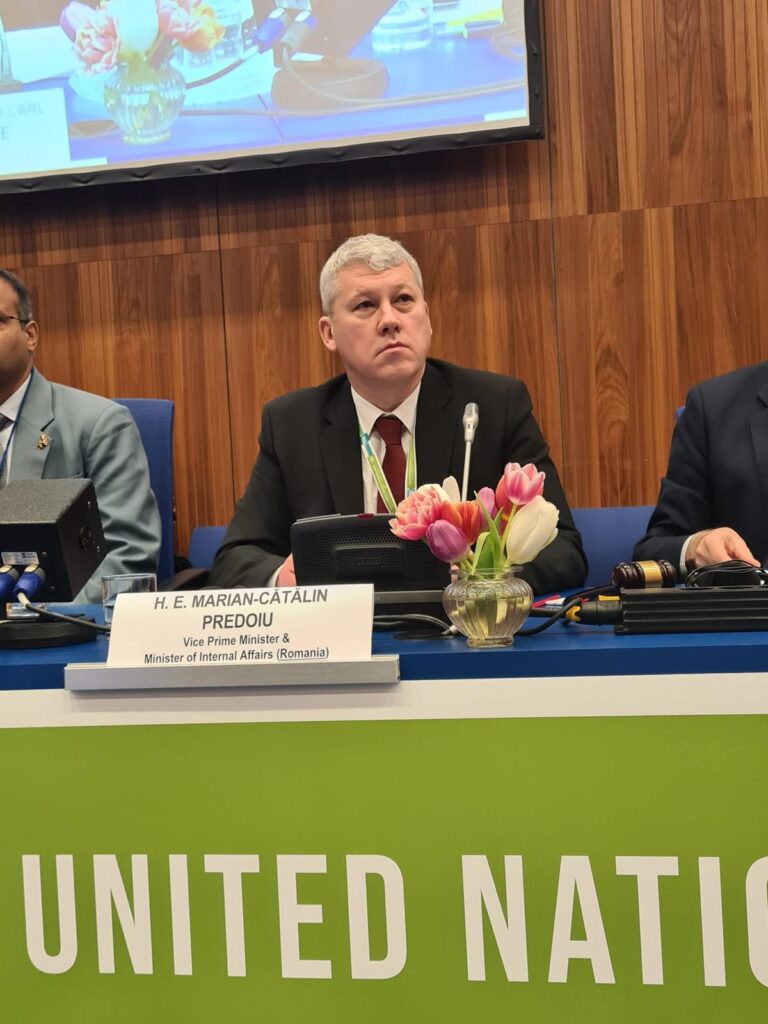
Romania’s Interior Minister Cătălin Predoiu on Friday said ‘dismantling criminal networks and confiscating criminal proceeds’ were the key to a crackdown on drug trafficking.
He said narcotics trafficking and drugs use need to be tackled globally in a unified manner to be successful.
Drugs not only threaten security and health, they are closely linked to crimes committed by organized crime groups, and require an innovative approach by law enforcement agencies, in comments made at a major international conference.
The minister was a key note speaker at The Way Forward: The Road to 2029 event, organized within the ministerial segment of the UN Commission on Narcotics, the most important global working format on developing strategies and policies to combat the drug phenomenon.
He said the focus should be on dismantling criminal networks and identifying and confiscating criminal proceeds.
Romania has developed a modern, balanced approach, based on the needs identified in practice, in line with the UN Conventions on drugs and the EU Strategy on Drugs.
Public campaigns aimed at young people have been launched to raise awareness of the risks caused by drug use.
Romania also supports the European Ports Alliance, launched by the European Commission in January and US Global Coalition against the Threats Posed by Synthetic Drugs, an approach aimed at stimulating actions in the field of combating the threat posed by synthetic drugs to public health and global security Global.
The previous day, Mr. Predoiu met Ylva Johansson, European Commissioner for Home Affairs and Ghada Waly, Executive Director of the UN Office on Drugs and Crime (UNODC).
The discussions took place in the context of the ministerial segment of the 67th session of the UN Commission on Narcotic Drugs and aimed to develop joint efforts to prevent and combat drug trafficking and consumption.
“We agreed today that together with UNODC and with EU support, we will focus our efforts and pool our resources and expertise to develop a partnership in our region, committed to a health- and human rights-centered response to drug use, drug-related disorders.”
“We will strengthen cooperation …with Western Balkan countries, Moldova and Ukraine. This will strengthen our capacities to prevent and combat drug trafficking, but also ensure a common approach by encouraging the adoption of joint regional drug policy documents.”
On Wednesday, Mr. Predoiu visited the Nadlac-Csanádpalota border crossing between Romania and Hungary.He was joined by the General Inspector of the Border Police, Cornel Laurian Stoica, and other regional police chiefs.
The activity focused on evaluating the implementation of measures to increase the efficiency of the Border Police in the fight against illegal migration, trafficking in human beings and drugs, and a more fluid flow at border points.
“In Nadlac we have an adequate number of border guards…. and we have ordered additional preparations for the summer season when traffic will increase exponentially,” the minister said.
Currently, border Police process cars in less than 10 minutes and trucks in one hour. Waiting time depends on the time for document processing and checks by other institutions,such as tax authorities.
Statistics show border police have become more efficient in tackling illegal migration, human and drugs trafficking, and cross-border crime.
The Romanian Border Police are on the alert for an increase in the number of illegal migrants attempting to cross borders as the country prepares to join the passport-free Schengen zone.
“I will ask the European Commission for more funds for border protection and discuss with other partners …about increasing the endowment of the Border Police with logistical means,”the minister said.
In 2023, approximately 11 million people crossed the border through the Nadlac II Border Crossing Point, the second point in terms of traffic after Otopeni Airport. Some 5.2 million vehicles were checked.
During the weekend of 11 to 13 August, 2023, some 340,000 people crossed the Nadlac border crossing, an all-time record for a single border crossing point.
