


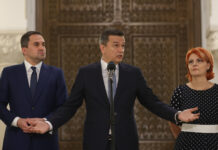

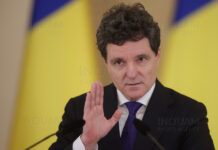






Two weeks after the collapse of the government, the situation is in an impasse.
During consultations with President Nicușor Dan on Monday, the parties came with the same proposals they had already made in informal consultations.
Those proposals had already been announced through the press immediately after the vote of confidence and nothing has moved on in two weeks.
The president also hasn’t really moved his position since then.
There are two reasons for the deadlock:
- The way the government fell destroyed the trust between the parties in the coalition. Once the Social Democrats (PSD) torpedoed the trust, it was sign of maturity of the other parties to no longer accept the new PSD offer which President Dan also wants -– the same coalition, minus Ilie Bolojan as prime minister (meaning the PSD has the right and veto of a new prime minster.)
- The way President Dan started the consultations by saying a majority was needed. It wasn’t the head of state’s position to say that, but for a party to identify a majority or to fail to identify a majority. In such a situation, Nicușor Dan could have quickly asked the PSD to try to find a majority (because the PSD overthrew the government). And if the PSD failed, President Dan could then ask the second largest party in the old coalition, the Liberals (PNL), to do the same. If the PNL failed then the president should relaunch the discussions with the parties, this time testing a minority government scenario. Such an approach would have made the parties responsible and given especially the PSD a genuine responsibility in unblocking the situation. It could have also diminished irreconcilable positions between the parties. But Nicușor Dan preferred to identify a majority from the start leading to maximalist and therefore irreconcilable positions. Certainly, the president had his calculations, but they weren’t too brilliant. And they started from the idea of a majority which was bizarre, as the room for finding a majority was from the outset was extremely narrow and restrictive, due to three elements: the PNL did not split, the parties expressed their positions clearly, and the public demand for a “pro-Western” government.
It is obvious that the president is avoiding a minority government. It’s understandable, as reforms require a government with deep anchors in Parliament.
But Nicușor Dan failed to stop the PSD bringing down the government (in the unlikely event that he actually did something) so there’s no real justification for his stubbornness in insisting on a majority government.
Worth noting is that the scenario of a technocratic government has been ruled out since consultations.
This would probably be the worst of the bad solutions and needed to be ruled out from the start.
Romania has had an unhappy experience with technocratic governments.
The chances that technocracy will work this time is even more costly, given the situation with the budget deficit, reforms that, structurally, are no longer postponed and if they are missed with cost us generous international funding.
A technocratic government (regardless of how many technocrats there are in the Cabinet) will sow the seeds for a new political crisis in a few months’ time.
A technocratic government would be a reward for those who created the current situation, rather than forcing them to pay.
A technocratic government also offers a guarantee to those who have avoided deepening much-needed reforms.
No super technocrat prime minister is needed to fight the deficit and implement the necessary reforms for two reasons:
- The arithmetic of the deficit is already clear, the measures to reduce it are clear, and regardless of the political color (or lack of color) of the future government, anyone who ends up in Victoria Palace (Eds: government’s offices) needs to implement the same measures. At the same time, the reforms are clear and written in the PNRR “contract”, so it is not a question of a technocrat shedding light on them.
- Without real political support and political levers of their own, any technocrat will have their hands tied. They will pay for the pots broken by others and their mistakes, but he will not pay the country’s bills, because he will be held back, politically, at the slightest sign of reformist ambition. And without reforms, Romania will lose money. A technocratic governing formula risks the death of hope – and would again stop attempts to recover the country.
In order to move forward with the talks on the new government, President Nicușor Dan needs to do four things:
- To stop putting the cart before the horse – that is asking for a majority before forcing the parties to take responsibility for identifying that majority.
- To give the PSD the task of coming to Cotroceni with a government formula (without extremists) with which it can go to Parliament. And if the PSD fails this, then Nicușor Dan should ask the PNL to try. At some point, a government will emerge and in order to avoid losing their mandates, there will certainly be enough elected representatives who will vote for a government that is at least reasonable, to avoid early elections.
- To embrace the solution of the minority government.
- Not to bet on a technocratic government (neither a 100% technocratic government, nor a technocratic prime minister).
