












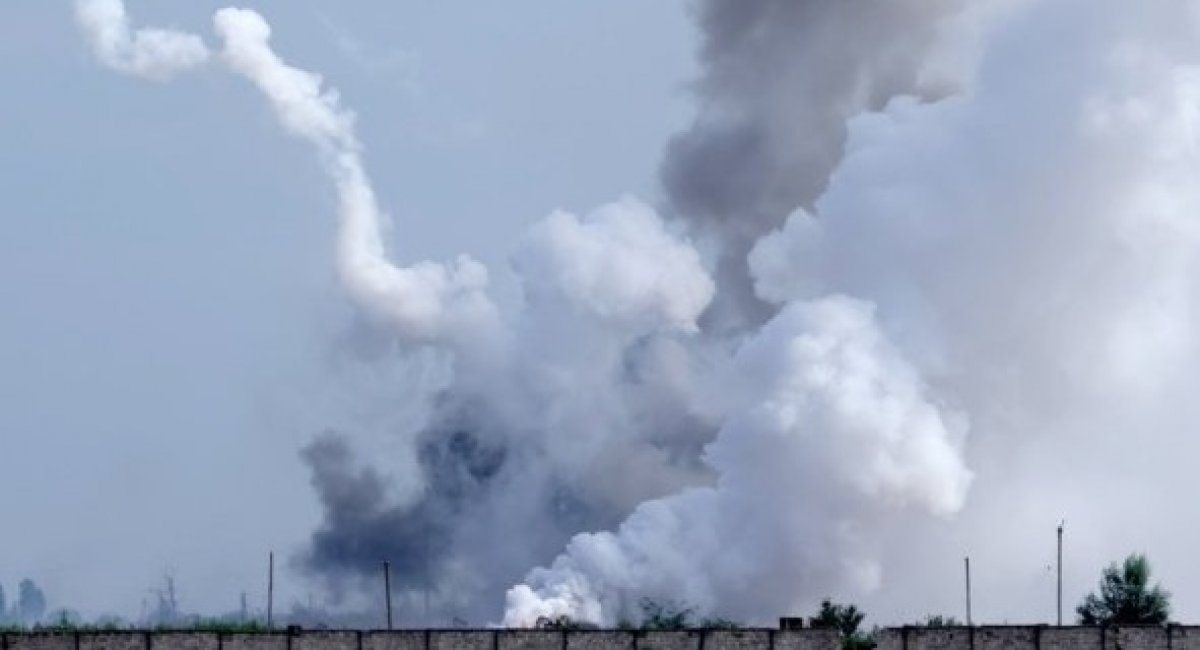
Iranian kamikaze drones used in the latest attacks on Ukrainian cities are filled with European components, according to a secret document sent by Kiev to western allies, in which it appeals for long-range missiles to attack production sites in Russia, Iran and Syria.
A 47-page document submitted by Ukraine’s government to the G7 governments in August claims there were more than 600 raids on cities using unmanned aerial vehicles (UAVs) containing western technology in the previous three months.
According to the paper, obtained by the Guardian, 52 electrical components manufactured by western companies were found in the Shahed-131 drone and 57 in the Shahed-136 model, which has a flight range of 2,000km (1,240 miles) and cruising speed of 180kmh (111mph).
Five European companies including a Polish subsidiary of a British multinational are named as the original manufacturers of the identified components, says the Guardian.
“Among the manufacturers are companies headquartered in the countries of the sanctions coalition: the United States, Switzerland, the Netherlands, Germany, Canada, Japan, and Poland”, it claims. The document goes on to say that Iran has already diversified its production through the use of a Syrian factory delivering to the Russian port of Novorossiysk but the production of drones is shifting to Russia, to the central Tartar region of Alabuga, although Tehran continues to supply the components.
It says the Iranian government is trying to “disassociate itself from providing Russia with weapons” and “cannot cope with Russian demand and the intensity of use in Ukraine”.
Among the suggestions for action by Ukraine’s western allies – at which they would probably waver – are “missile strikes on the production plants of these UAVs in Iran, Syria, as well as on a potential production site in the Russian federation”.
The document goes on: “The above may be carried out by the Ukrainian defence forces if partners provide the necessary means of destruction.”
There is no suggestion of any wrongdoing by the western companies whose parts have been identified. “Iranian UAV production has adapted and mostly uses available commercial components, the supply of which is poorly or not controlled at all,” the paper says.
Customs information is said by the Ukrainian report to show that “almost all the imports to Iran originated from Turkey, India, Kazakhstan, Uzbekistan, Vietnam and Costa Ric”.
Bart Groothuis, an MEP who sits on the European parliament’s defence and security subcommittee, said there had been insufficient coordination among the EU’s intelligence services to grapple with the misuse of western components. “I think many European intelligence agencies aren’t even looking at sanctions”, he said.
The Ukrainian government document – “Barrage deaths: report on Shahed-136/131 UAVs” – provides the most up to date analysis of Russia’s changing drone tactics and production plans since the first use of Shahed drones was recorded in the Kharkiv region on 13 September 2022, in the city of Kupiansk. It claims:
-
A pause in attacks that lasted from 17 November to 7 December was “likely due to the adaptation of drones designed for a warm climate to the Ukrainian winter”, and this “may indicate additional cooperation between Russia and Iran in the production and modernization of the Shahed-136/131”.
-
Deliveries of Shahed-136/131 UAVs from Iran to Russia take place across the Caspian Sea. “From Tehran, the drones are delivered to the Iranian port of Amirabad, from where they are shipped to the Russian port city of Makhachkala.”
-
The markings on the electronic components on drones used in Ukraine in recent months had been destroyed, “probably with the use of a laser”, and the Russian forces have started using the names Geranium-1 and Geranium-2 for the drones, which is “likely part of an agreement between Iran and Russia to conceal Iran’s role”.
-
In early July, a new Shahed-136 model marked Y002 was shot down in Ukraine, which “may have been assembled at a new production facility in Russia”. The sample is said to have had a different wing moulding, which “may also indicate production at a new location”.
-
Russia and Iran are “already working on a new engine for the Shahed-136, which should provide better speed and range”.
A wide range of components produced by western companies have been found in the downed drone models, according to the submission to the G7, which comprises France, the US, the UK, Germany, Japan, Italy and Canada, plus the EU.
A fuel pump manufactured in Poland by the German company Ti Automotive GmbH, of which the British multinational TI Fluid Systems is the parent company, was discovered in a Shahed-136, as well as a microcontroller with built-in flash memory and a very low-voltage drop regulator with inhibitor made by the Swiss firm STMicroelectronics, according to the paper.
Also discovered in a Shahed-136, was an integrated circuit of a buffer network driver and a transistor made by International Rectifier, a subsidiary of the German firm Infineon Technologies AG.
TI Fluid Systems did not respond to a request for comment. Their equipment is freely available to buy from retailers across Europe and the company has previously said it does not sell into Iran.
A spokesperson for Infineon said it did not sell components to Iran and it had liquidated its operation in Russia in March last year.
In the Shahed-131 model, the Ukrainian experts identified a 14-channel, customisable integrated power management circuit and a microprocessor made by the Dutch company NXP Semiconductor and a power transistor and integrated circuit from International Rectifier.
A 32-bit microcontroller, a 32-bit processor, a microcontroller with built-in flash memory and a very low-voltage drop regulator with inhibitor made by STMicroelectronics was also found, and a GPS tracker chip made by the Swiss firm U-blox.
A spokesperson for U-blox said: “U-blox strongly condemns the invasion of Ukraine by Russia. Immediately after Russia’s invasion of Ukraine in February 2022, U-blox stopped all sales to Russia, Belarus and the territories occupied by the Russian army in Ukraine, irrespective of the intended use. Recently, U-blox has also decided not to sell to members of the Eurasian Economic Union (a free trade zone with Russia).
A spokesperson for NXP Semiconductor said it was seeking new ways to avoid the misuse of its technology.
